July 20th, 2026
Microglia are innate immune cells of the brain, analogous to macrophages elsewhere in the body. Both cell types are deeply involved in the intricate processes of tissue maintenance and regeneration. The central nervous system has only limited regenerative capacity, but it can regain some lost function following injury, such as that caused by a stroke. Researchers here find a way to improve the regenerative activities of microglia, and demonstrate that this intervention can improve outcomes following stroke in animal models.
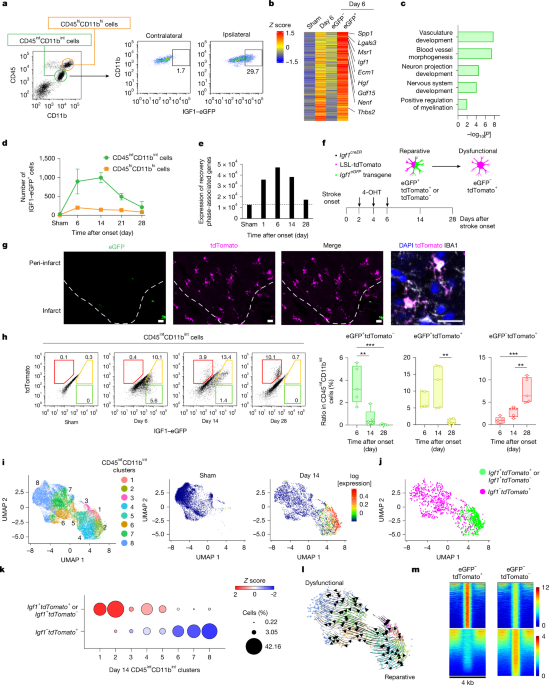
After a stroke, the brain launches a coordinated repair program that involves several types of cells. Among these, microglia, the brain's resident immune cells, play a pivotal role. Immediately after an injury, microglia are activated to trigger inflammation, but thereafter, they rapidly transition into a reparative state and produce growth factors, such as insulin-like growth factor 1 (IGF1), which support remyelination, strengthen neural connections, and promote functional recovery. But this only lasts for two months, limiting the brain's capacity to repair further.
To uncover the molecular mechanism responsible for diminishing microglial reparative functions the researchers identified a specific transcription factor called ZFP384, which increases as the brain's spontaneous repair functions diminish. They discovered that ZFP384 diminished the expression of genes associated with microglial reparative functions. Mechanistically, ZFP384 disrupts the chromatin interactions mediated by the protein YY1 that are necessary for the gene expression associated with neural repair. As a result, the microglia lose their reparative properties despite the brain's ongoing recovery needs.