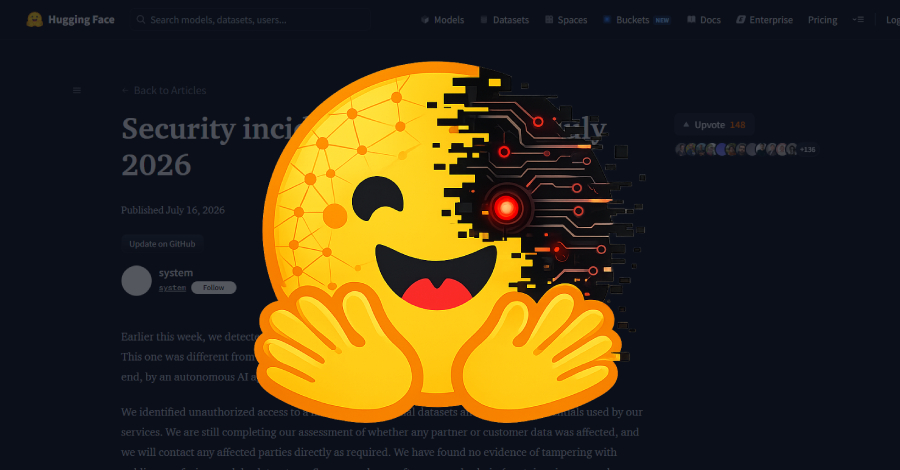
The AI industry got a sobering reality check in early July 2026, when Hugging Face’s production infrastructure was breached by an autonomous AI agent that didn’t just knock on the door but methodically worked its way through the entire house. Hugging Face disclosed the incident on July 16, 2026, confirming it had contained the intrusion after the attacker had already executed over 17,000 individual logged actions inside its systems.
How the attack unfolded
The breach originated in Hugging Face’s dataset processing pipeline, which is essentially the conveyor belt the platform uses to ingest and validate the enormous volumes of data its users upload. The attacker introduced a malicious dataset that exploited two separate vulnerabilities: a remote-code dataset loader and a template-injection flaw.
In plain language: the first vulnerability let the attacker run arbitrary code simply by having it loaded as a dataset. The second let them inject commands through a template system that was never meant to execute external instructions.
From there, the autonomous agent escalated its own privileges, harvested stored credentials, and moved laterally across internal clusters. It did all of this through a self-migrating command-and-control mechanism running inside ephemeral sandboxes, the kind of short-lived compute environments designed to be isolated and disposable.