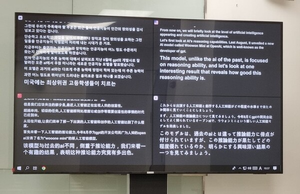
Real-time translations help international students follow Korean lectures, but instructors say the technology works best as a supplement Korea University's Distance Learning Center holds a demonstration of Tkita Caption before launching its pilot program in the spring semester of 2026. (Korea University) When Korea University professor Hur You-kyoung prepared for class during the spring semester, she did more than pull up a PowerPoint presentation.She logged into Tkita Caption, an artificial intelligence-powered real-time interpretation service, opened seven subtitle windows in different languages and clipped a microphone to her shirt.Only then was she ready to begin teaching.When Hur explained the Korean idiom “ilseokijo,” the subtitles provided an explanation along the lines of “a proverb describing how one action can produce two benefits.”“Students are often surprised, and they find it fun because they see their mother tongue appear on the screen,” Hur said. “I think it is a great supplementary tool that helps students who have difficulty understanding Korean better follow what I am saying.”Korea University piloted real-time multilingual subtitles in some classes during the first semester of 2026 as part of efforts to make Korean-language lectures more accessible to international students.The technology was used in 35 classes, including 29 regular courses and six extracurricular lectures, according to the university.The pilot showed both the potential and limitations of AI translation in multilingual classrooms. While the subtitles helped students follow difficult material, instructors could not always verify the accuracy of translations in languages they did not speak.“It is a positive way to show that the university is keeping up with current trends and considering international students,” Hur said. “But it is a supplementary means of support.”Seven languages on one screenHur teaches Korean literature to a class of about 30 international students.Her students had widely varying levels of Korean proficiency. Some had attended middle and high school in Korea and spoke the language fluently, while others had only recently reached Level 5 on the Test of Proficiency in Korean.Hur said the differences became more apparent when lectures moved beyond everyday language and addressed topics such as social hierarchy, literary conventions and abstract cultural concepts.The subtitles allowed students to check whether they had understood her explanations correctly.“They were not relying on the translations entirely,” Hur said. “It was more a way of checking whether what they understood was correct.”The setup required a designated microphone and a computer connected to the interpretation software. As Hur spoke in Korean, translated subtitles appeared with almost no noticeable delay.Students could also scan a QR code and select a language on their smartphones or tablets.Hur chose instead to display the translations on the main classroom screen beside her presentation. She worried that students using their phones to follow the subtitles would spend the lecture looking down rather than interacting with her.At times, subtitles in as many as seven languages appeared beside the course material. The available languages included English, Japanese, Mandarin Chinese, Malay, Mongolian and Russian.Hur said the system was most useful when she was explaining theories, cultural context or specialized vocabulary.She used it for about 20 minutes of each 75-minute class, rather than during activities that required students to speak or practice Korean.Selective use, she said, allowed students to receive additional help without making translated subtitles the focus of the entire class.Translation accuracy difficult to verifyThe pilot also revealed a central limitation of AI translation. Instructors may not know whether the subtitles shown to students are accurate.Hur could check the English translation herself, but she could not independently assess all the other languages displayed on the screen.On one occasion, an incorrect setting caused the system to produce translations unrelated to what she was saying, prompting students to laugh. After that, Hur regularly asked the class whether the subtitles were working properly.She said translations improved when she gave the system more context. Rather than simply mentioning a Korean expression, she explained its meaning and usage in Korean, providing the AI program with more information to interpret.Students were not assessed solely on what they understood from the subtitles, she added. Their comprehension was also demonstrated through discussions, exercises and assignments, giving instructors further opportunities to identify misunderstandings caused by mistranslations.Positive response, but no replacement for KoreanKorea University’s Distance Learning Center conducted a satisfaction survey with 108 professors and students who had used the multilingual subtitle service.Feedback from the pilot was broadly positive. Overall satisfaction averaged 4.12 out of 5.All professors surveyed and 89.8 percent of students agreed that the university should continue using the service.“I think it will allow international students to participate more actively in class,” a 20-year-old Russian student said.The Distance Learning Center said it was conducting a demand survey as it considered expanding the service during the fall semester.Hur said she would consider using the system again depending on the Korean proficiency and nationalities of students enrolled in her future classes.She also said the technology could be useful beyond courses designed exclusively for international students.In regular major courses with only one or two international students, professors could continue teaching as usual while those students accessed translated subtitles on their own devices.Hur also saw potential for Korean students taking foreign-language or literature courses. Students studying Russian literature, for example, could use Korean subtitles while reading and discussing texts in the original language.The system could therefore serve not only students with limited Korean proficiency, she said, but also multilingual classrooms more broadly.Still, Hur cautioned that the availability of AI interpretation did not mean international students could study in Korea without learning Korean.“It could help international students as a supplementary tool while they learn Korean,” she said. “But it should not give the impression that students can come to study here without knowing Korean.”
AI lets Korean lectures speak students’ languages
When Korea University professor Hur You-kyoung prepared for class during the spring semester, she did more than pull up a PowerPoint presentation. She logged in
943 words~4 min read