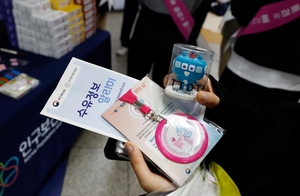
Nonpregnant people who use the badges could face criminal charges, legal expert says A pregnant woman holds a pink pregnancy badge at Yeouido Station in Seoul on April 28. (Newsis) South Korea’s pink pregnancy badges are changing hands online, raising concerns that a public symbol of consideration for expectant mothers is being misused as a ticket to pregnancy-only benefits, news reports said Monday.A recent post on Karrot, the country's largest neighborhood-based secondhand marketplace, titled "Unopened, brand-new pregnancy badge," offered the item for 1,000 won ($0.68), describing it as useful for accessing priority seats on public transit reserved for pregnant passengers. The listing sparked controversy and has since been deleted.Similar listings have also appeared on other online resale platforms, where the badges are listed for anywhere from a few thousand won to more than 10,000 won. Some users give them away for free. A screenshot of a Karrot post offering a pregnancy badge for sale for 1,000 won, uploaded late last month. The item is marked as sold. (Threads) Screenshots of Karrot posts offering pregnancy badges for free, uploaded last week. (Threads) Karrot said it classifies items distributed by public institutions, including pregnancy badges, as prohibited for sale. However, the restriction does not apply to listings intended for nonprofit sharing, which the company said can serve a public-interest purpose."In some cases, people who need pregnancy badges or blood donation certificates cannot obtain them due to limited availability. We therefore do not prohibit nonprofit sharing intended to ensure they reach those who genuinely need them," a company official said.Pregnancy badges are increasingly being used and accepted as proof of eligibility for priority services and financial benefits available only to expectant mothers.Beyond priority seating on subways and buses, pregnant women are eligible for dedicated check-in services and priority access through the departure screening area at Incheon Airport.Hotel buffets have also become part of the incentive. At Jeju Shinhwa World in Seogwipo, expectant mothers receive 50 percent off lunch and dinner at its buffet restaurants.While many businesses require proof of pregnancy, such as a medical certificate or a hospital-issued maternity record book, to access these benefits, some accept the pregnancy badge alone as valid proof."We offer a 20 percent discount on dinner to customers who show a pregnancy badge because we assume they must have already provided proof of pregnancy to a public health center or somewhere else to get it," a manager at a hotel restaurant in Yongsan-gu, Seoul, told The Korea Herald.Introduced by the Ministry of Health and Welfare in 2006, the pregnancy badge is issued to women who have obtained a pregnancy confirmation certificate from a hospital. The badges are typically available at local public health centers, with some municipalities also distributing them at subway station offices.Addressing the controversy, the Health Ministry called for greater civic consciousness, urging people not to misuse a system intended to support a vulnerable group."We are aware of some cases of misuse, but retrieving badges that have been improperly traded would cost more than producing them, making such a recall impractical," a ministry official said.Although no law explicitly criminalizes the sale or purchase of pregnancy badges, legal experts say misusing the badges could still expose individuals to civil or criminal liability."Presenting a pregnancy badge while falsely claiming to be pregnant could be regarded as a 'deceptive act' under the law. Depending on the nature of the benefits obtained, such conduct could also result in criminal charges, including fraud, obstruction of business or unauthorized use of an official mark," Choi Kwang-hyun, an attorney at Daeryun law firm, told a local news outlet.
Pink pregnancy badges are on sale, raising concerns over misuse of maternity benefits
South Korea’s pink pregnancy badges are changing hands online, raising concerns that a public symbol of consideration for expectant mothers is being misused as
596 words~3 min read