F5 has shipped fixes for a critical nginx flaw that lets a remote, unauthenticated attacker trigger a heap buffer overflow in the worker process with crafted HTTP requests. CVE-2026-42533 was patched on July 15 in nginx 1.30.4 (stable) and 1.31.3 (mainline), and in NGINX Plus 37.0.3.1; anyone on an earlier build should upgrade.
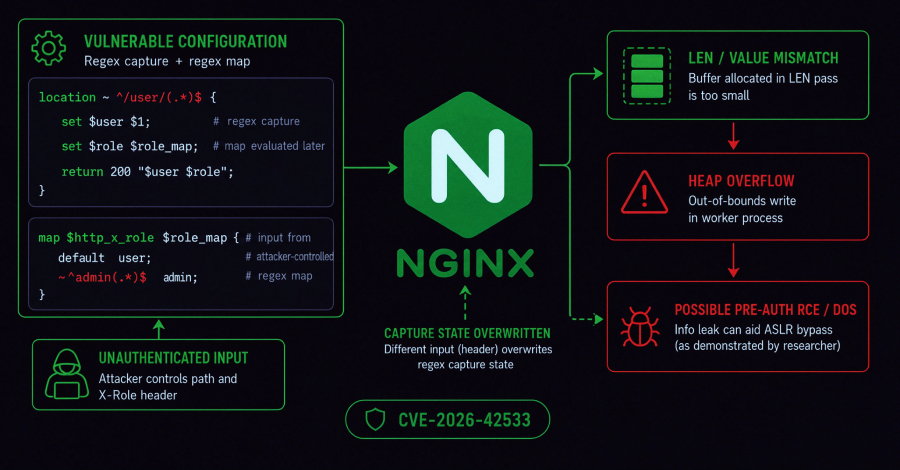
Triggering it can crash or restart the worker, causing a denial of service; where ASLR is disabled or can be bypassed, F5 says it may also allow remote code execution.
The overflow lives in nginx's script engine, the code that assembles strings from directives at request time. It only surfaces under a specific configuration: a regex-based map whose output variable is referenced in a string expression after a capture from an earlier regex match.
Under that pattern the engine's two-pass evaluation comes apart. The first pass measures how many bytes the result needs and allocates a buffer to fit; the second pass writes the bytes in. Both read the same shared capture state, and evaluating the map's regex in between the two passes overwrites it.
So the measuring pass sizes the buffer for the original capture, a reference like $1 from the location match, while the writing pass fills it from a different, attacker-sized one. The buffer is too small, and both the length and the content of the overrun come straight from the request.