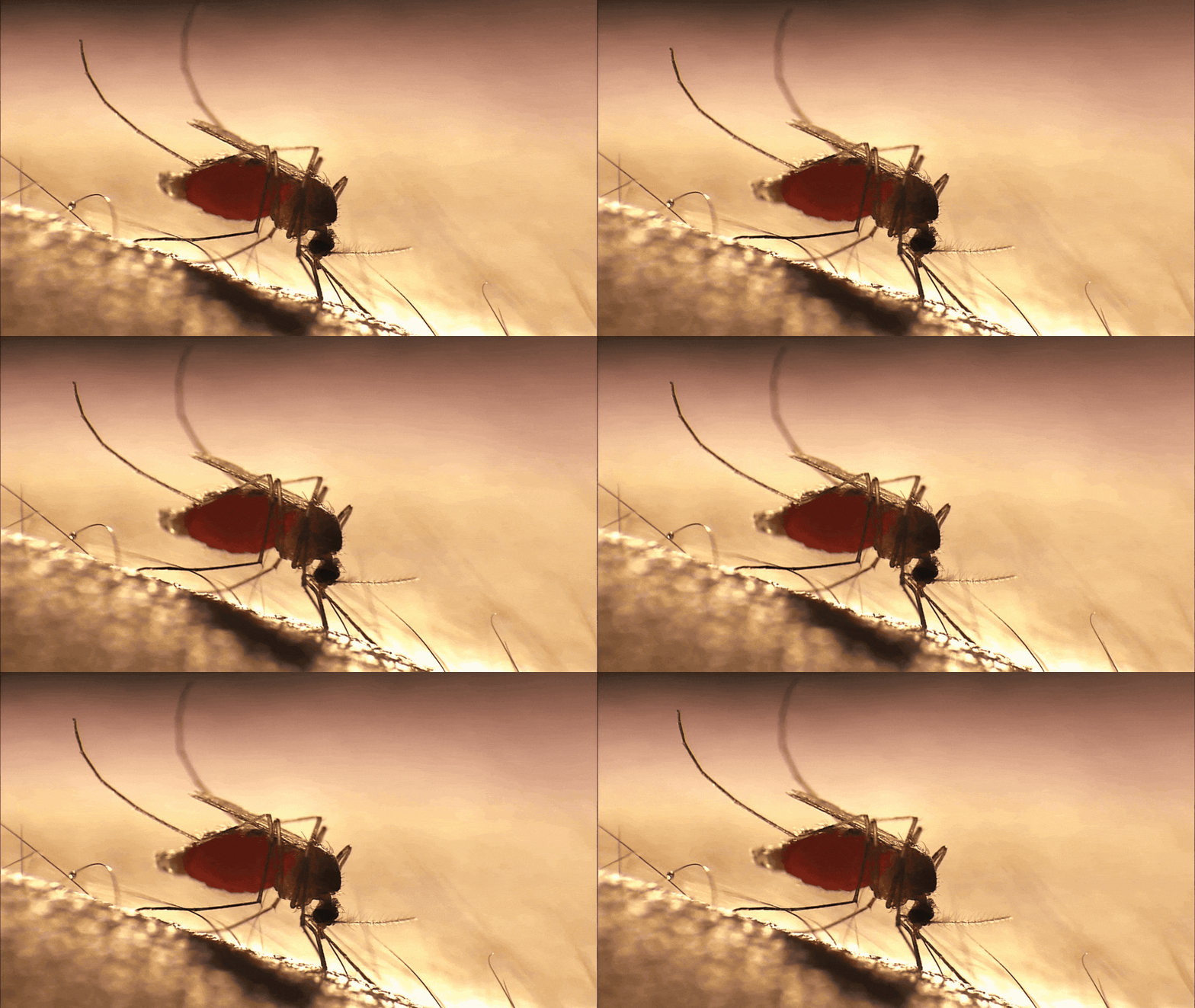
A single mosquito carrying malaria parasites can infect dozens of people. A single gene in that mosquito can spread slowly through its population. Gene drives aim to bend this inheritance in our favour by ensuring that a particular genetic change passes to far more than half of the offspring, helping reduce the disease burden.Whether through applications in health, diagnostics, drug discovery, and development or agriculture, today’s gene engineers can seem to have nature in the palm of their hands. Yet this misplaced view of unbridled human capacity has raised the false sense that any problem related to life on our planet can be addressed or solved by genetic engineering.Humans have acquired great power in our ability to manipulate cells and organisms. This capacity has helped, and will continue to help, address major problems. Yet our abilities are still modest compared to what nature itself has achieved over billions of years. Manipulating nature in a predictable manner is not straightforward: it involves trade-offs. Understanding nature’s journey over evolutionary time is both illustrative of what an engineered future can look like and a cautionary tale about the complexities that human-driven genetic engineering will face.A drive to proliferateOf the many applications of genetic engineering, ‘gene drives’ have received much attention. Gene drives are stretches of DNA engineered into the genome of an organism, say a mosquito. The stretches expand their presence in the population from generation to generation until eventually the inserted DNA is present in almost all the animals in that ecosystem.Suppose the DNA has the effect of making mosquito males sterile. Males that do not carry the gene drive can mate with females that do, but the progeny, both males and females, will carry the gene drive. This could, in principle, drive the population of mosquitoes to sterility or collapse.Proponents point to how this can greatly reduce, or even eliminate, disease-carrying vectors such as mosquitoes that transmit malaria or dengue. Critics point to possible failure through the development of resistance, environmental concerns, and the potential for unanticipated biological consequences. If we are to form a considered opinion on this, it will be useful to understand the past, present, and likely future of gene drives.From viruses to whales, the stretches of DNA called genes share a common feature: the drive to replicate successfully and amplify in populations. For genes, the organism is merely the vehicle to achieve this goal. The reproductive success of the organism is essential to serve this purpose. A virus that infects a host, multiplies several thousand times, exits, and infects hundreds of other hosts is successful at this game. If it is so virulent or the host so weak that it kills the host before it can replicate and spread, it will have failed.
Why engineering evolution is a high-stakes race between cure and chaos
Explore the complex balance of risks and benefits in gene drives, a powerful tool in genetic engineering and disease control.
1,743 words~8 min read