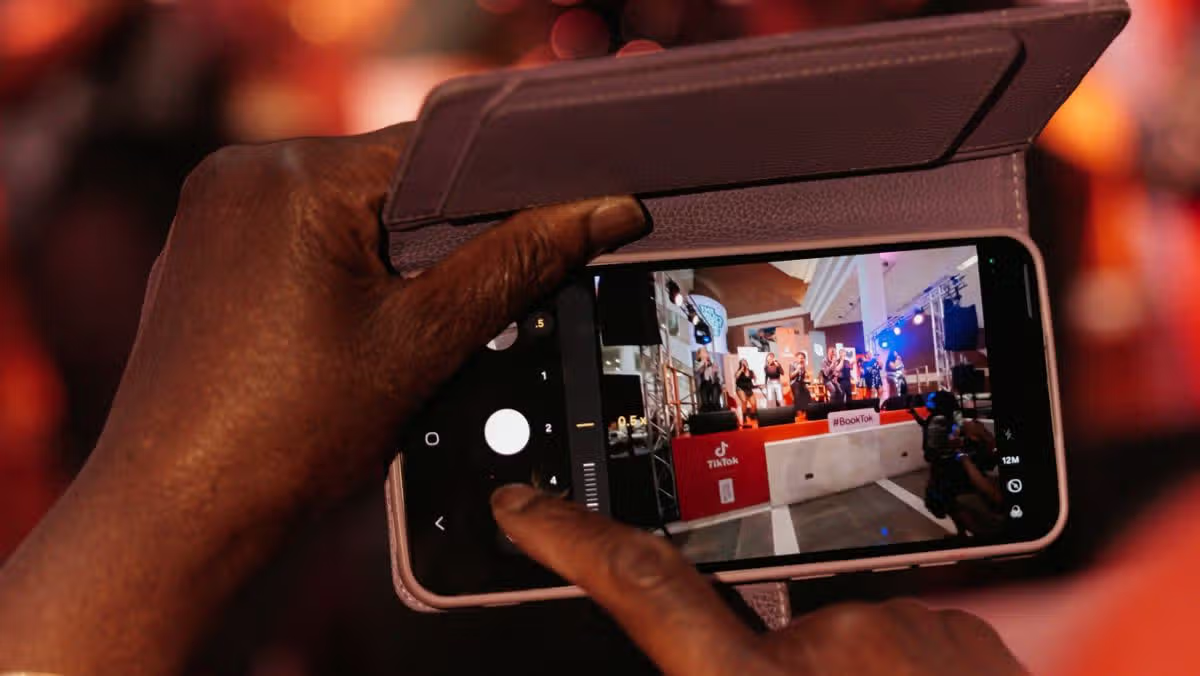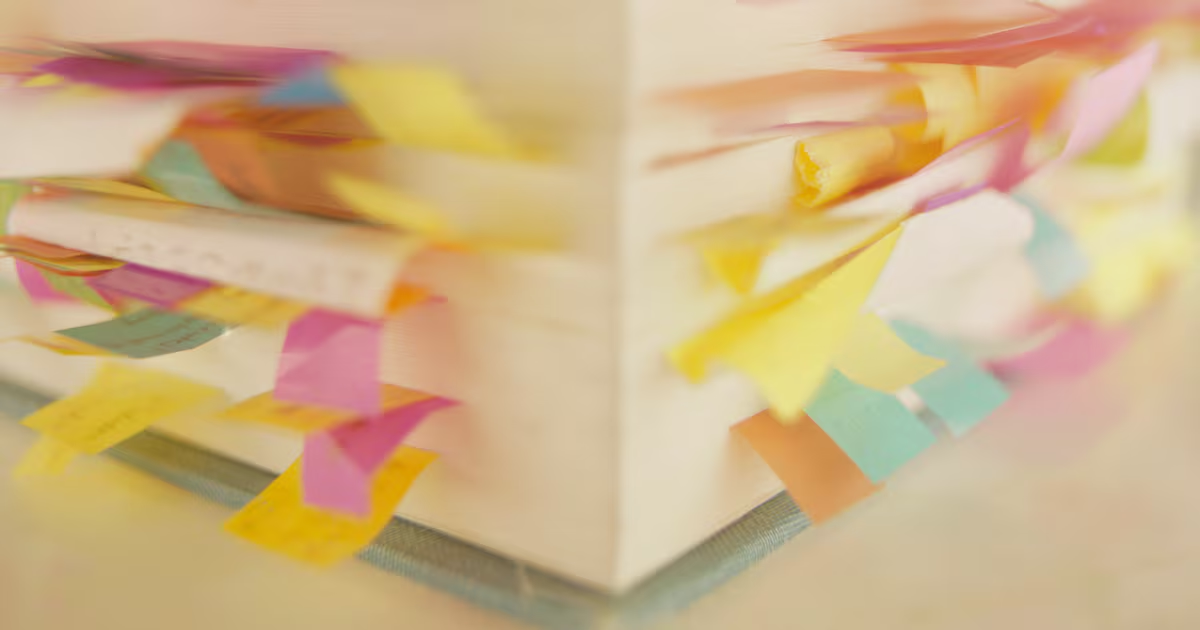
People are (and should be) weird about how they treat their books. All approaches are valid. I spent teenage years refusing to break the spine on new paperbacks. With the volume open just far enough to reveal text at the inner junction, I gave observers the impression of a curious goose looking into an empty bottle.A visit to the corner of TikTok known as BookTok (and to the self-explanatory Bookstagram) reveals that contemporary readers remain as eccentric as ever. Some buy two copies of each book: one to read messily and another to display smartly on the shelf. Others regard damage to larger, more difficult volumes as they might view battle scars. And many, many of them annotate. Furiously. Dedicatedly. Fanatically.If you are thinking a few scribbled notes in the margin then think again. Over the past few years a craze has, apparently organically, sprung up for turning books into groaning, brightly decorated metatexts. Colour-coded tabs on pages link themes, plot strands and moral lessons. Transparent sticky notes offer personal meditations. Highlighter pens provide some other service. The most dedicated annotators look to be making such additions on practically every page. And they are doing so on long books.The corner of BookTok that focuses on “classic literature” has its own oddball canon. Somehow or other, John Steinbeck’s East of Eden, once seen as turgid claptrap, is now, puzzlingly, treated as imperishable masterpiece. More understandably, Alexandre Dumas’s The Count of Monte Cristo – usually in Robin Buss’s impeccable 1996 translation – is exalted as the supreme adventure novel. There are dozens of videos on the service in which strong-armed users wave the enormous tome (more than 1,200 pages in my edition) before the camera, revealing a forest of differently coloured tabs that speak to close interaction.One Jessica Riches is among those talking us through an “annotation system for The Count of Monte Cristo”. It is, as they now say, a lot. “The highlighters help me understand what’s happening while I’m reading,” Riches explains. “The tabs help me find what happens later.” [ ‘Coffee must be dropped at different height than wine’: The Berlin team making books look well-readOpens in new window ]Sure enough, she brandishes an index that links yellow highlighter to “new character/new description”, pink highlighter to “timeline/weather” and so forth. Differently coloured tabs bind “key moments”, “betrayal/revenge” and “quotes”. She goes on to explain that her “supplies are pretty simple”. She requires one brand of “midliners”, some clear sticky notes, a fine Sharpie and a “1.3 pen for margin notes”. The average reader might view these as rather elaborate supplies for merely reading a book, but we are, here, deep into hobbyist territory. It takes a while to read The Count of Monte Cristo. Imagine how much longer it takes if you are writing simultaneous commentary on various adhesive media.Elsewhere on TikTok the writer Anam Iqbal, addressing her annotating process, also begins with notes on “all the equipment you need” as if launching into a video on scuba diving. “If you’re not careful with the highlighters and pens you use they can bleed into the other side,” she says. “And I’ve had really bad experiences with that.”Enthusiasts will, quite rightly, note that marginalia have a long and distinguished history. Before the invention of printing, additions to valuable volumes helped expand and enhance the formal text. In 2023 a copy of Isaac D’Israeli’s Curiosities of Literature, sparsely marked by a young Jane Austen, sold at Sotheby’s for about €188,000. Fermat’s Last Theorem, for centuries the thorniest unproven mathematical dictum, first appeared as a note in the margins of Diophantus’s Arithmetica. (Pierre de Fermat wrote that he had a proof, but it would not fit in the space allowed.) Following her death, Marlene Dietrich was found to have written furious commentary in a biography of herself. “All lies!”[ Summer reading hitlist: New novels, classics and nonfiction books recommended by writersOpens in new window ]Something different appears to be going on with the current vogue. This surely has to do with the hobbyfication of reading. Not too long ago everyone was expected to have a book “on the go”. Reading was just something you did. Like eating. Or sleeping. At some point in the past 30 or 40 years people began listing “reading” when asked for their hobbies. This would once have seemed as odd as writing “wearing clothes” in the same space.The natural result of all this is that reading ends up as a pastime for which you need equipment – like butterfly collecting or metal detecting. What harm? None at all. I am too lazy to produce a shadow Count of Monte Cristo while racing through Dumas’s breakneck prose, but one has to grudgingly admire the dedication and invention of the contemporary annotator. The most diligent creates a knotty, multimedia entity that has aesthetic merit in its own right. Better that than spending your hours speculating about Taylor Swift’s wedding. My hat is off to them all.
Reading has become a hobby for which you need equipment, like scuba diving
Visits to BookTok and Bookstagram reveal readers remain as eccentric as ever
827 words~4 min read