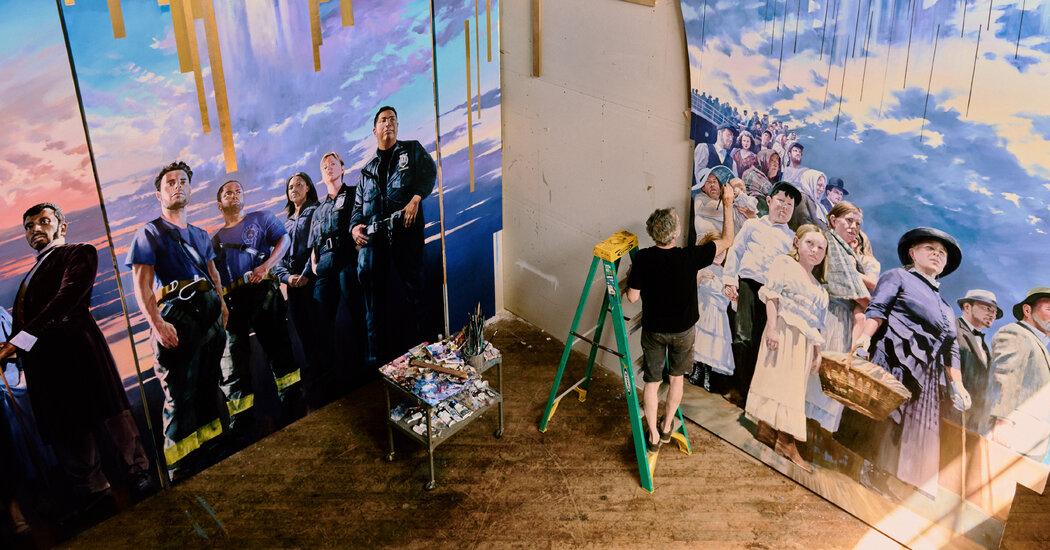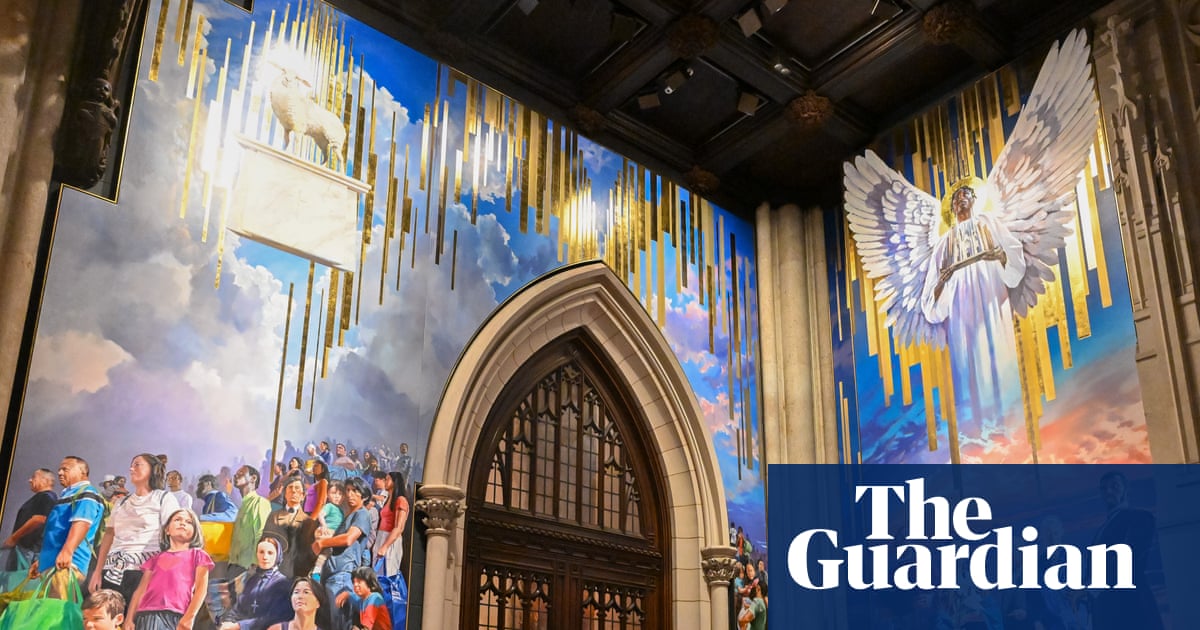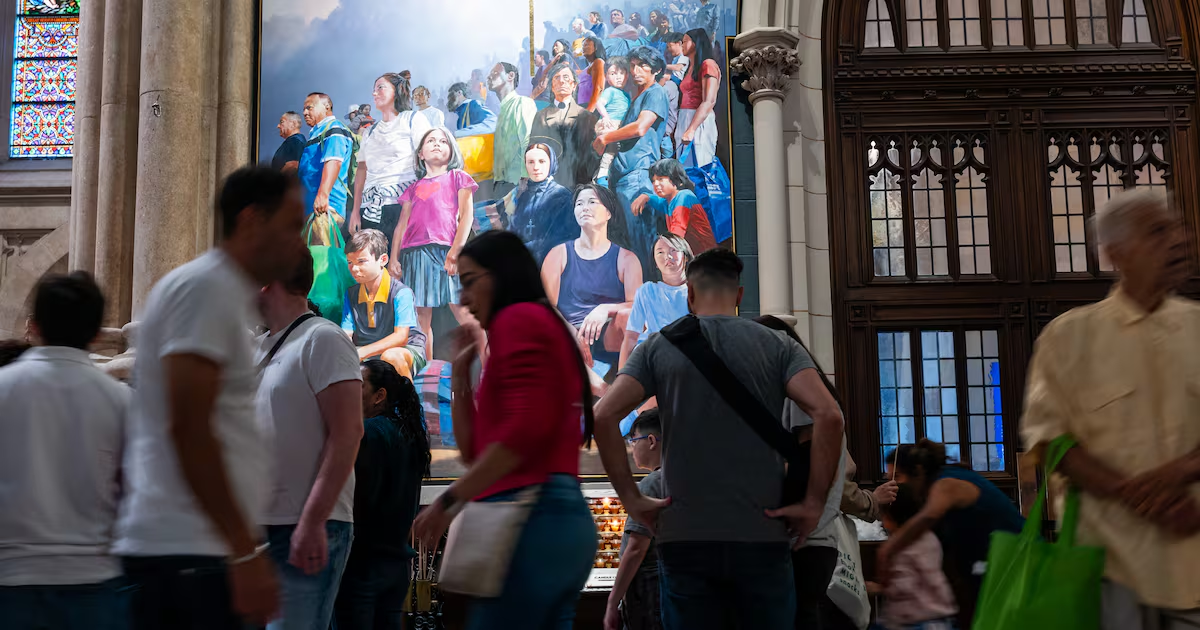
St Patrick’s Cathedral in New York is a bastion of the Irish-American community. Its construction was begun by John Hughes (1797-1864), the first Catholic archbishop of New York and a native of Co Tyrone. Subsequent archbishops of New York, with one exception, have all had some Irish ancestry.Hughes has been credited by historian Daniel Howe with “fostering a strong Irish-American identity, one centred on the Catholic faith rather than on the secular radicalism of the Irish nationalists who competed with him for community leadership”. That identity is highlighted in the huge mural in four panels recently erected just inside the cathedral, celebrating New York’s Irish and other immigrant history and the US’s wider Catholic heritage. Its principal feature is a representation of the Apparition at Knock in 1879, by coincidence the same year that St Patrick’s was opened to the public. The mural was commissioned by Cardinal Timothy Dolan, who has now retired as archbishop of New York, and is by the American artist Adam Cvijanovic. It is entitled “What’s so funny about peace, love and understanding”. It covers the three walls of the entrance area, the narthex – two panels on the west wall, separated by the main door of the cathedral, the other two on the north and south walls of the narthex.The figures of St Joseph, Our Lady and St John the Evangelist, replicating the iconography of Knock, hover over a group of Irish immigrants disembarking from a ship in the panel on the north wall. The panel on the south wall shows a group of newer immigrants of various nationalities beneath the image of the Lamb of God on an altar from the Knock apparition.Placed among these newer immigrants are St Frances Xavier Cabrini (1850-1917), the first US citizen to be canonised, and the Ven Félix Varela y Morales (1788-1853). Both are recognised for their work among poor immigrant communities in New York.The first of the panels on the west wall honours five notable New York Catholics. An angel positioned above the figures carries a model of St Patrick’s Cathedral. Appropriately, Hughes is included in the group. The others are: St Kateri Tekakwitha (1656- 1680), a Mohawk convert who is the first Native American saint; Alfred E Smith (1873-1944), four-term governor of New York and the first Catholic nominee for president by a major party (in 1928, but he was defeated by Republican Herbert Hoover); Dorothy Day (1897-1980), the journalist and social activist; and the Ven Pierre Toussaint (1766-1853), a former slave in Haiti who became a philanthropist and benefactor to Catholic causes in New York. Alfred Smith is depicted almost as a caricature of a New York politico, with a fat cigar in his hand. It is, by any standards, an incongruous portrait in a church setting.The other panel flanking the main door is a tribute to New York’s so-called first responders – firefighters, police officers and rescue workers. These are occupations in which Irish-Americans and other immigrant communities are heavily represented. The panel is intended to remind us of the 9/11 tragedy – which occurred 25 years ago this year- but the service given by first responders to the city of New York is not, of course, limited to that particular event. An angel carrying a policeman’s cap and a firefighter’s helmet overhangs the five figures depicted in the panel – paralleling the angel above the five notables in the other panel on the west wall. The symmetry between these two panels and likewise between the other two – both with Knock iconography and immigrants past and present – is clearly deliberate.What – or, more accurately, who – is missing from the mural? Bishop Fulton Sheen (1895-1979), the renowned broadcaster and an auxiliary bishop of New York, who will be beatified next September, is one glaring omission. So too is Cardinal Terence Cooke (1921-1983), archbishop of New York from 1968 to 1983, whose cause for canonisation has been initiated and who is buried in the cathedral. It is perhaps surprising that Alfred Smith was favoured for inclusion in the mural over John F Kennedy, who was the first Catholic to be elected US president and whose Irish-American family moved to New York from Boston when he was aged 10. His brother, Robert Kennedy, represented New York in the US Senate and his funeral Mass in 1968 was held in St Patrick’s Cathedral – so he too had some claim to be included in the mural.The mural is on an epic scale, with vivid colours and gold leaf embellishments, but it is somewhat discordant with the quiet gothic splendour and devotional ambience of the cathedral. It is strictly realistic in style and reminiscent of the work of American artists of the mid-20th century such as Norman Rockwell. It lacks the subtlety of, for example, PJ Lynch’s Apparition mosaic in the basilica at Knock.Felix M Larkin is a historian and retired civil servant
Rite & Reason: A vision of Knock in New York’s St Patrick’s Cathedral
Rite & Reason: A new mural at the cathedral was commissioned by Cardinal Timothy Dolan, retired archbishop of New York, and is by the American artist Adam Cvijanovic
817 words~4 min read