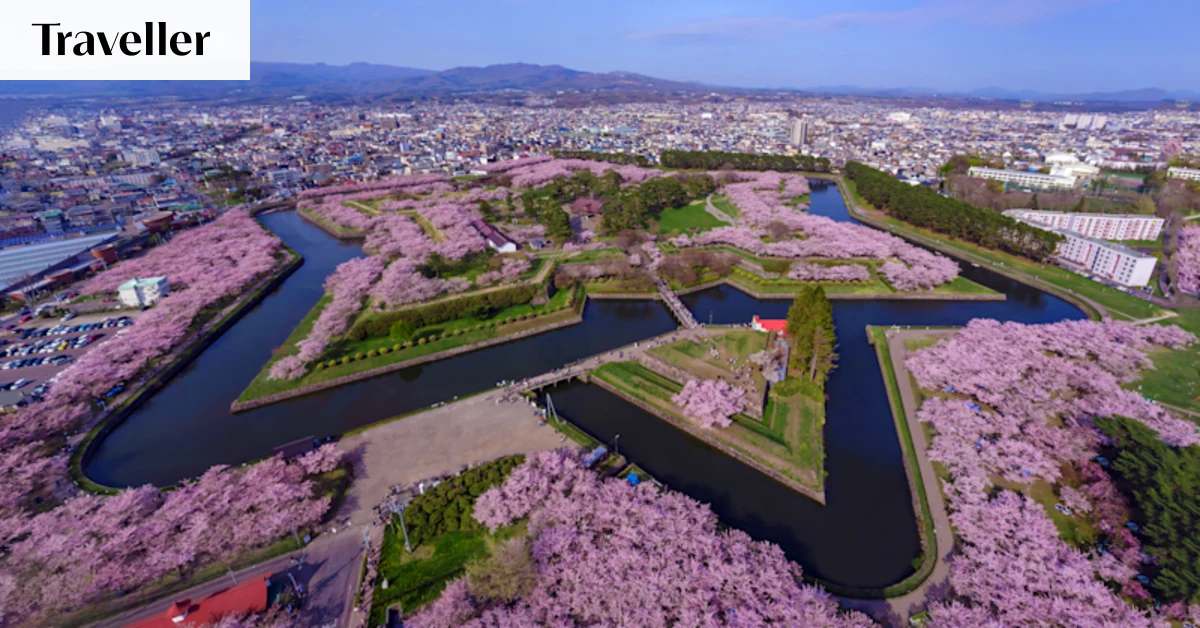
July 19, 2026 — 5:00amI’ve no sooner disembarked from Silversea’s Silver Moon, when I discover that Hakodate, situated on Japan’s northernmost island of Hokkaido, is a city made for gazing: downwards to its manholes that feature a quirky squid design; into the fish tanks at its seafood market and up at Japan’s first-ever concrete electric pole (yes, that’s a Hakodate claim to fame).Destroyed by fire in 1934, Hakodate was rebuilt into the well-organised sprawl it is today. For a town that looks unremarkable from the port, it turns out there’s plenty to see. And that’s before ascending the landmark Goryokaku Tower that provides a remarkable view of the city and its historic fort, as well as an insight into its past.The view from Hakodate’s Goryukaku Tower during cherry blossom season.Getty ImagesI make my way through Hakodate’s must-sees, all easily accessed by tram. My first stop is the bustling morning market that started after the end of World War II as a black market selling fresh produce, before fishermen eventually threw in their catch. I laugh along with a young couple attempting to hook a squid from a tank (once caught, the stall owner will serve it sashimi-style).Next, I catch the tram to one of Hakodate’s most important landmarks, Goryokaku Fort. It was completed in 1864, several years before the collapse of the isolationist Tokugawa Shogunate, as a defence against the colonialist threat from the West. Designed along similar lines as European citadels, its star shape allowed for more gun posts than traditional Japanese forts. Converted into a park in 1914, Goryokaku is understandably popular for its autumn colours and spring cherry blossoms. Adjacent to the park is the 107-metre-high Goryokaku Tower, whose pentagon-shaped design cleverly reflects that of the star-shaped fort. I soak in the fabulous 360-degree views and peer down at the moat and the fort’s walls. They’re massive, even from up here. A floor below the observation deck is the “History Corridor”, with displays outlining the fort’s history, which is also the best place to take photographs unimpeded by visitors.Sign up for the Traveller Deals newsletterGet exclusive travel deals delivered straight to your inbox. Sign up now.Catch breakfast and your own squid sashimi at the Morning Market. Getty ImagesMy next stop is Motomachi, a cobblestone neighbourhood located between the foot of Mount Hakodate and the harbour. This fascinating area was built in the late 19th and early 20th centuries when Hakodate’s port opened to international trade. Its intriguing buildings blend Japanese and Western architectural design: the Old Public Hall of Hakodate Ward; the turquoise-roofed Russian Orthodox Church; the Roman Catholic Church that “pops” with bright red tiles, and the Old British Consulate where a café serves scones and tea.The afternoon skies turn and heavy cloud obscures Mount Hakodate. My plans to do the thrilling three-minute ride to the summit on the Mount Hakodate Ropeway, a cable car, are dashed. Locals are disappointed that I can’t visit Gagyu-zan (Lying Cow Mountain), nor witness the expansive vista that extends, on clear days, to the water.The view, on a clear day, from the city’s Mount Hakodate Ropeway.
This Japanese town looks unremarkable, but is an unexpected delight
One a day trip to Hakodate, I discover a city made for gazing, with highlights all accessible by the local trams.
750 words~3 min read