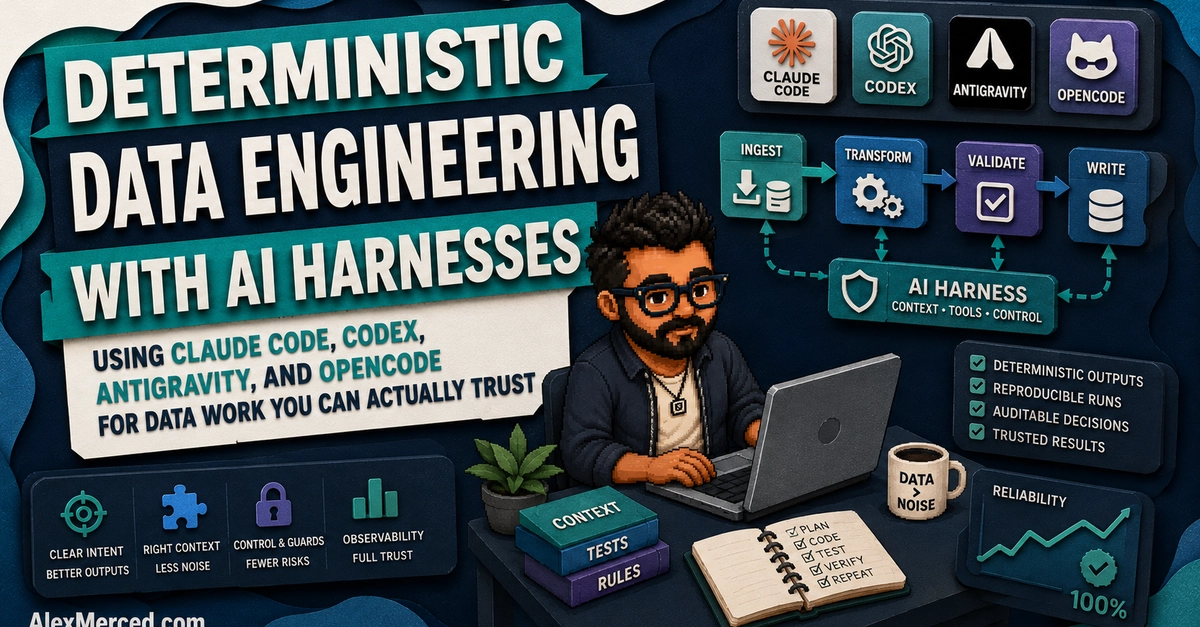
There is an apparent contradiction at the heart of using AI agents for data work, and resolving it properly is worth an entire article, because the teams that resolve it are quietly getting enormous value while the teams that do not are generating incidents.
The contradiction: data engineering and analytics are disciplines built on determinism. The pipeline must produce the same output from the same input every run. The revenue number must reproduce, to the penny, when the auditor asks. The metric must mean the same thing on every dashboard. Meanwhile, the most powerful new tools in a data professional's kit, the agentic coding harnesses, Claude Code, OpenAI's Codex, Google's Antigravity line, OpenCode, and their peers, are built on language models, which are probabilistic by nature: ask twice, get two phrasings, sometimes two approaches, occasionally two answers.
The resolution is not to avoid the tools, and it is not to hope the models stop being stochastic. It is an architectural principle, old as software and newly urgent: use the agent to author deterministic artifacts, and let the artifacts do the work. The model's creativity lives at development time, where variance is cheap and review catches error. The runtime path, the thing that actually touches your data every night, is code: versioned, tested, reviewed, reproducible, exactly as deterministic as it ever was. Get this boundary right and the harnesses become the largest productivity gain data teams have seen in a decade. Get it wrong, agents improvising in the runtime path, numbers with no provenance, and you have built a very fast way to lose the business's trust.