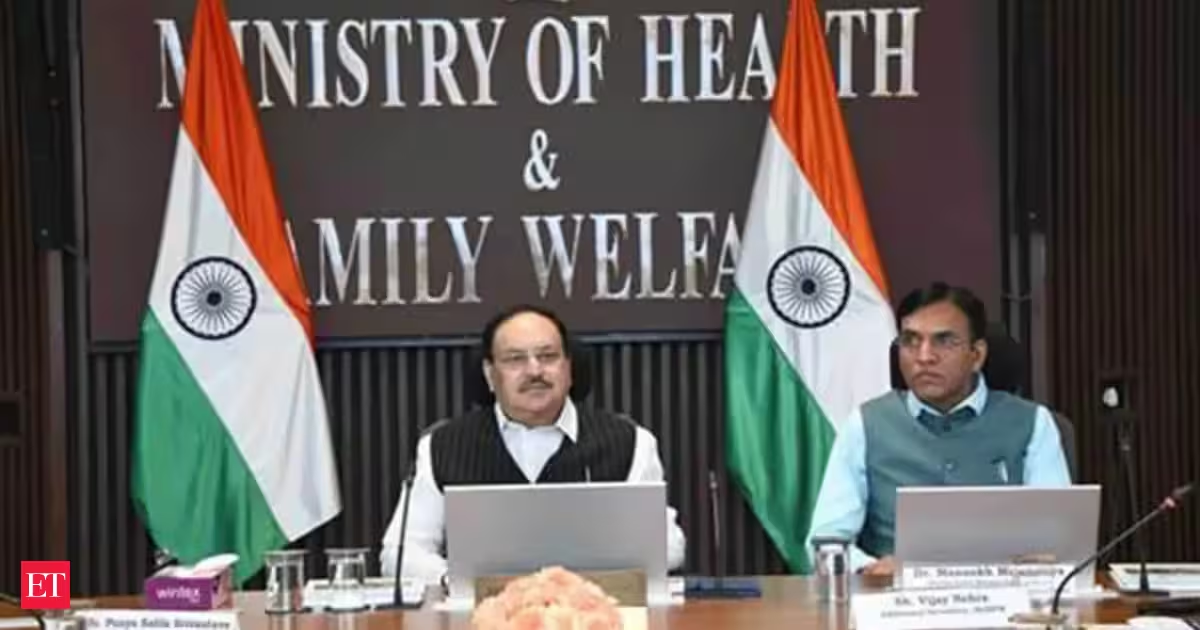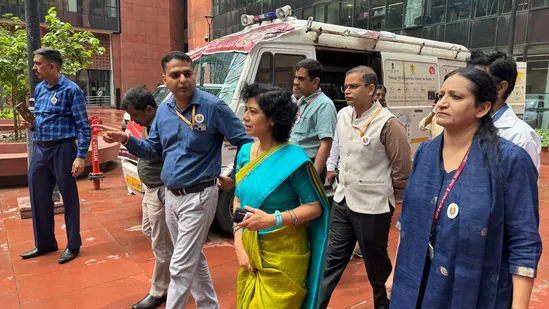
Officials assessed upgrades to core IT platforms covering beneficiary identification, hospital empanelment, transaction management and programme analytics
| Photo Credit:
Nearly two years after the Centre expanded the Ayushman Bharat Pradhan Mantri Jan Arogya Yojana (AB PM-JAY) to cover all citizens aged 70 years and above, the scheme has reached only a fraction of its intended beneficiaries. Of the six crore senior citizens eligible under the Ayushman Vaya Vandana Yojana, only about 1.29 crore have been approved for coverage, according to data available on the National Health Authority (NHA) dashboard. The dashboard also shows that around 1.2 crore beneficiaries have applied for Ayushman cards, while only 63,812 cards have been delivered.The rollout has been similarly slow for frontline workers. Of the 72.23 lakh ASHA workers, Anganwadi workers and Anganwadi helpers eligible under the scheme, coverage has been approved for only 44.1 lakh beneficiaries.Against this backdrop, the National Health Authority (NHA) has asked States and Union Territories to prioritise enrolling all eligible beneficiaries under AB PM-JAY, expedite Ayushman Card generation, ensure complete coverage of ASHA workers, Anganwadi workers and Anganwadi helpers, and accelerate the implementation of the Ayushman Vaya Vandana Yojana for senior citizens. The directions were issued during a two-day National Review Meeting (Chintan Shivir) organised by the NHA under the Ministry of Health and Family Welfare to review the implementation of AB PM-JAY.The Centre expanded AB PM-JAY in phases over the past two years. In the Interim Budget 2024-25 presented on February 1, 2024, Finance Minister Nirmala Sitharaman announced health insurance coverage under the scheme for ASHA workers, Anganwadi workers and Anganwadi helpers. Subsequently, on September 11, 2024, the Centre approved extending the scheme to all citizens aged 70 years and above, irrespective of income or socio-economic status, making them eligible for a dedicated Ayushman card.review meetingDuring the two-day Chintan Shivir, officials reviewed the implementation of AB PM-JAY and the Ayushman Bharat Digital Mission (ABDM), assessing progress since the previous review meeting. Discussions focused on expanding beneficiary coverage, improving service delivery, streamlining claims management, strengthening hospital empanelment and tracking the implementation of earlier action points.Inaugurating the meeting, Union Minister of State for Health and Family Welfare Prataprao Jadhav said the government’s flagship health insurance scheme had facilitated cashless treatment worth more than ₹1.91 lakh crore through over 37,000 empanelled hospitals, making it the world’s largest health assurance programme. He added that more than 94 crore Ayushman Bharat Health Account (ABHA) numbers had been created and over 100 crore digital health records linked.The review also examined key policy and technology reforms under PM-JAY, including a proposed framework for planned pre-authorisation of select medical procedures, enhancements to the auto-adjudication engine for faster and more transparent claims settlement, and the National Anti-Fraud Unit’s use of risk-based monitoring and data analytics to detect fraudulent claims.Officials assessed upgrades to core IT platforms covering beneficiary identification, hospital empanelment, transaction management and programme analytics. They also reviewed the rollout of the National Health Claims Exchange-HMIS pilot, aimed at enabling interoperable digital exchange of health claims between hospitals and insurers.The meeting further reviewed the implementation roadmap for digital health initiatives launched by the NHA in June, including Aarogya Setu 2.0, the upgraded Ayushman App, the Ayushman Sarathi WhatsApp chatbot, e-Sushrut Clinic, the National Drug Registry, the Unified Health Interface and the National Health Claims Exchange.Financial management under PM-JAY and ABDM was another key agenda item, with discussions centred on improving fund utilisation, financial planning and the timely release and utilisation of grants by States and Union Territories. Officials also deliberated on revised grant-in-aid guidelines and measures to strengthen financial accountability.analytical toolsThe first day concluded with a presentation by AIIMS, New Delhi, on its Clinical Decision Support System, which uses artificial intelligence to assist evidence-based clinical decision-making.On the second day, the NHA recognised States and Union Territories for their performance under PM-JAY. Andhra Pradesh, Sikkim and Lakshadweep received awards for issuing the highest number of Vay Vandana Scheme cards per lakh population in the large State, small State and Union Territory categories, respectively. Madhya Pradesh, Meghalaya and the Andaman & Nicobar Islands were honoured for recording the highest number of biometric-authenticated pre-authorisations.The NHA’s Health Analytics and AI Unit also showcased advanced analytical tools designed to support evidence-based policymaking under PM-JAY. These included frameworks for analysing beneficiary portability, district-level healthcare access, hospital performance and service utilisation, helping States identify gaps, optimise hospital empanelment and improve healthcare planning.There was also a discussion on innovative financing mechanisms for hospital receivables through the National Health Claims Exchange (NHCX). The platform is expected to facilitate faster settlement of approved PM-JAY claims, enabling empanelled hospitals to access working capital without waiting for reimbursements from State Health Agencies, while improving transparency and efficiency in the claims settlement process.Published on July 18, 2026