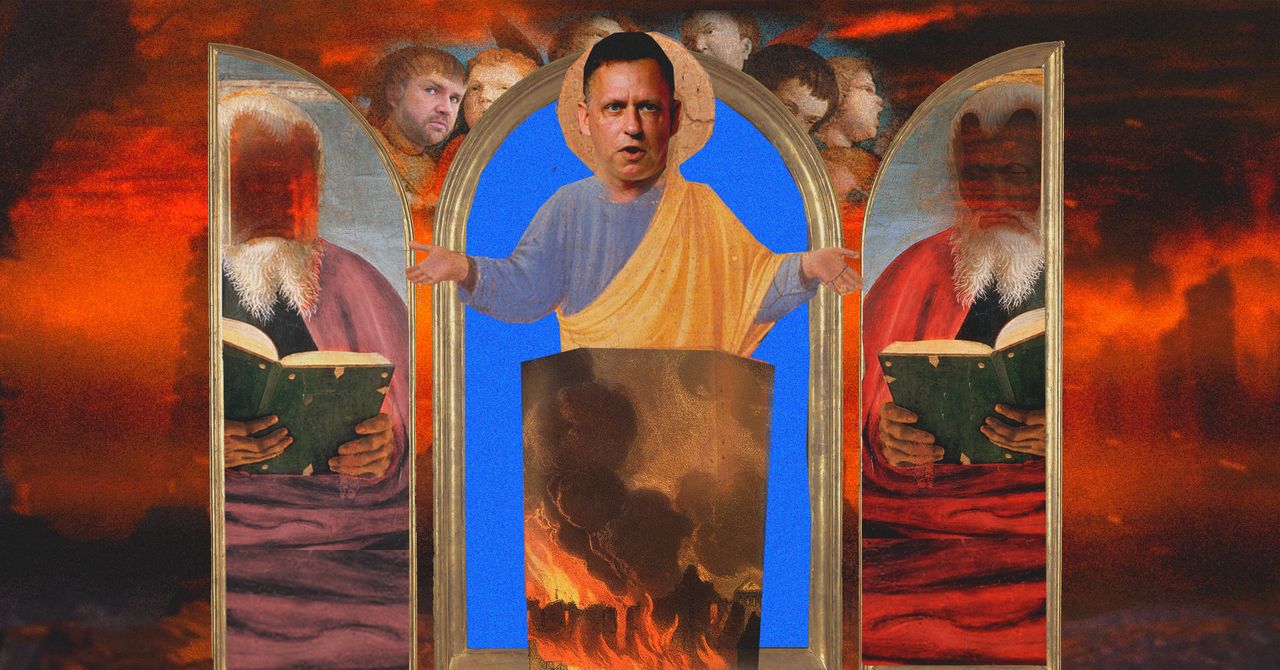
Peter Thiel has spent 30 years arguing, on political and economic grounds, the regulatory state is the primary obstacle to technological progress.
He cofounded Palantir, the surveillance and data-analytics company whose government contracts depend on minimal oversight. He was the first outside investor in Facebook, an early backer of dozens of AI companies, and the most consequential political financier in Silicon Valley’s history—the man who backed President Donald Trump before it was safe, who bankrolled J.D. Vance’s Senate campaign when Vance was a longshot, who has built an ideological project aimed at weakening the international institutions and regulatory frameworks that have governed technology and climate for a generation. He has made this case in newspaper columns, in books, in conference speeches, and in the funding decisions of his venture firm.
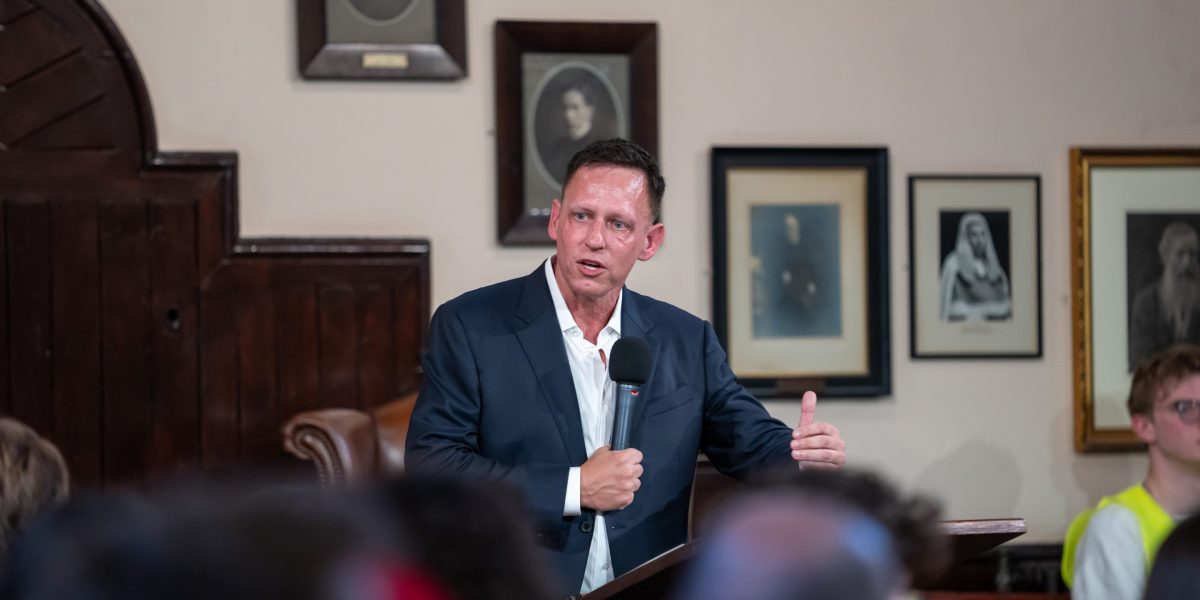
He has also been developing, for nearly a year, a theory about what he calls “the Antichrist.” The theory has escalated in stages: a four-part private lecture series in San Francisco in September 2025; leaked audio that made it a national story via the Washington Post that October; a first co-authored essay in First Things, the leading journal of Catholic intellectual conservatism in America, “Voyages to the End of the World.” He repeated the lecture series near the Vatican in Rome in March, which drew institutional pushback; and now he has co-authored a second, more pointed First Things essay. The idea centers on a provocation. In earlier centuries, Thiel argued, the Antichrist might have looked like a Dr. Strangelove-style mad scientist, a figure of obvious menace. But that isn’t how the Antichrist shows up in the 21st century.