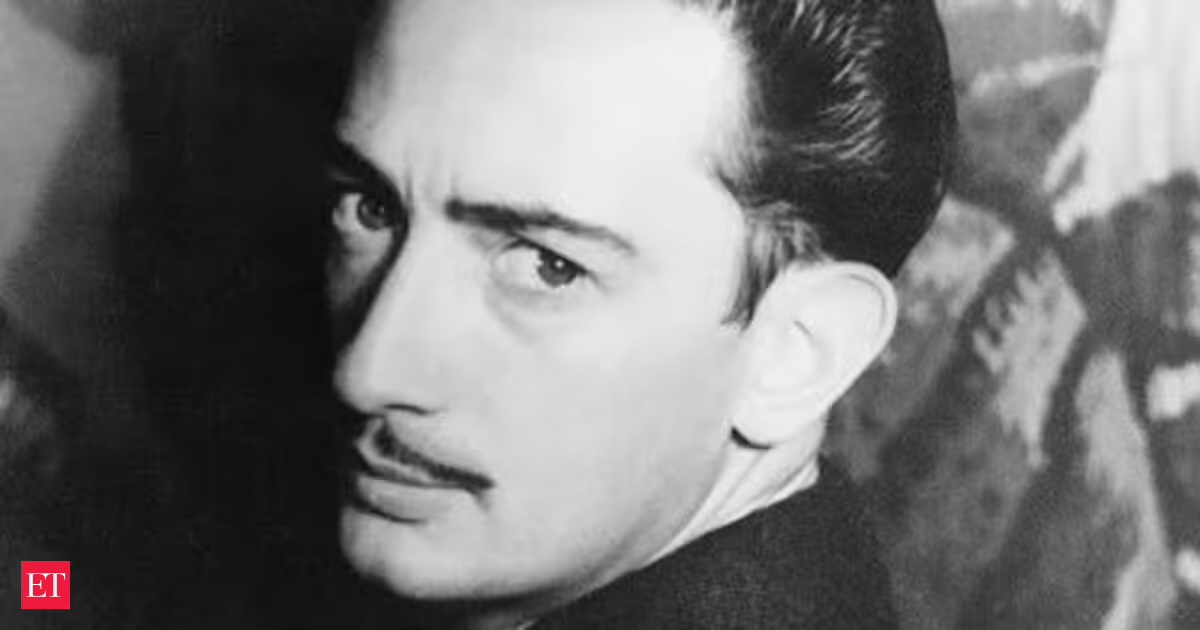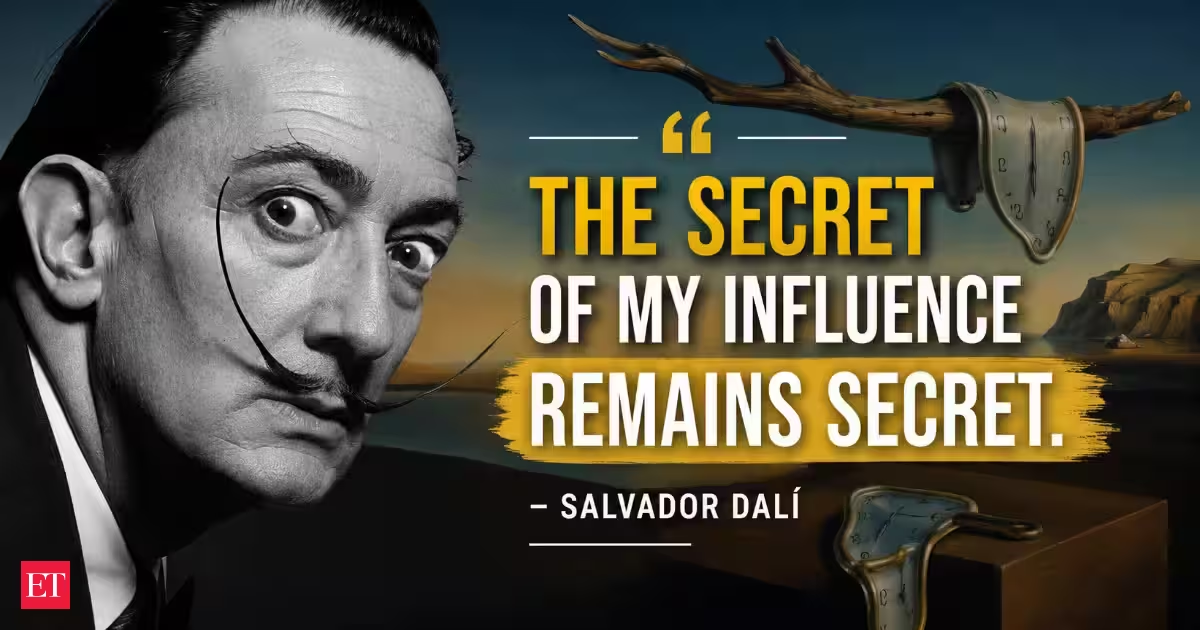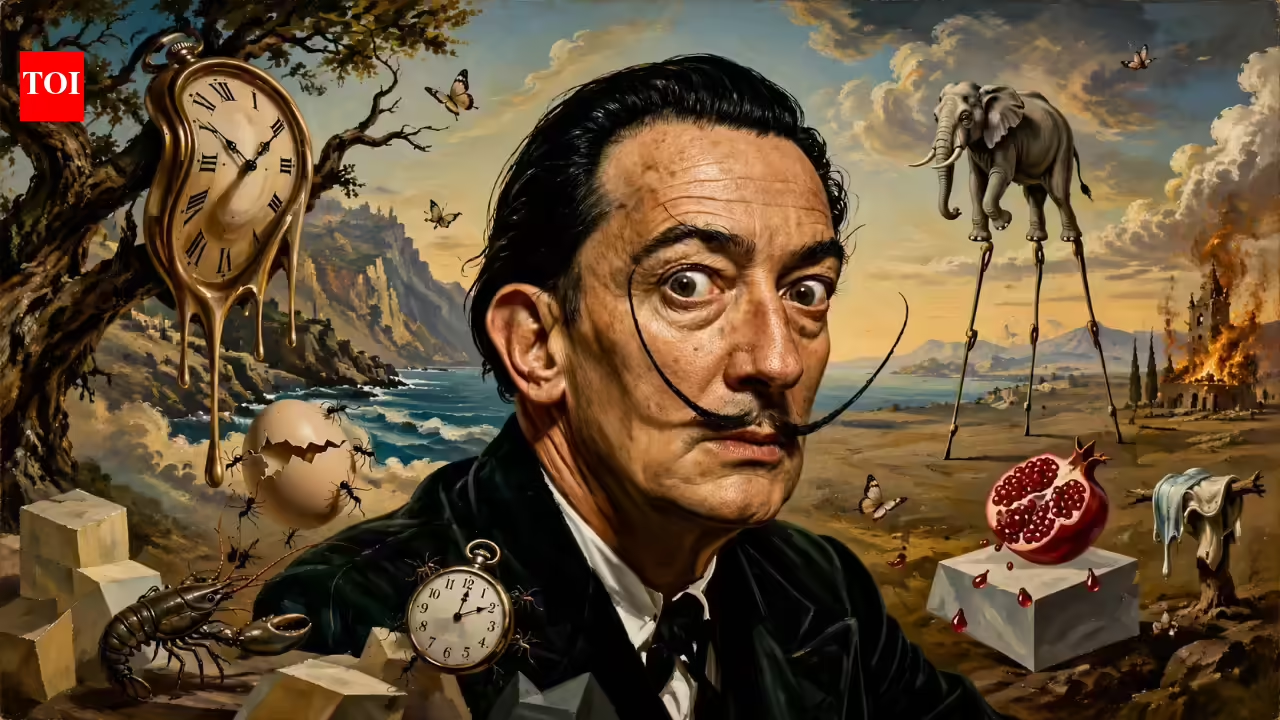
The quote originated during a period when Dalí was reflecting on his own artistic journey, his relationship with mistakes, and the heavy psychological weight that creators place upon themselves"Have no fear of perfection - you'll never reach it"In the mid-20th century, amidst the shifting landscapes of post-war Europe, one of history’s most eccentric minds sat down to lay his subconscious bare on paper. The year was 1964. The writer was the legendary Spanish surrealist Salvador Dalí, and the place was the pages of his famously raw diary, later published as the autobiographical book Diary of a Genius (originally Journal d'un génie).Dalí did not pen these words as a rigid academic lesson, but rather as a liberating manifesto on the chaotic, unpredictable nature of creativity.The quote originated during a period when Dalí was reflecting on his own artistic journey, his relationship with mistakes, and the heavy psychological weight that creators place upon themselves. Written at the height of his global fame, the context was deeply personal: Dalí believed that mistakes were "of a sacred nature" and that trying to force absolute, rigid perfection onto art was a form of creative paralysis. By declaring perfection unattainable, Dalí sought to break the shackles of self-doubt for himself and for generations of artists to come.Deconstructing the meaning: Why imperfection is freedomAt first glance, telling someone "you'll never reach perfection" sounds like a pessimistic critique. In Dalí's world, however, it is the ultimate expression of optimism and relief.The quote targets the phenomenon of **perfectionism paralysis**—the debilitating fear of making mistakes that stops people from starting a project, finishing a painting, or trying something new. Dalí shifts our perspective by pointing out a mathematical and human reality: perfection is a concept, an illusion, not a destination. Because human beings are inherently flawed, absolute perfection is structurally impossible to achieve.Therefore, Dalí argues, if failing to reach perfection is a guarantee, **you no longer have to fear it.** The pressure is off. By relinquishing the unyielding demand to be flawless, we give ourselves the permission to experiment, make messy mistakes, and simply create. It redefines failure not as a defeat, but as a natural step in the artistic process.Who was Salvador Dalí?To truly understand the quote, one must understand the architect behind it. Born in Figueres, Spain, in 1904, Salvador Dalí was the undisputed crown prince of the Surrealism movement. Instantly recognisable by his gravity-defying, upturned waxed moustache, Dalí was a master showman who treated his entire life as a piece of performance art. He became globally famous for his unique visual language, blending highly realistic painting techniques with bizarre, dreamlike, and nightmarish imagery.As a prominent figure defining the global avant-garde, Dalí shared a highly fascinating, complex dynamic with his contemporary across the Atlantic: Mexican painter Frida Kahlo.Both artists occupied a uniquely shared cultural space—both possessed unmistakable personal styles, challenged standard societal taboos, and heavily explored the inner workings of the human psyche. While André Breton (the "Pope of Surrealism") famously travelled to Mexico and labelled Kahlo a natural surrealist, Kahlo fiercely rejected the label, famously stating that while Dalí painted dreams, she painted her own harsh reality. Dalí, deep in the Paris and New York art circles, was deeply aware of Kahlo's striking brilliance, and though their artistic philosophies diverged—Dalí mining the subconscious mind while Kahlo bared her physical and emotional suffering—their mutual eccentricities placed them hand-in-hand as the twin titans of 20th-century visionary art.Beyond this artistic dialogue, Dalí was a relentless force of creative diversity, leaving an indelible mark across multiple mediums:The persistence of memory (1931): His defining masterpiece features limp, melting pocket watches draped across a desolate Catalan landscape, symbolising the fluid, non-linear nature of time.The surrealist objects: Dalí took his genius off the canvas, turning ordinary functional objects into subconscious poetry, most notably with the Lobster Telephone (1936) and the Mae West Lips Sofa (1937).A Renaissance man of excess: Far from just a painter, Dalí expanded his empire into fashion (collaborating with Elsa Schiaparelli), commercial design (creating the iconic Chupa Chups lollipop logo), and cinema (working with director Luis Buñuel on Un Chien Andalou and collaborating with Walt Disney on the short film Destino).Dalí passed away in 1989, but his philosophy lives on. Today's quote reminds us that the value of human endeavour isn't found in a flawless, pristine final product, but in the wonderfully imperfect courage to make something out of nothing.
Quote of the day by Salvador Dali: 'Have no fear of perfection...' - How a Spanish painter’s simple advice helps everyday people beat self-doubt and just get things done!
"Have no fear of perfection - you'll never reach it"
729 words~3 min read