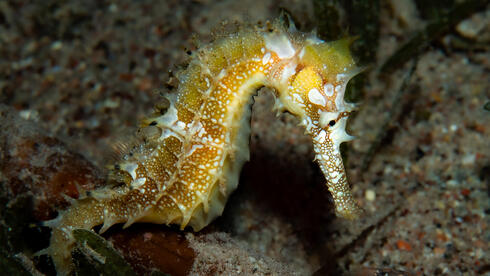
Poor swimmers with delicate bodies, seahorses rely on a biological spring to ambush prey in milliseconds, but warming seas, pollution and habitat loss may outpace their ability to adaptMaya Pelach, Zavit|Seahorses are among the easiest marine animals to admire. Their upright posture, elongated snout and curled tail make them look so unusual that it is easy to forget they are fish.They live in oceans and seas around the world, including the Mediterranean and Red Sea. Yet their poor swimming ability and dependence on specific coastal habitats leave them especially vulnerable to human activity, pollution and environmental change.GalleryA seahorse (Photo: Maayan Neiger Rahmilevitz)Dr. Hadar Ella of Tel Aviv University and the Interuniversity Institute for Marine Sciences in Eilat studies seahorses under the supervision of Prof. Roi Holzman. Her research focuses on the remarkable feeding system hidden behind their delicate appearance.Where are seahorses found?
“Seahorses are a broad group of fish found in Israel in both the Mediterranean and Red Sea,” Ella said. “In fact, they can be found across most of the world’s oceans.”They are generally most common in warm, shallow tropical waters and in a wide range of coastal habitats.Some seahorse species are endangered or close to being classified as such, while scientists still lack enough information about others. The group as a whole is considered highly sensitive to human activity, including damage to coastal habitats, pollution and fishing.What makes them unique?