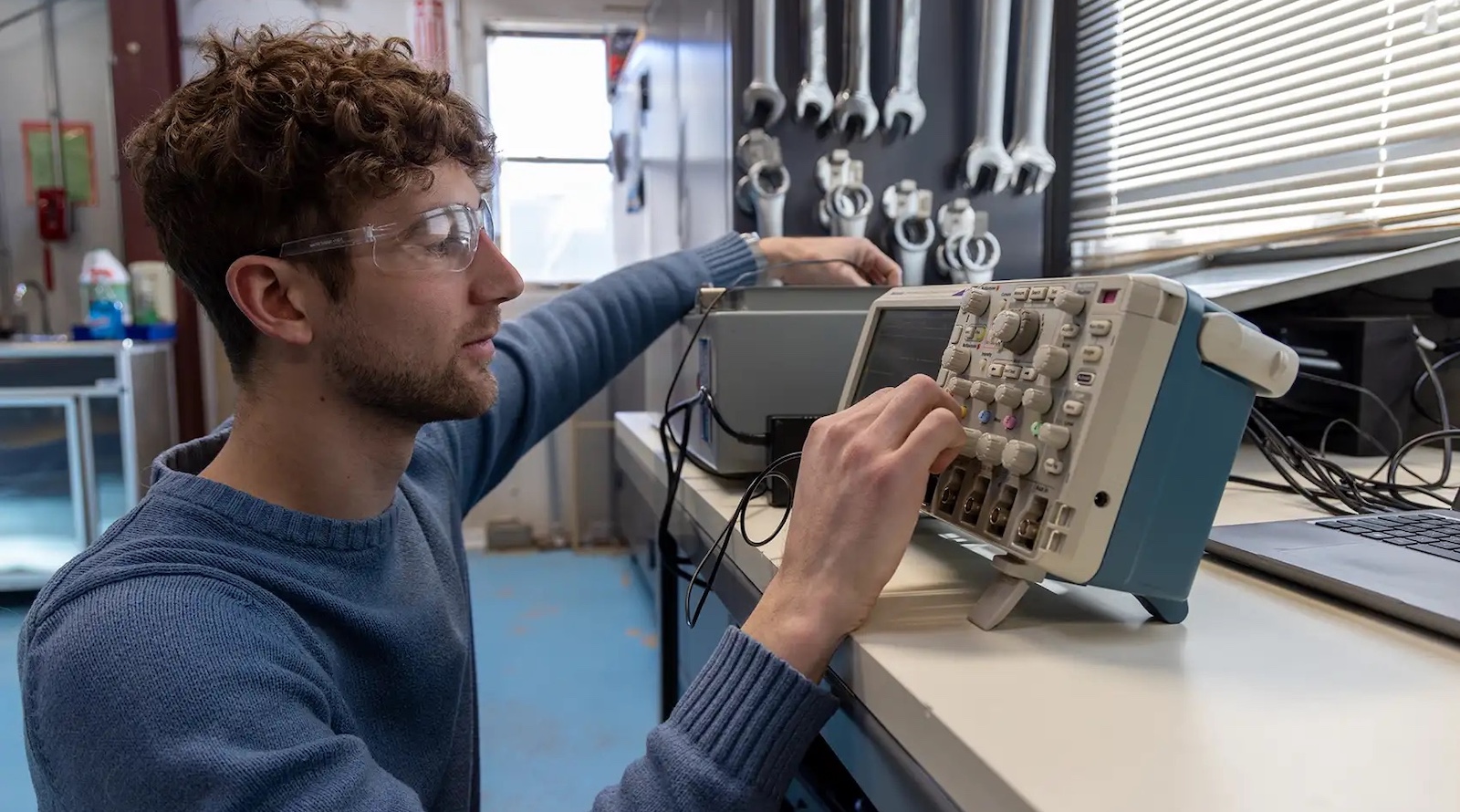
National Laboratory of the Rockies (NLR) researcher Alec Schnabel tests the custom-built charge controller in the Water Power Instrumentation Laboratory on NLR's Flatirons Campus. Photo by Taylor Mankle, National Laboratory of the Rockies.
Support CleanTechnica's work through a Substack subscription, on Patreon, or on Stripe. Help us produce all of the high-quality, original content we publish week after week despite the challenges of content-scraping AI, antisocial media, inflation, and other hurdles.
Latest HERO WEC Mission Status Update Examines How New Charge Controller Design Addresses Critical Challenge in Wave Energy Industry
Since 2024, researchers at the National Laboratory of the Rockies (NLR) have been improving the overall design of NLR’s hydraulic and electric reverse osmosis wave energy converter—or HERO WEC. Their work aims to fill vital data gaps that pave the way for more reliable and deployable wave energy technologies.
The HERO WEC, which is funded by the U.S. Department of Energy’s Hydropower and Hydrokinetic Office (H2O), uses energy from waves to desalinate seawater. The prototype can operate using either a hydraulic or an electrical configuration to pump seawater through an onshore reverse osmosis system to produce fresh drinking water. NLR researchers began designing the HERO WEC in 2020, and after hundreds of hours of testing across three in-lab programs and five ocean installations, the team is retiring version one (V1) and drawing on lessons learned to design version two (V2).