Somaia argues that the entire Western consensus, from export controls to the hyperscalers' hundreds-of-billions investment race to the "Compute Moat" investment thesis, rests on a single assumption: that computing power determines capability.
But scarcity has forced innovation. Moonshot AI's in-house Mooncake stack for AI training was built precisely because the startup didn't have enough GPUs, Somaia says. "A small lab with taste can compress the compute needed to make a frontier model, even if it can't afford to serve one."
Dylan Patel, founder of hardware analysis firm SemiAnalysis, agrees. "What they did with an extremely talented small team, strong research in RL, arch, data helps make up for lot of the compute deficit," he writes. But Patel also points out that Chinese companies can easily rent GPUs outside of China, which makes a portion of the export restrictions pointless.
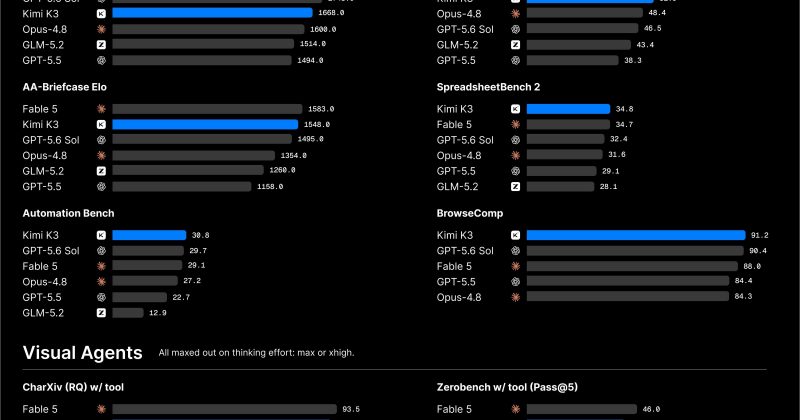
A Google Deepmind researcher calls Kimi K3 "insanely good"
Western AI labs often accuse Chinese companies of a form of data theft through distillation, where a smaller AI model learns from the output of a larger one and essentially free-rides, threatening Western AI labs' business models. Until now, distillation has been the go-to explanation for how Chinese labs stay competitive despite having less compute.