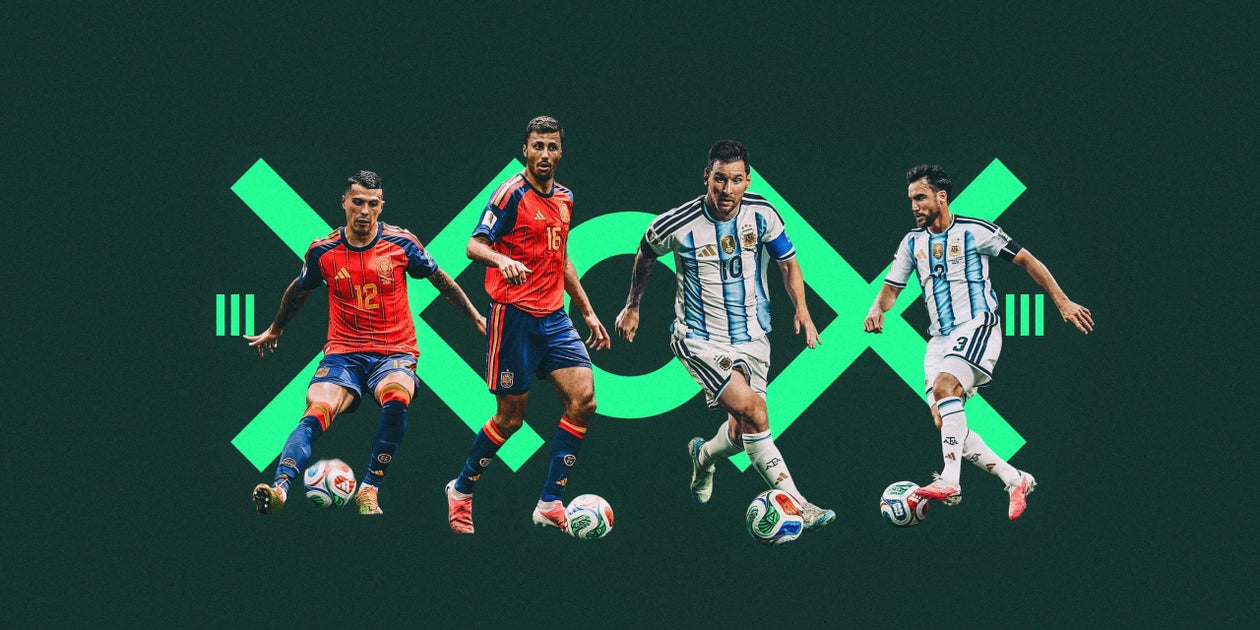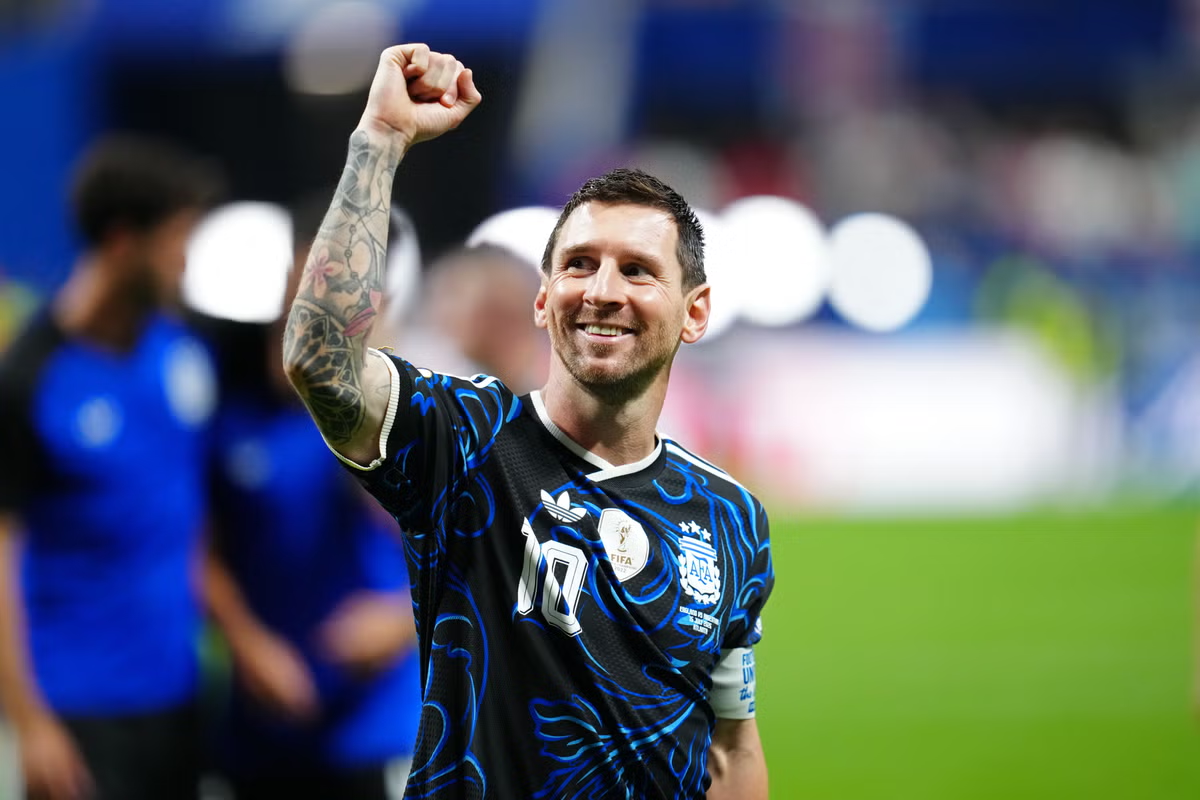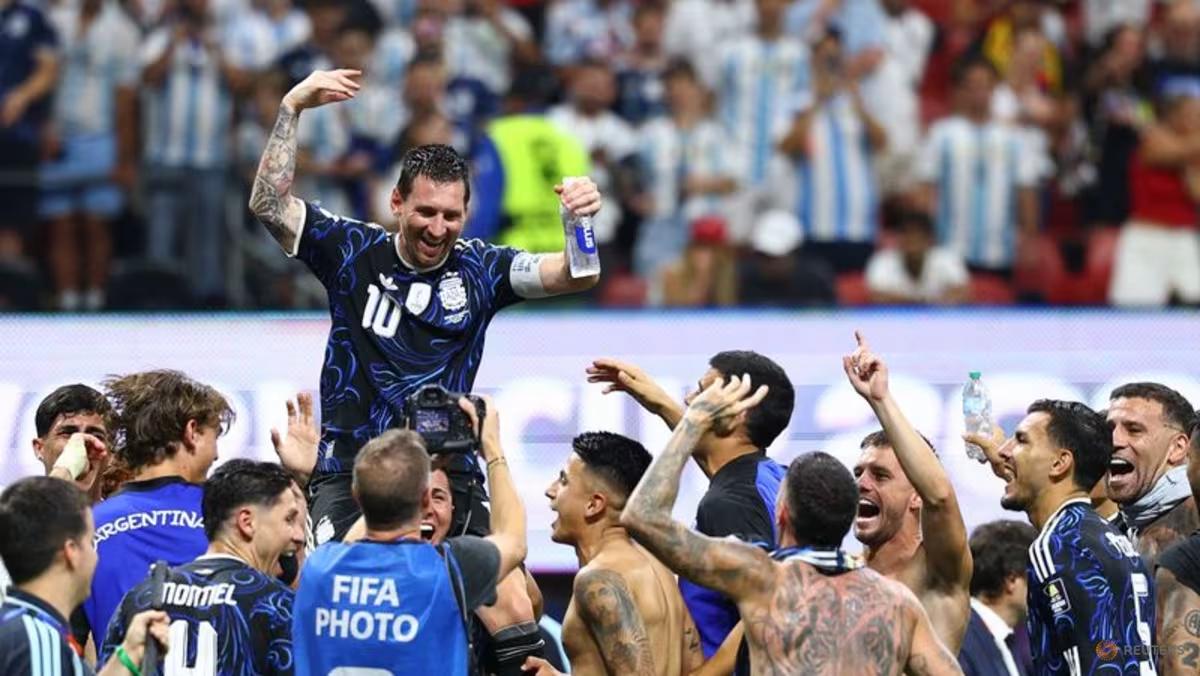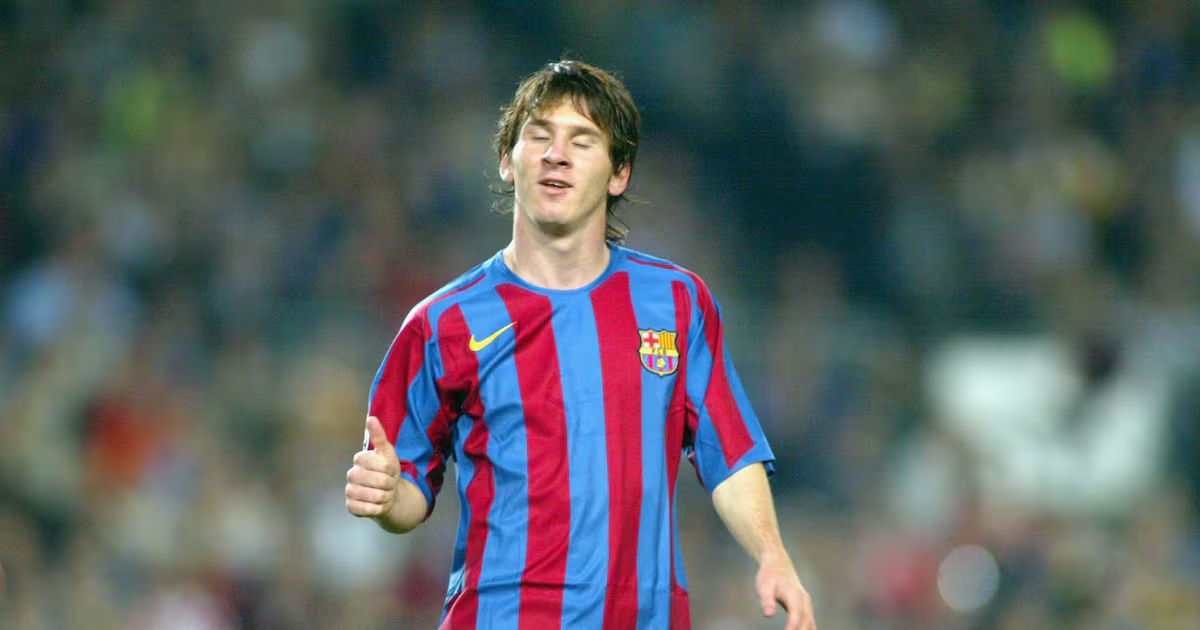
Football is the world’s game, but at the elite level it can only ever be a village where the living and dead gods intermingle. If Argentina has carried the shade of Diego Maradona on its quixotic adventure through the United States this summer, then the elegant silhouette of Johan Cruyff lingers over Sunday’s World Cup final. Luis de la Fuente, Spain’s manager, was once asked in one of those throwaway questionnaires which player he would choose as a transfer to his national team. He laughed as he selected Lionel Messi. But he was also asked to name the best player in history. Johan Cruyff, he replied.March 24th this year marked the 10th anniversary of the Dutchman’s death. In October 2015, Cruyff took part in a coaching conference in Berlin which turned out to be one of his final public football appearances. In his first question, he was asked about the observations made by the previous day’s guest, Thomas Tuchel.The young Dortmund coach, reviewing his time with the youth academies, said if he could do one thing differently it would be to make the conditions a bit more challenging and basic for the apprentices – training on poor pitches occasionally, less air conditioning in the changing rooms, a little bit of induced stress.“I think the same way because when we were young you could play on the street,” Cruyff said. “You can’t play on the street anymore. But a lot of time with small children, I was playing on the parking lot. What does that mean? It means that the surface is bad. When you fall down, it hurts. So, you try to learn not to fall down. For small players, they quickly understand that they have to be technically much better than the others.”The build-up to Sunday’s World Cup final will just about achieve a shift in focus from the firehose of criticism pointed at Tuchel for his decision-making and substitutions as England manager in that broiling closing 30 minutes of Wednesday night’s 2-1 defeat to Argentina. Tuchel could not be depicted in a more villainous light had he been unmasked as a long-term German psy-ops, created with the sole intention of sabotaging another generation of England players on the brink of returning Albion to the summer of 1966. Tuchel calmly accepted responsibility for the defeat because he is England’s manager and perhaps could not share his full reasoning for those controversial substitutions. But the clue may lie in the comments he made after the 2-1 quarter-final win against Norway.Nico O'Reilly and Dan Burn of England stand on the touch line with Thomas Tuchel during the Fifa World Cup 2026 semi-final match between England and Argentina. Photograph: Richard Pelham/Getty Images “The commitment is there but we made life very, very difficult for us in the way we played, how we played. Sloppy, tactical mistakes, not fast enough. Not repetitive enough. We were lucky enough. We will get better; we need to get better. Now it’s celebrations. Now it’s taking it all in. We need everything to make a better performance.”Nobody was in the mood to hear that sobering assessment, not least Jude Bellingham, England’s marauding midfield star. But Tuchel was watching the tournament and could see for himself the withering precision of Spain, the creative luxuries Didier Deschamps enjoyed with France and the unique challenge imposed by Argentina. He knew, to use a notorious political phrase, that he didn’t have the cards. How much better could he hope to make them in the few days between Norway and the semi-final? England’s nightmares began after they opened the scoring against Argentina in the 54th minute. Within 10 minutes, it was clear that the starting 11 were labouring under the enormous physical and emotional stress of playing their way through what had begun as a stress test imposed by a smaller Argentina team who knew they were technically better, and who had, in Messi, the genius curated by Spanish football. There is every chance that Tuchel’s Norway assessment applied when he surveyed his physically tiring and technically inferior England team. It wasn’t as though it didn’t occur to him that he could have sent in a Rashford or Saka to try and get England on the front foot. But maybe he envisaged those Argentinian packs chasing down those for-king-and-country runs. He decided to gamble by crowding the field with defenders in the hope that good old English courage would see them through.They were caught by a furious onslaught of wizardry conducted by the 39-year-old Messi and by Argentina’s obvious belief that they are being guided through this summer by higher powers. But had England somehow stumbled through – had Argentina, say, hit the crossbar and post five times instead of two – then they would have had to contend with an even more frightening prospect in Spain on Sunday.A few years ago, Rodri, Spain’s captain on Sunday and the resident Manchester City midfield linchpin since 2019, sat down with Gary Lineker to discuss his life and football in general. By then, he had become just the second Spanish player to win the Ballon d’Or, after Luis Suarez in 1960. At one stage, Lineker asked him why Spain produces so many exceptional midfielders.“I think it’s because of the basis- the way you start growing and how they teach you football,” he replied.“They teach you that it is collective and the ball goes faster when you pass it than run with it. It is a culture. If you go to Italy maybe they defend better, if you go to England maybe they do more power, strength.”Kylian Mbappé of France after the 0-2 loss as Rodri of Spain celebrates during the Fifa World Cup 2026 semi-final match between France and Spain. Photograph: David Ramos/Getty Images Intrigued, the English host asked Rodri how early in his career this teaching had started.“We always started with boxes; we start with possessions. I don’t remember doing much stuff in the gym. They preferred the team doing good rather than, ‘oh, that player is unbelievable’.”Rodri has made nuanced variations on that same sentiment throughout the tournament. If you listen to the Spanish press conferences, “technical” (or technique) and “collective” are among the words that both the captain and De la Fuente emphasise most often. Here’s Rodri reflecting on the precise, almost indifferent methodology through which the Spanish team dismantled France’s attacking machine.“Collective. Collective effort of everyone. I think Spain have being growing around the World Cup and today we did our best performance so far. I mean, what a team we faced, with all the strength they have in all the lines and they can punish you in every single moment. So I think the focus in every single moment was key. Unbelievable effort from everyone- I cannot say a player- it was an unbelievable effort from everyone that played and the guys from the bench always raising the level.”[ Why Catalans and Basques will be watching the World Cup final out of the corner of their eyeOpens in new window ]In that Berlin conference, Cruyff reflected on the changes he implemented when he returned to Barcelona as a coach in 1988.“I think the biggest problem was confidence in yourself. I think what we changed there was the confidence of the players, of the people.”Cruyff’s transformative influence, his emphasis on youth team culture, his development of Pep Guardiola as a protege and his implementation of a system that remains the blueprint for the Barcelona and Spanish game has been well-chronicled. Barcelona acquired 13-year-old Lionel Messi in 2000 after a snap decision by Carlos Rexach, Cruyff’s teammate in the 1970s iteration at Barca and his assistant when the Dutchman assembled the peerless team of the early 1990s.“I was in Argentina when I heard about a kid named Messi, and I was surprised that they were referring to a 12-year-old boy. At first, I thought they were talking about an 18-year-old. Since I was already there, I figured I would go take a look at him, and yes, of course he surprised me,” Rexach told ESPN for an oral history on Messi’s early years in Spain.Lionel Messi during the Uefa Champions League Group C match between Barcelona and Panathinaikos in November 2005. Photograph: Luis Bagu/Getty Images “He was physically very small, but I could tell he had an uncommon ability, a special instinct. Once in Barcelona I decided to sign him on a paper napkin that a waiter gave me because I couldn’t let him get away. His father felt that things were not all too clear and told me they would leave. It was then I decided on the fly.”Early recollections reflect a general sentiment that although they knew Messi was something unique in his formative Barcelona seasons, they had no inkling of what would happen over the next 20 years. Meanwhile, Barcelona’s midfield trio of Xavi, Iniesta and Busquets would provide the engine of the Spanish team that swept aside decades of serial underachievement and national disappointment by winning Euro 2008, the 2010 World Cup and Euro 2012.There’s a wonderful clip of Cruyff advising a delighted Xavi of the loneliness of coaching, and of the temperament it requires.“The coach is a guy who is out there alone. He has everyone in his favour or against him depending on his capacity to win or lose. But you are the one making the decisions based on your knowledge of the game. The only way to survive is if you can tell the club’s president to f**k off. You need to have the strength to say, this guy, according to you, is the best player. But I am not convinced by him, so I’m leaving him out. No, it’s quite unpleasant. It can be a painful experience.”[ Argentinians in Dublin: We have a ‘special’ relationship with England tooOpens in new window ]There are three acts to Lionel Messi’s career with Argentina. First came the crushing expectation and the national judgment following defeat in the World Cup final of 2014 and successive Copa America final defeats, on penalties, to Chile. Then, his announcement that he was done with international football. Lionel Scaloni coaxed him back and has built around Messi a support team of elite support players: a collective designed to allow the individual genius to flourish through technical ability and a fatalistic nationalist fervour. “For this shirt, win or die,” the chant goes. Scaloni, Argentina’s manager, was a student of De la Fuente’s at the Royal Spanish Football Federation in 2017. Messi arrived at Barcelona in 2000. Cruyff had already left four seasons earlier. But 15 years into his Barca career, Messi had this to say after Cruyff’s death.“Mostly all that Barcelona has been living in the last few years is because of him. A person that changed the heads- the way of thinking in the Barcelona football world.”Fans unveil a mosaic tribute to the former Barcelona player and manager Johan Cruyff before the La Liga match between Barcelona and Real Madrid at Camp Nou in April 2016. Photograph: Paul Gilham/Getty Images In some ways, this historic World Cup final between two countries with richly defined football identities has been decades in the making. It pits the ultimate expression of the Spanish collective against the most extravagant talent to emerge from its football culture: the virtuoso who inspires those around him to play above themselves.The surging force of those traditions and the years of deliberate, careful cultivation surely contributed to Tuchel’s bleak attempt to keep England safe through siege-mentality defence in those fraught closing minutes when football, pure football, was rushing in like the tide.“You have to be convinced,” Cruyff said at that conference at which Tuchel was a fellow speaker 11 long years ago. “You’ve got to convince the people. The best work of a coach is: his eyes.”World Cup Wallchart
Spain v Argentina: Johan Cruyff’s legacy clear as the nation that shaped Messi faces its masterpiece
The World Cup final pits the Spanish collective against the most extravagant talent to emerge from its football culture
1,969 words~9 min read