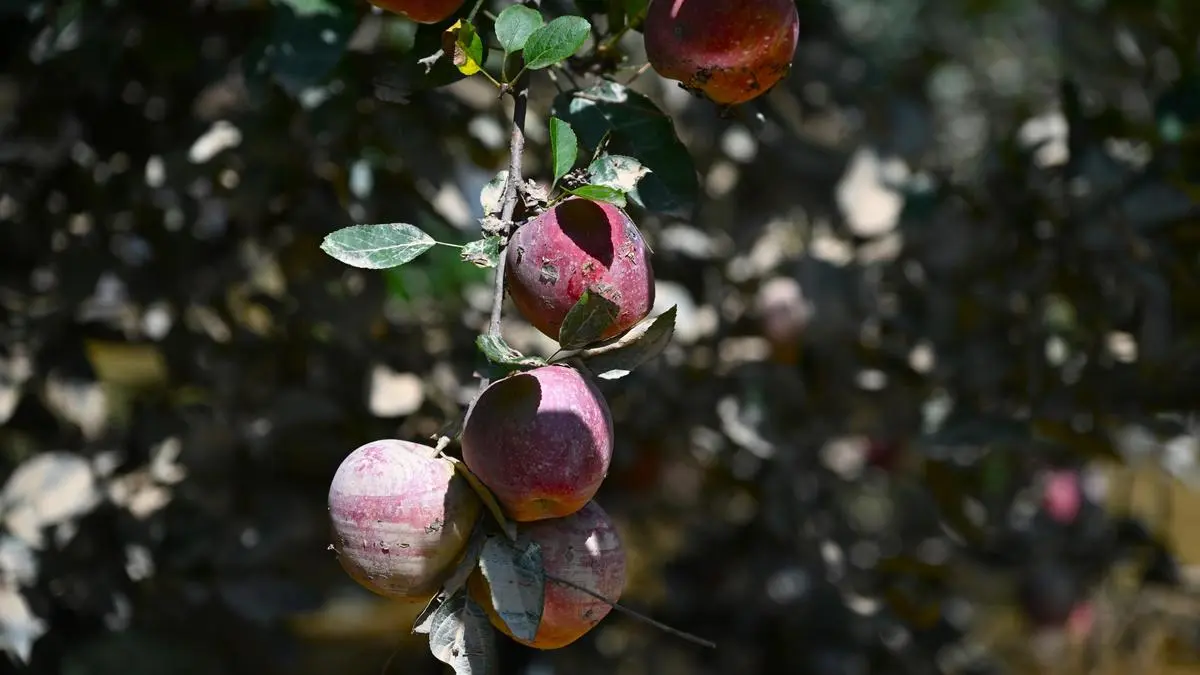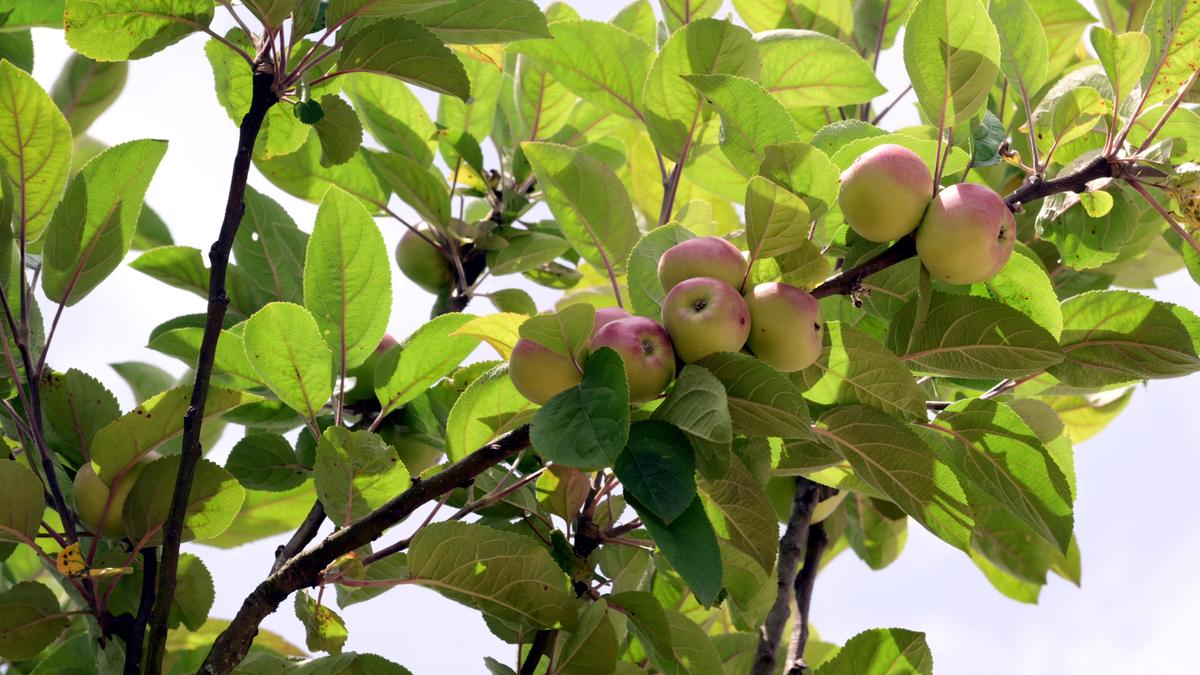
Apples ready for harvest at a farm in Kavunji village in Kodaikanal hills.,
| Photo Credit: KARTHIKEYAN G
In 2014, a group of farmers from Kodaikanal returned from Kashmir with the kernel of a dream and a hope to transform the rich valleys of Kodaikanal hills into flourishing apple orchards.In 2026, two of the farmers nurtured about six apple trees that are now resplendent with soft luscious pink fruits.This exposure visit, organised by R. Murthy, a farmer, former member of the National Horticulture Board in coordination with the Indian Council of Agricultural Research (ICAR), was conducted at the Central Institute of Temperate Horticulture (CITH) in Srinagar. “We came back with saffron bulbs and also apple saplings. The apple saplings flourished in this climate. Now, as we see these trees bearing fruits year after year, we can with certainty say that high-chill varieties of apples can grow in the high-altitude villages of Kavunji and Poondi,” Mr Murthy says.Another farmer, Mr Murugan, who was also there on the trip, now proudly shows two apple trees heavily laden with fruits. “At a time when farmers are leaving agriculture due to problems like lower number of workers and invasion of wild boars, shifting to growing fruits can mitigate some of the issues and also protect the farm lands,” he argues.Mr. Murthy sees an imperative need to have a horticulture ministry. He argues that States like Uttar Pradesh, Madhya Pradesh, Maharashtra and Karnataka have separate horticulture ministries. “In the Western Ghats like Kodaikanal where exotic fruits, like apples, rambutan and avocados can be cultivated, there is a need to have special focus on creating awareness among landholders so that the crops they raise can bring them higher revenue and value addition can bring in more income to other stakeholders,” he points out.Marketing strategies differ for horticulture crops when compared to marketing of traditional foodgrains. Horticulture products need specific infrastructure like cold storage, refrigerated transport etc. to keep alive the supply chain. As these products unlock export opportunities, a more vibrant and focused ministry can help farmers in Kodaikanal, the farmers say.The Horticultural and Forestry Research Station under TNAU in Kodaikanal has successfully propagated low-chill varieties like Kodaikanal-1 apple, a selection from Parlin’s Beauty and Tropical Beauty. These varieties are now growing in orchards in Kanthalloor in the Munnar belt.Former Dean J. Rajangam of Horticultural College and Research Institute, Periyakulam, states that these varieties grow well in frost conditions and thrive in 600 to 800 chilling hours a year that Kodaikanal hills experience. “In order to get sustained yield on an annual basis, we are propagating these varieties using MM106 as a rootstock under the whip and tongue grafting method. MM106 rootstock is also resistant to the woolly aphid pest that is prevalent in Kodaikanal hills,” he adds.Now, these farmers hope that the new government in the agriculture budget will show a renewed focus on growing and marketing exotic fruit varieties from Kodaikanal. “Awareness among various stakeholders and financial impetus from the government can help retain farming activities in this fertile belt,” says Mr. Murthy. Published - July 17, 2026 07:24 pm IST