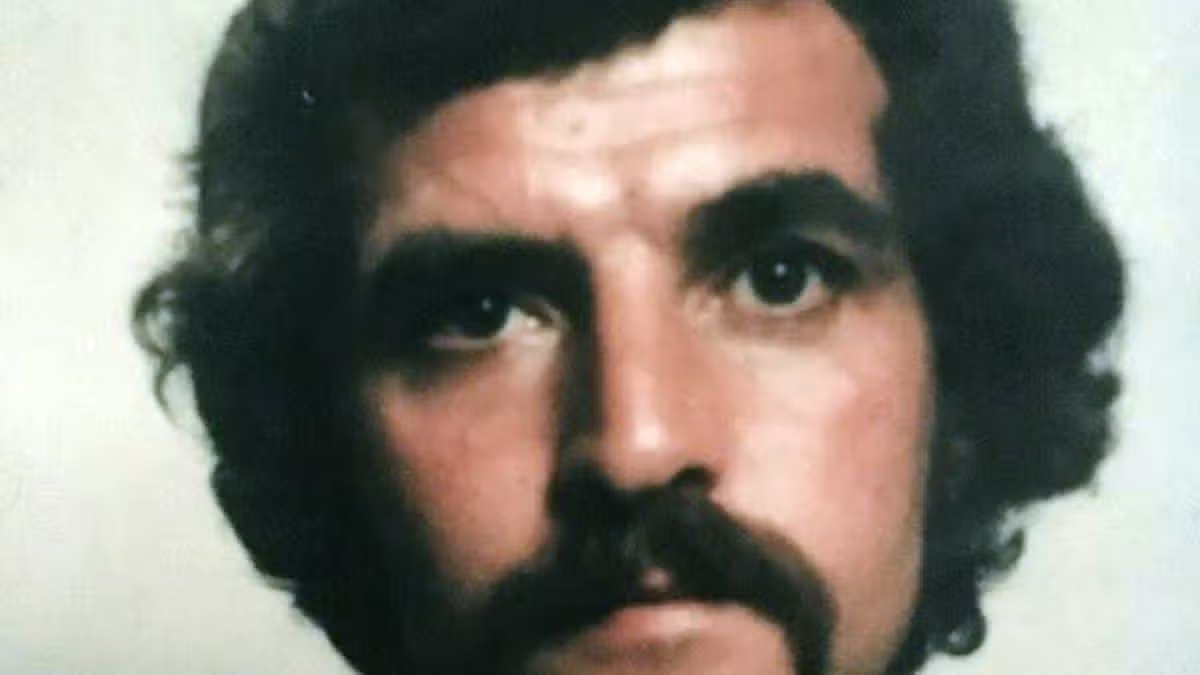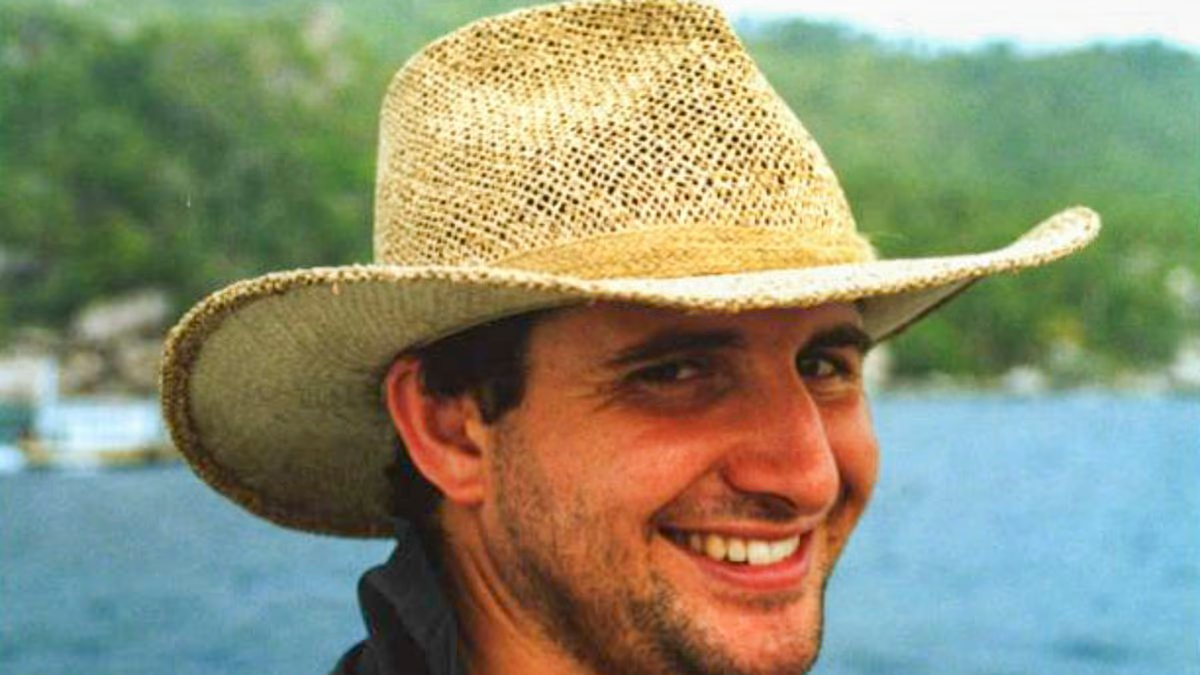
Few would blame John ap Rhys Pryce if he spent his retirement consumed by bitterness after the horrific murder of his son Tom, who was stabbed to death on the streets of London months before his wedding day.Tom, a 31-year-old Cambridge graduate and high-flying lawyer, was senselessly murdered by serial muggers Donnel Carty, 18, and Delano Brown, 17, as they preyed on commuters on the Underground for cash and mobile phones.The pair made off with the pitiful haul of £20, an Oyster Card and a mobile phone. Heartbreakingly, left behind was a blood-stained note in Tom's pocket with the wedding vows he planned to read out to his fiancée, Adele Eastman.It begs the question: how does a parent suffer the loss of a child to such senseless violence and not feel hatred towards the killers? How can a prison sentence ever be enough?Speaking to The Crime Desk in a moving interview in his village home in Surrey, twenty years after his son's murder, Mr Pryce says: 'If you hold that anger in you, it doesn't do you any good, really.'My main emotion I suppose is sadness – sadness for Tom. Sadness for them - they've wasted 20 years of their lives.' Pictured: Tom ap Rhys Pryce with his fiancee Adele Eastman on New Year's Eve 2005 Serial muggers Donnel Carty (left), 19, and Delano Brown (right), 18, were jailed for life for Tom's murder in 2006 Tom's father John ap Rhys Pryce spoke to The Crime Desk from his home in Surrey twenty years after his son's deathCarty was sentenced to life with a minimum 21-year term and Brown, 17, to 20 years for Tom's murder.Last month Brown was recommended for transfer to an open prison and remarkably Mr Pryce, a former civil engineer, now says he's prepared to do what most people would assume unthinkable – sit down in the same room with him.The devout Christian believes the conversation could 'clear the air' after two decades of heartache.But what do you say to the two men who took your son's life and still have theirs to look forward to?'I suppose, 'Why?'. I'm sure they've had a lot of time to think about it', he says.'It depends on what they've done with themselves, whether they've used the time to learn, educate or get a trade. There are lots of things you can do.'I don't remember too much about their home lives, but I don't think they were very good.'Unknown to Tom's loved ones, Carty and Brown were part of 'steaming' gang, The Kensal Green Tribe, who were attacking commuters on the Tube when they encountered him.Having run away from the scene, 20 minutes later Carty spotted Tom walking down the road and whistled to his accomplice. It signalled Brown to join the attack on the lawyer who was making his way home after a night out with colleagues. He was knocked to the ground and kicked in the face.His family believe proud Tom would have fought back, which led to violence escalating and the lawyer being stabbed in the heart, just a short distance from the flat he shared with Ms Eastman.Mr Pryce and late wife Estella's elder son Michael, then a Thames Valley Police detective, tearfully broke the news to his parents that Tom had been stabbed twice in the chest as he made his way home. Tom was murdered for £20 in cash, an Oyster card and his mobile phone. Tragically, police later found his wedding vows on a bloodstained note in his pocket Tom, pictured as a young man with his father, played violin, piano and saxophone, spoke five languages, travelled the world and gained a first-class degree in classics at Cambridge Tom is believed to have fought back against his muggers but died in hospital from two stab wounds to the chestMichael, who arrived at their house about 3am, had been called by a colleague but had few details at that stage. The family raced to Central Middlesex Hospital, arriving just before the murder squad but shortly after Tom had been pronounced dead.Mr Pryce said 'They didn't know what to do with us, really. We were completely stunned and shocked by the whole thing.'Retired detective inspector Tony Bishop was a case officer in Tom's murder investigation and can still recall the moment Ms Eastman was delivered the horrifying news about her fiancee.He tells The Crime Desk: 'The violence used was so unnecessary to steal next to nothing.'The lives of his fiancée and family were absolutely shattered by this event.'You can't imagine that set of circumstances. One minute Adele Eastman was sat at home, cooking supper and talking to her mother, probably about the wedding, and then that's it.'Close to tears, Mr Pryce recalls events leading up to his son's murder: 'Tom was extraordinarily bright. He was very enthusiastic about everything – lots of optimism, lots of go. Tom was very sociable.'The silly thing was they'd been working late. I don't know what the project was, but anyway, they got to a point where they were having a bit of a celebration, so they all went down to the pub. Part of the deal with Linklaters [Tom's legal firm] is that if you have worked late, which they had, they will pay you for a taxi home.'But because Tom had done this commute every day, he didn't bother to take the taxi, so he just took the normal Tube to Kensal Green and was walking home. It's only 200 or 300 yards from the station to his flat.'We'll never know exactly what happened, but there was obviously some sort of altercation and an argument, and they perhaps didn't believe him [that he had nothing on him]. I don't know.'And then he started trying to run back to his flat, and they chased him. That was that. Completely senseless.'Detectives soon arrested the killers after the pair used Tom and Mr Ali's mobiles to ring their girlfriends later that night.Through a trust in Tom's memory, Mr Pryce is dedicating his life to finding out how his son, Carty and Brown – who lived streets from each other – could have turned out so vastly different. Metropolitan Police issued CCTV images of Tom (left) at Kensal Green Train Station shortly before he was attacked near his home on January 12, 2006 John described his son's murder as 'completely senseless' but said he does not hate Carty and Brown. Pictured, father and son together on holiday Tom was murdered just a short walk from the home he shared with his then fiancee Ms Eastman. Pictured, floral tributes are left at the sceneAs the trial heard, Tom had 'all that is best in life just ahead of him', a wedding in Italy in September of that year and a career due to his hard work and ability to excel at everything he did.As a teenager, Tom had won a music and academic scholarship to Marlborough College. The gifted young man played violin, piano and saxophone, spoke five languages, travelled the world and gained a first-class degree in classics at Cambridge.Meanwhile, his greedy killers treated him as a 'means to an end'.Unlike a lot of gang thugs, Carty and Brown both grew up in homes with strong father figures whose attempts to play a formative role keeping them on the straight and narrow were rejected.Raised as a churchgoer, Carty went to live with his grandparents in Kensal Green because, ironically, he regarded his father Gerald Carty as too much of a disciplinarian. His mother, Barbara Smith, was a community care worker.Increasingly, the teenager spent time with an uncle who had a string of criminal convictions - two cousins are now serving separate life sentences for murder.Brown and two sisters were brought up by his mother Maureen Leo, a cook for the Metropolitan Police. His builder father, Wayne, still owns a string of properties in London and Florida and even had plans for his son to work with him in the United States.According to a summary of the Parole Board decision to transfer Brown to an open prison, he had made progress by undertaking jail programmes to address aggression, decision making and victim awareness. He still had the support of certain family members, it said.'Mr Brown had been willing to resort to violence and use weapons,' the author said of Brown's teenage years.'He could act on the spur of the moment without thinking adequately about the consequences. He had experienced significant trauma in his own life and struggled to cope with his emotions. 'There were problems in his relationships. He did not have anywhere suitable to live, he did not have enough money and he did not have constructive activities to structure his day. He also struggled to trust and open up to professionals.' Tom, 31, had 'all that is best in life just ahead of him', including his wedding in Italy, his murder trial heard A court sketch of Donnel Carty and Delano Brown embracing after they had been found guilty of the murder of Tom ap Rhys Pryce at the Old Bailey Tom’s Farm opened at in 2009 and is helping boys with behavioural, emotional and social difficulties. Pictured, Tom's parents John and Estella visit Tom's farmHowever, the report says in Brown's case 'having a job and his good work ethic' might be protective factors to reduce the risk of reoffending. The panel concluded 'at this point' it was not satisfied his full release 'would be safe for the protection of the public', but there is to be another parole review in due course.In the two decades that have followed his murder, The Tom ap Rhys Pryce Memorial Trust has invested £2.4 million in projects to steer other underprivileged youngsters away from gang culture and violent street crime.Tom's charity, which is supported by law firm Linklaters where he worked, teamed up with St Giles Trust in Camberwell which uses ex-offenders to speak to at-risk schoolchildren and those who have been excluded.Today the trust supports more than 25 grassroots organisations across London from Camden to Croydon and Brixton to Bermondsey, changing the lives of thousands of young people through mentoring, youth clubs, boxing, football, rehabilitation, employment opportunities and training. From donations and investments, grants totalling about £150,000 are given out annually.The trust also opened Tom’s Farm in 2009 and is helping boys with behavioural, emotional and social difficulties. The hope is by getting close to the animals, children from deprived backgrounds might learn empathy.At Mr Pryce's side for most of his crusade was beloved wife Estella, who shared his immense empathy for those in difficulty or deprived, until she died of ovarian cancer aged 75, in 2018.He now lives in a nearby village with son Michael, 54, and a Ukrainian refugee who moved into the detached property he charmingly calls a 'bachelor pad'.Ms Eastman, a senior counsel at the King's solicitors Farrer & Co, has since married.Mr Pryce remembers how outraged the public were after Tom's murder. 'It wasn't like a school spat or something like that, you know, a lot of the stabbings that you hear about now, warfare between rival gangs on the streets and that sort of thing.'It was just literally a mugging that went wrong, and I think that was what was shocking about it.'Mr Pryce aims to carry on the trust for another five years, with a particular emphasis on primary schoolchildren. Twenty-five years in total would reflect what might have been Tom's career in the legal world.'It means his life wasn't in vain and it keeps his memory alive,' he says. 'We felt the reason for the tragedy was the fact that these two young men really hadn't been taught the right way of doing things and hadn't got anything else to do. 'They were caught up in 'steaming' gangs and it was just unfortunate Tom was in the wrong place at the wrong time.'If we can help disadvantaged children to achieve their potential and to lead rewarding lives, that will be a fitting legacy for Tom.'For further information on the Tom ap Rhys Pryce Memorial Trust, visit tomaprhyspryce.com
My son was stabbed to death with his wedding vows in his pocket
Few would blame John ap Rhys Pryce if he spent his retirement consumed by bitterness after the murder of his son Tom, who was stabbed to death on the streets of London months before his wedding day.
2,012 words~9 min read