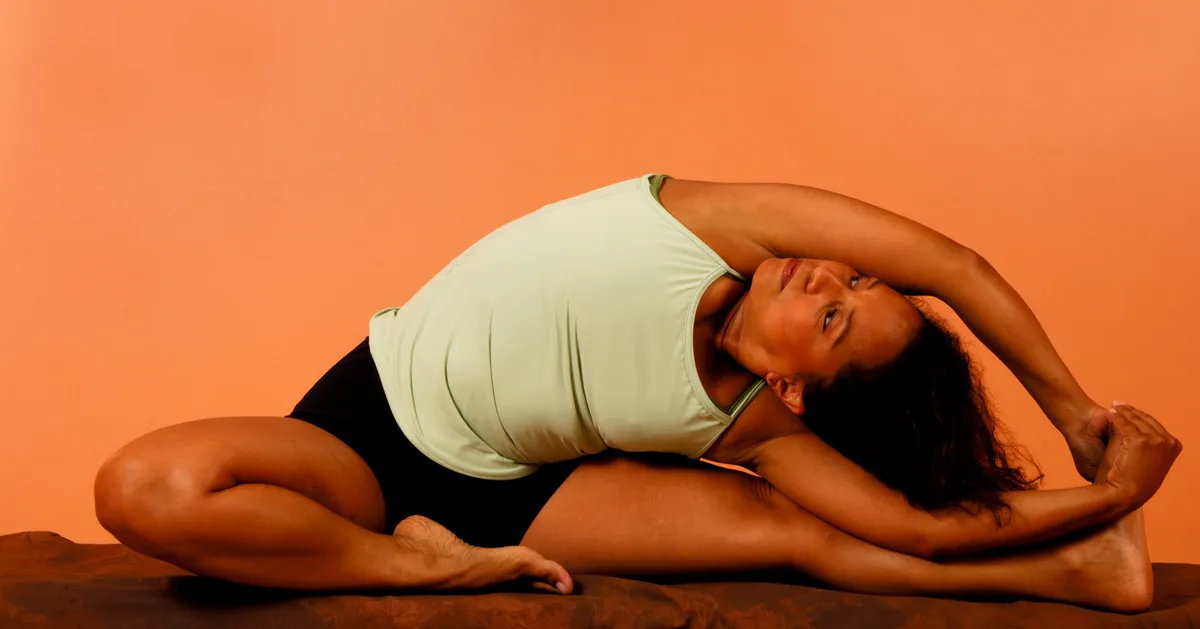
Every Tuesday in New Orleans, I lead Somatic Flow, which is a yoga-adjacent mindful movement practice. I’ve been a yoga teacher for decades, but this particular moment in America feels like it needs more rigor than what white-girl yoga generally has on offer. So, we do sun salutations, but we also sigh, shake and scream. Most of us are queer. One of my regular students calls it “rage relief class,” because most of us walk in the door fuming over the state of the world, but when we leave, we sleep like little gay babies.I am a somatic movement teacher who happens to be queer, but that’s not a coincidence. Queer and trans people have been spreading the nervous system regulation gospel since long before it became a wellness industrial complex trend. No shade to the cis-hets, but we definitely scooped you on this one.For us, the body has always been political. “Ball culture, AIDS caregiving networks, queer bars and other social spaces, and houses and chosen families were all created in response to trauma and oppression,” says Kevin Nadal, a professor of psychology at CUNY and author of “Queer Psychology: Intersection Perspectives,” widely taught in university psychology programs. These informal support systems offered the type of belonging, validation and support that queer people could not receive from their families of origin, Nadal explains.AIDS Coalition to Unleash Power, aka ACT UP — the AIDS activist group that turned grief into direct action — used bodies as the argument in its fight for healthcare, staging elaborate mass “die-ins” at airports, at the FDA headquarters, on the White House lawn. New York ballroom culture vogued us into visibility and sometimes even acceptability. AIDS caregiving networks made touch into a form of resistance and pleaded the case for co-regulation as healthcare. Our communities designed these systems of expressing autonomy, care and resistance because we know, and have always known, that the state was not taking care of us.“Somatic practices have been around as long as humans have been around,” says Rae Johnson, a professor of somatic psychology at the California Institute of Integral Studies.Indigenous people have been using what we would now call somatic techniques long before we wrote them down. “Somatics is about really listening to the subjective internal information and knowledge that’s available,” they explain — and that impulse, they argue, is as old as human suffering itself.“The roots of embodiment stretch far beyond the somatic canon,” says Prentis Hemphill, founder of training and research organization The Embodiment Institute and author of “What It Takes to Heal.”“There is a huge wealth of scholarship and practice that comes out of movements that opposed authoritarian governments in the last century,” Hemphill says. When there have been crackdowns on queerness, they explain, people have grappled with what it means to have a body, the body’s relationship to the state and how the body becomes free or pursues freedom."There is a huge wealth of scholarship and practice that comes out of movements that opposed authoritarian governments in the last century," says Prentis Hemphill.Photo: Ociele HawkinsIn other words, the pursuit of liberation as a physical, embodied reality has always been necessary for queer people because our bodies have always been the site of authoritarian obsession and oppression and because we have rarely been able to rely on institutions or traditional family structures to keep us safe. Nor can we now.Our oppression has made us into extremely skillful somatic teachers and practitioners. “Folks with marginalized identities are put in a position where, in order to know who they are, they have to go looking,” Johnson says. “For queer folks, the act of having to investigate and articulate how we’re different requires us to go on an exploration of ourselves that most people never do because they don’t have to.”Queer and trans people do not have the luxury of having our identities validated by the status quo. That forces us to inquire within — to find out who we are and to learn to trust knowledge that comes from the inside. Or, as Hemphill puts it, “queerness offers, or invites, us to trust what is emerging from our own bodies, even as it is disruptive to social norms... It [queerness] is a deep trust of what I feel in me and what and who I know myself to be.”We do not keep this hard-earned wisdom to ourselves. Yes, we experience pain at the hands of the status quo, and we also know the pain of trying to be status quo. “Members of marginalized groups understand members of the dominant group way better than vice-versa — and sometimes way better than members of the dominant group understand themselves,” says Johnson. And so many of us become teachers, healers, facilitators and organizers who recognize that change must happen for all of us, that the body is the first site of transformation and that transformation begins with healing.Healing, though, in somatic practice, is not simply a personal journey. “Healing can also happen through community, collective action, cultural connection, storytelling, collective joy,” says Nadal. Somatic healing, then, is social. And it is not a productivity hack or a self-help strategy designed simply to allow you to survive oppression. “The goal of any treatment should not be to just help people adjust to an oppressive world; instead, it should be a goal to also build conditions where that oppressive world causes less harm in the first place,” says Nadal.Which is why the commodification of these practices is not just annoying — it’s a betrayal. “We’ve decontextualized somatic work so much that we haven’t always understood that the roots of even what we call somatics now... stretch into culture and communal technologies, ways of knowing,” says Hemphill. The branded marketing of somatic knowledge as personal optimization is classic gaslighting. “Telling someone that they ‘just need to regulate their nervous system’ or ‘just need better coping skills’... could be labeled as participating in a form of gaslighting,” Nadal says. This marketing nonsense is just another attempt to scam you into feeling like everything bad you feel is really all your fault and if you just sign up for this webinar, you will be skinny and rich, as MAGA intended.The antidote is not a better wellness product. It’s each other.Shaking and sighing in queer community gives us practice in exactly what Hemphill says we need most right now: to “trust more quickly, repair more quickly, reach for each other, even when we have a kind of discomfort inside of us.” This builds trust on a cellular level. If we can be authentically embodied together, we can remake the world.What is embodiment, then — isn’t having a body enough? Not if you’ve never been allowed to inhabit it fully. “Embodiment is conviction,” says Hemphill. “Embodiment is congruence, not in a perfectionist sense, but more or less, it’s like being more of yourself more often... those create dynamics between us that, to me, keep the world intact. It’s like the invisible architecture of the world is all of this training that we’ve internalized,” they explain.It is in our bodies, in our embodiment, that we create culture and systems and relations and, well, everything. If each of us has the capacity and skill to be more fully embodied, with greater authenticity, it strengthens the web of interconnectivity that’s holding this whole world together. Literally. In a world that is constantly pressing against us too closely with reminders to dissociate and get back to work and notifications that everything is exploding, we are going to have to learn to resist by relearning how to be together in our real, imperfect, delightfully needy and preposterously generous mammalian bodies. Or, as Hemphill says, “some things have to be felt together, especially in a time of compounding crises. It will be too much to bear in isolation.”Together, we can feel our way through this. RelatedLGBTQQueer VoicesWellness
I'm a Queer Somatics Teacher. Our Community Has Been Doing This Work for Decades.
Shaking and sighing in queer community gives us exactly we need most right now: to trust, repair and reach for each other.
1,313 words~6 min read