Dear readers, some years ago, I went on a business trip to Switzerland with a colleague. Which sounds very fancy, no doubt. Oh, look at Sidin, flaunting his flashy international lifestyle while I am stuck in traffic, it has been raining non-stop for three days, I am trying to distract myself by reading this newspaper, and this rascal is talking about his trip to Geneva.Please be patient. There will be further reasons to take things personally as you read this column. Hold your ire, I beg you.So, we were in Geneva. This was sometime in 2011-12. Due to various logistical reasons, my colleague and I were travelling separately. I arrived in Geneva, and then at the hotel, only to discover that my colleague had booked both of us into a single room.
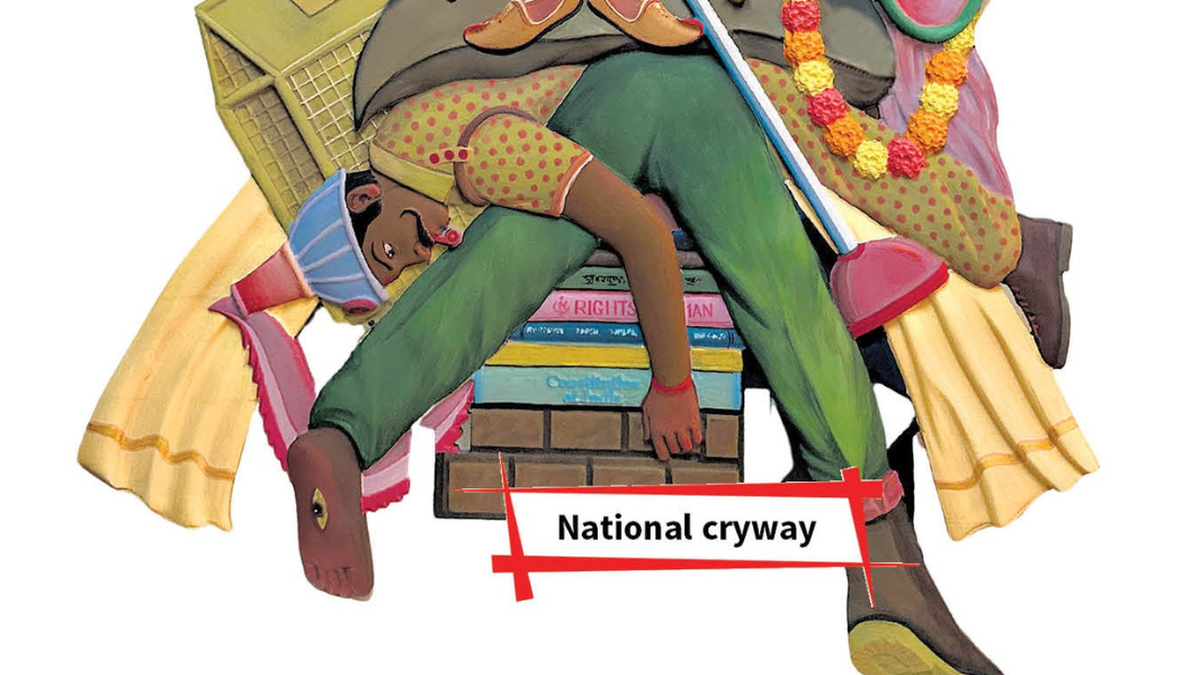
‘Carrier Extension-I’ (2024) by Yogesh Ramkrishna.
| Photo Credit:
Latitude 28
What nonsense, I said. Surely the company was paying for two rooms? Yes, he said. But this way, we could save money on the expenses, and have more left for shopping, food, beverages, and other such jollies.Which was fine. But there was just one problem, dear readers. The hotel had allocated a room for us that was usually allocated to couples. By which, I mean adults engaged in some sort of romantic relationship. And one feature of this was the fact that the bathing cubicle did not have walls. Instead, it was surrounded on three sides by frosted glass panels. If any one person was using the shower, the other would be subjected to fuzzy but still very lifelike silhouette of the showering individual.My colleague and I were friends. But not that friendly. We immediately agreed to vacate the room when the other person was partaking of the facilities.To this day, the memory sends a shiver up and down my spine.Anyway. The next morning, we went down to the dining room for breakfast. And were immediately surrounded by a very large, and very boisterous, group of Indian tourists.The vast majority of these tourists was perfectly normal. The children, especially, were very well behaved. But there were two men who were really quite obnoxious. And it was clear that their co-travellers were quite embarrassed by their shenanigans.“Those two fellows are unbearable, no?” I said to my colleague.He nodded in agreement. “The Indian government should ban such people from travelling abroad. They just make all of us look bad.”And then we proceeded to have a pointed breakfast conversation about civic sense, public behaviour and decorum. And then as we got up to leave, one of the obnoxious men came over to our table.“Are you also from India,” he asked. Yes, we said. And then we made some polite small talk, shared tips on local tourist spots. And then it transpired that the man was from the exact same State in India as my colleague. They bonded briefly, but enthusiastically, and then the both of us ran to catch a tram for our business meetings.On the tram, I made a fatal mistake. I should have known better. But I erred. “That dude was so weird, no?” I told my colleague, assuming we both still agreed that he was obnoxious.“No! I think he was a good guy.”There was a soft thud as my jaw hit the floor of the Geneva tram. I quickly reeled it back in.“Sidin, we are too harsh on Indian tourists. Do we say the same when we see tourists from other countries? Of course not. I think it is a colonial mindset.”I never brought it up again. Until today. But only with you. Because in the years since then, I have discovered that there is a very thin opportunity to discuss Indian problems with other Indian people. That opportunity lies between two points of perception.Firstly, the problem should be perceived as a problem. Then, you can have a discussion. But then the problem should never be framed as a matter of identity or politics. Because the moment it turns into one of those, the discussion is over.So, for instance, you can say that roads in India are bad and full of potholes. But if you say that roads in Nairobi or Colombo are better? Finished. Immediately conversation will fall apart like a road in some other country, definitely not India.It is only in that tiny space between a problem being a problem, but a problem not being a political or identity problem, that we can actually discuss it without fisticuffs and absolute shenanigans.And I think it is time we came up with a term for this small gap. And that term is: national cryway.Example sentence: “Ajay and I were making excellent progress on the subject of airports, but the moment I mentioned that Naples airport was 15 Arab crore times better than Chennai, the national cryway was shut down with immediate effect.”What do you think, reader? Is this a problem only in India? OK, please calm down.The writer helps early stage companies communicate better. He blogs at www.whatay.com.