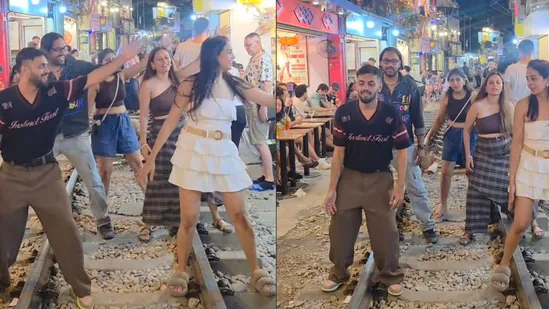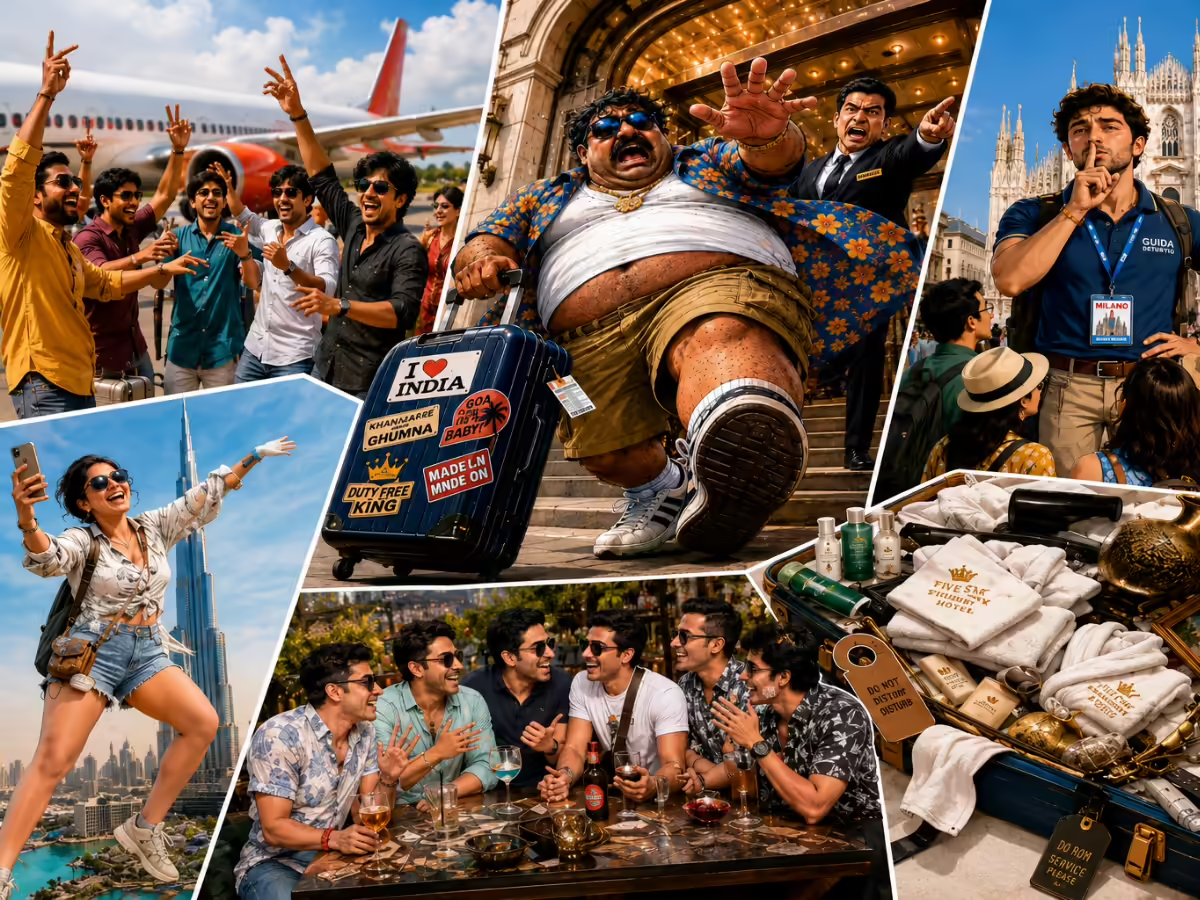
Given the recent spate of online derision against Indian tourists breaking into song and dance in public spaces in Europe, I thought I'd ask a friend who runs a travel agency whether the flak was justified. The most viral videos involve synchronised Gujarati steps on a Vietnamese airport tarmac, a Sydney train, Mt Titlis in Switzerland, and, oddly, at the statue of a fallen soldier commemorating WW2. The final one was for an Instagram reel, and its creator was almost deported for insensitivity.'Indian tour groups love the volume of sightseeing. It doesn't matter to them what they're seeing. They need a photo or video in front of something large in the background, or something that doesn't look like India, and they can rush on to the next thing,' he said. 'I am often asked, how many things are you showing us? The other operator promised 12 things in Greece. You are saying only 8. It's a volume game, not a quality game.'Naturally, it makes little sense to stereotype all Indian tourists based on a group of 20 drunken software engineers going wild to a Telugu hit song on a Pattaya beach. Likewise, Bollywood dance routines in front of European monuments are mild compared to those of South American football fans, who have been known to bring violence into rival countries, or wealthy Gulf visitors flaunting luxury cars, entourages, and conspicuous wealth. That said, one trait that does seem distinctly Indian is the emphasis on extracting the greatest possible value by seeing as many attractions as possible during a trip.I recently experienced this in Greece. In Athens, the Acropolis area is the main - and, some would argue, the only - concentrated district where many of the city's most significant ancient sites are located. Within a short walk are Socrates' Prison, the world's oldest surviving Byzantine church, Theatre of Dionysus - where Sophocles' Oedipus Rex was first staged in 5th c. BC - and Acropolis itself, crowned by Parthenon and often associated with the birth of democracy.In the middle of all this arrived a large Indian tour party, confused and disinterested in history. The tour guide announced, in Hindi, 'Yeh koi important jaga hoga, photo aur reel bana lo.' (This must be an important place. Take your photos and make your reels. )I had to ask him why, as tour guide, he wouldn't explain the history of this place, the birthplace of modern Western civilisation. He replied, 'I tried earlier. My clients are not interested. They want to dance in front of something flashy and foreign. Put it on Instagram for their friends, with the background of some Hindi song. And every day, they want to stand in front of 5 or 6 things like that.'By that logic, Acropolis is a failure. By volume, it has only four main things to dance in front of, one being a derelict prison, and most of it being ruins. Compare that to, say, Switzerland, where there is a lot more to dance in front of, by volume. What Indian tourists are after is not knowledge, but a postcard.Although it's great that new Indian incomes allow people to travel the world, if dancing, photos, and backdrops are their main goal rather than any interest in culture and history of where they are going, and if travel is reduced to a volume comparison, then every summer the job is very hard for the tour operator.My friend explained an incident he had with a large tour party from Surat at the Louvre. They'd planned the trip with so many things to see in Paris (volume=30) that they were left with only an hour at the museum. And even here, one uncle said he wanted to see as many paintings as possible for 'value for money': Mona Lisa by Da Vinci, The Raft of the Medusa by Gericault, and The Wedding at Cana by Veronese.'So, I suggested they jog and film their reel for the best value for money,' my friend said.(Disclaimer: The opinions expressed in this column are that of the writer. The facts and opinions expressed here do not reflect the views of www.economictimes.com.)
Indian tourists abroad: Viral reels, volume travel and culture clash debate - The Economic Times
A reflection on viral videos of Indian tourists abroad, exploring debates over travel behaviour, Instagram culture, and the tension between sightseeing volume and cultural appreciation.
TL;DRAI
**Avvertenza**: Questo articolo non è pertinente a Warptech Tech News (non rientra in nessuna categoria redazionale: tech, AI, business, economia, startup, geopolitica, scienza, salute). Procedo comunque col riassunto: --- Indian tourists viral for dancing at European landmarks prioritize high-volume sightseeing over cultural engagement. Tour operators report clients treat travel as photo-extraction exercises, demanding maximum attractions daily rather than historical understanding.
688 words~3 min read