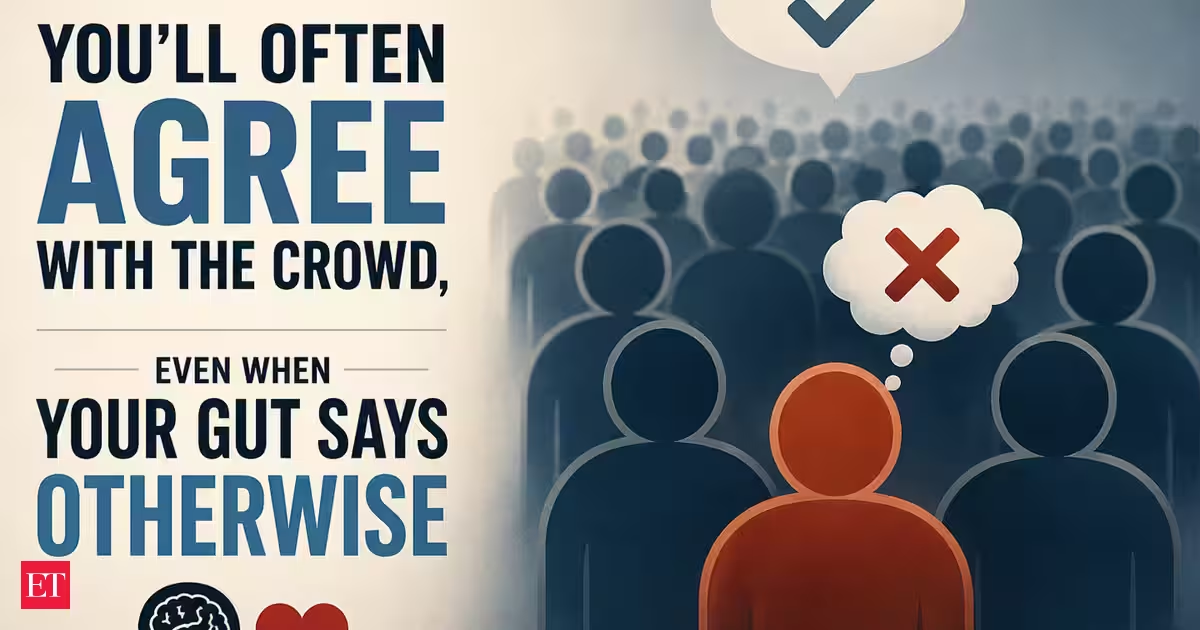
Have you ever agreed with a group even though you knew it was wrong? Maybe you stayed silent during a meeting, laughed at a joke you did not find funny, or went along with a popular opinion just to avoid standing out. According to psychology, this behavior is far more common than many people realize. Humans are social beings, and the desire to belong often shapes our decisions, even when our private beliefs say otherwise. Researchers have spent decades studying why people conform to group opinions and how social pressure influences everyday behavior. Their findings show that people often follow the crowd to gain acceptance, avoid conflict, or because they assume the group knows something they do not. While conformity can help societies function smoothly, it can also lead people to ignore their own judgment. Understanding the psychology behind this tendency can help us make more thoughtful and independent decisions.THE FAMOUS ASCH CONFORMITY EXPERIMENTSOne of the best-known studies on conformity was conducted by psychologist Solomon Asch in the 1950s. In his famous line-judgment experiments, participants were asked to identify which of three lines matched a reference line. The answer was obvious, but several people in the room were secretly working with the researchers and intentionally gave the wrong answer. Asch found that about 75% of participants conformed at least once, even when they clearly knew the group was wrong. His research showed that the fear of standing out or being rejected could be stronger than trusting one's own eyes. The study became one of psychology's most important demonstrations of how powerful social pressure can be.WHY PEOPLE FOLLOW THE CROWDPsychologists explain conformity through two main ideas. The first is normative social influence, where people agree with the group because they want to be accepted and avoid criticism. The second is informational social influence, where people assume the group has better knowledge, especially in uncertain situations. Research by Muzafer Sherif in the 1930s supported this idea. Using the autokinetic effect - an optical illusion that makes a stationary light appear to move - Sherif found that people gradually adopted the group's estimate when judging how far the light moved. His study showed that when there is no clear right answer, people naturally look to others for guidance.BRAIN SCIENCE EXPLAINS SOCIAL PRESSUREModern neuroscience has provided more evidence for why conformity feels so natural. A 2005 study by Gregory Berns and colleagues at Emory University used brain imaging while participants completed tasks under group pressure. The researchers found that conformity was linked to changes in brain regions involved in perception rather than simply decision-making. This suggests that social influence can actually affect how people experience reality, not just what they say publicly. In other words, under enough pressure, people may genuinely begin to see things differently because of the opinions of those around them.HOW TO THINK INDEPENDENTLYFollowing the crowd is not always harmful. It helps people cooperate, learn social rules, and work together. However, blind conformity can lead to poor decisions, misinformation, and unethical behavior. Psychologists recommend developing critical thinking, seeking evidence before accepting popular opinions, and being comfortable expressing respectful disagreement. Research by Irving Janis on 'groupthink' in 1972 also showed that highly cohesive groups can make serious mistakes when members avoid questioning the majority. Encouraging diverse viewpoints and open discussion reduces this risk.Understanding why people conform is the first step toward making more independent choices. By recognizing the influence of social pressure, individuals can balance the need to belong with the confidence to trust their own judgment when the evidence points in a different direction.
Psychology says you'll often agree with the crowd, even when your gut says otherwise
Humans often conform to group opinions due to a desire for acceptance and to avoid conflict. Solomon Asch's experiments demonstrated how social pressure can override personal judgment. Normative and informational influences explain why individuals follow the crowd in various situations. Neuroscience reveals that social pressure can alter perception and brain activity.
593 words~3 min read