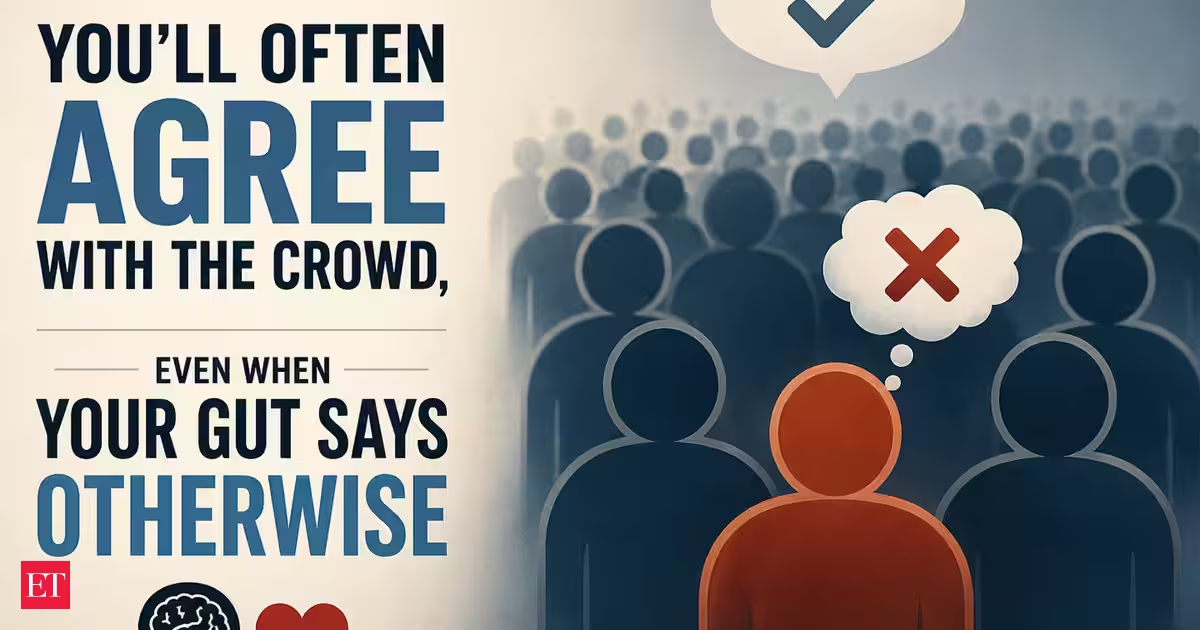
A meeting is wrapping up at work. A new proposal is presented, and one by one, everyone around the table expresses support. You have reservations. In fact, you can already see several problems with the plan. Yet when your turn comes, you simply nod and move on.Hours later, you wonder why you didn't say anything.Most people assume silence means agreement. Psychology suggests otherwise. Researchers who study group behavior, social influence, and public opinion have long observed that individuals often suppress their true beliefs when they think they are in the minority. This tendency can occur in workplaces, classrooms, friendships, online communities, and even entire societies. Known as the Spiral of Silence, the phenomenon was first proposed by German political scientist Elisabeth Noelle-Neumann, who argued that people's willingness to express opinions is strongly influenced by their perception of what others think. The theory suggests that the fear of social isolation can be so powerful that many people choose silence over disagreement, even when they believe they are right.At the center of the Spiral of Silence is a basic human need: belonging.Psychological research has consistently shown that social acceptance is deeply important to human well-being. Studies on social exclusion have found that rejection can trigger emotional responses similar to physical pain. Noelle-Neumann argued that people continuously scan their social environment to determine which opinions appear popular and which do not. When individuals believe their views align with the majority, they tend to express them confidently. When they perceive themselves to be in the minority, they often become more cautious and less willing to speak publicly.The result is not necessarily dishonesty. More often, it is a protective response designed to avoid criticism, conflict, or exclusion.Silence can create the illusion that everyone agreesOne of the most important insights of the theory is that public opinion and perceived public opinion are not always the same thing.When people with minority viewpoints remain silent, their opinions become less visible. Others observing the situation may conclude that nearly everyone supports the dominant position. This perception then encourages even more people to withhold dissenting views, creating a self-reinforcing cycle.Communication researchers have found that this process can significantly influence public discussions. The more silent people become, the stronger the appearance of consensus grows. Over time, viewpoints that may actually be widespread can seem rare simply because few people are willing to express them openly.The spiral becomes powerful not because opinions disappear, but because they become invisible.Social media may have intensified the spiralAlthough the theory was developed in the 1970s, many scholars believe its relevance has increased in the digital age.Social media platforms provide constant feedback about which opinions receive approval and which attract criticism. Likes, comments, shares, and trending topics can create the impression that certain viewpoints are overwhelmingly dominant. Research published in communication journals has found that users are often less likely to share opinions when they expect backlash from their online networks.Ironically, platforms designed to amplify voices can sometimes make individuals more hesitant to speak.The consequences extend far beyond opinionsThe Spiral of Silence is often discussed in politics, but its effects appear in many areas of everyday life.Employees may avoid challenging a flawed workplace decision because everyone else appears supportive. Students may hesitate to question a classroom consensus. Friends may agree to activities they dislike simply because nobody wants to be the first person to object.Research on conformity, including the famous experiments conducted by psychologist Solomon Asch, has repeatedly shown that group pressure can influence behavior even when individuals privately disagree with the group.While these situations may seem minor, the same psychological forces can affect more serious decisions involving ethics, personal boundaries, and risky behavior.
Psychology explains why intelligent, confident people often stay silent in groups, and how that silence can create the illusion that everyone agrees
People often stay silent even when they disagree, fearing isolation. This 'Spiral of Silence' makes minority views seem less common. Social media can worsen this, creating an illusion of consensus. This impacts workplaces, classrooms, and friendships. Understanding this helps us see how perceived opinions shape reality.
607 words~3 min read