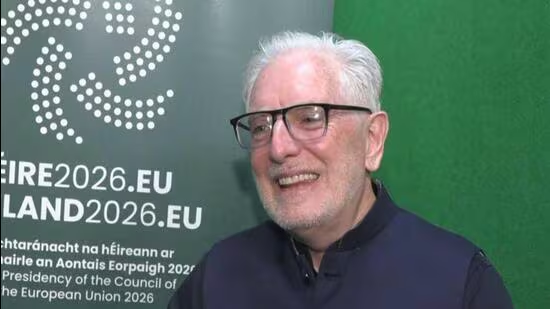
The US and China remain critically important trading partners for Europe, and Ireland’s presidency of the European Council can provide a platform to reinforce relationships with these global players. Canada, too, offers new horizons for Irish exports, with the EU-Canada free-trade agreement (Ceta) progressing through the final legislative stages in Ireland. But in an era of shifting alliances, supply chain disruptions and growing protectionism, what does the changing global trading environment mean for Irish businesses? Against a backdrop of tariff uncertainty and shifting global alliances, Enterprise Ireland’s regional director for the Americas, Aidan McKenna, says Irish companies should take a measured view. “The most recent client export figures show Irish exports to both the UK and [the] euro zone have each surpassed €11 billion, with the euro zone growing at a faster pace, a sign that the post-Brexit strategy of doubling down on European markets while maintaining UK ties has paid off.”Aidan McKenna of Enterprise Ireland has noticed a shift in how Irish businesses are thinking about international expansion. North America, meanwhile, is increasingly viewed as a scaling market by Ireland’s largest exporters. McKenna points to the figures: Irish companies now employ more than 200,000 people in the US, and Ireland has become the fifth-largest source of foreign direct investment into the country. “The investment into supporting growth there takes the form of deploying considerable resources to be successful,” he notes. Ceta’s significance extends well beyond Canada. Klaudia Dudzinska, trade and international affairs executive at Ibec, says that agreements of this kind are essential to Ireland’s long-term export resilience. “Trade agreements like Ceta are essential for diversifying Ireland’s export markets beyond traditional partners, safeguarding an open, competitive and sustainable trade environment,” she says, welcoming the Government’s active efforts in advancing Ceta towards full ratification.The broader trading environment, however, is growing more complex. Dudzinska is direct about the risks facing Irish businesses in an increasingly fragmented world. “Irish businesses face severe risks from rising protectionism, escalating tariffs, supply chain disruptions and complex regulatory compliance burdens,” she warns. Stabilising the transatlantic alliance, revitalising the EU-UK relationship and leveraging EU enlargement to access new consumer markets, she argues, offer the strongest paths forward.Regarding China, Dudzinska stresses the importance of reducing strategic dependencies, particularly in areas such as critical raw materials, while avoiding overreliance on any single market. A balanced approach, she says, is essential to securing long-term European resilience.Klaudia Dudzinska of Ibec: 'Despite significant challenges to the established multilateral order, openness remains the anchor of Ireland and Europe’s competitiveness.' McKenna also points to a shift in how Irish businesses themselves are thinking about international expansion. “One of the most obvious changes we are seeing among clients is the shift in thinking strategically about international markets, including dedicating more resources to core markets such as the UK and the euro zone that provide somewhat more stability and certainty.” Scaling into markets like North America, he cautions, demands strong leadership bandwidth, focus and the agility to respond to fast-moving external pressures.Both Dudzinska and McKenna see Ireland’s EU Council presidency as a significant moment. Dudzinska says that it offers a platform to push back against protectionist trends and advance Europe’s trade agreement network. “Despite significant challenges to the established multilateral order, openness remains the anchor of Ireland and Europe’s competitiveness,” she says. She is also emphatic on the need for regulatory simplification within the single market, arguing that a stable, predictable framework that reduces the administrative burden on enterprise is just as important as opening new markets externally. McKenna highlights the practical steps Ireland can take during its presidency to remove barriers to scaling within the EU, pointing to the potential to reduce administrative burdens, increase ambition and accelerate growth for Irish exporters. Looking ahead, there is a broad range of sectors well placed to capitalise on new trade opportunities. McKenna highlights Ireland’s global recognition in food and food technology, high-tech construction and materials, advanced manufacturing, financial services, technology and life sciences, and notes the growing role Irish companies are playing in the global data centre supply chain, an area driven by surging artificial intelligence demand. He points to Amazon’s recognition, during this year’s St Patrick’s Day programme in Washington, of Irish suppliers delivering next-generation solutions for data centre design, build, operations and maintenance.Dudzinska adds digital trade, medical devices and agri-food to the high-growth list, but stresses that realising this potential, particularly for SMEs, requires active Government support. “Many businesses are currently overwhelmed by growing regulatory compliance burdens alongside rising operational costs,” she cautions. Ultimately, both agree that resilience must be built from the inside out. For McKenna, that means Irish companies investing in research and development in addition to innovation, digitalisation and lean operations, and drawing on Enterprise Ireland’s network of 42 international offices to identify and develop new market opportunities. For Dudzinska, it means policymakers engaging with business early, streamlining regulatory frameworks and supporting companies in reducing supply chain dependencies. Ireland’s position as a small, open economy has always made it acutely sensitive to shifts in the global trading environment. But as McKenna puts it, that sensitivity can also be a strength, provided Irish companies continue to invest in competitiveness, innovation and leadership capability. “Irish companies are viewed as trusted partners to their customers internationally,” he says. In a world of growing uncertainty, that reputation may prove to be one of Ireland’s most valuable exports.
Opportunities for Irish exporters as European trade shifts
International trade deals essential to Ireland’s long-term export resilience
891 words~4 min read