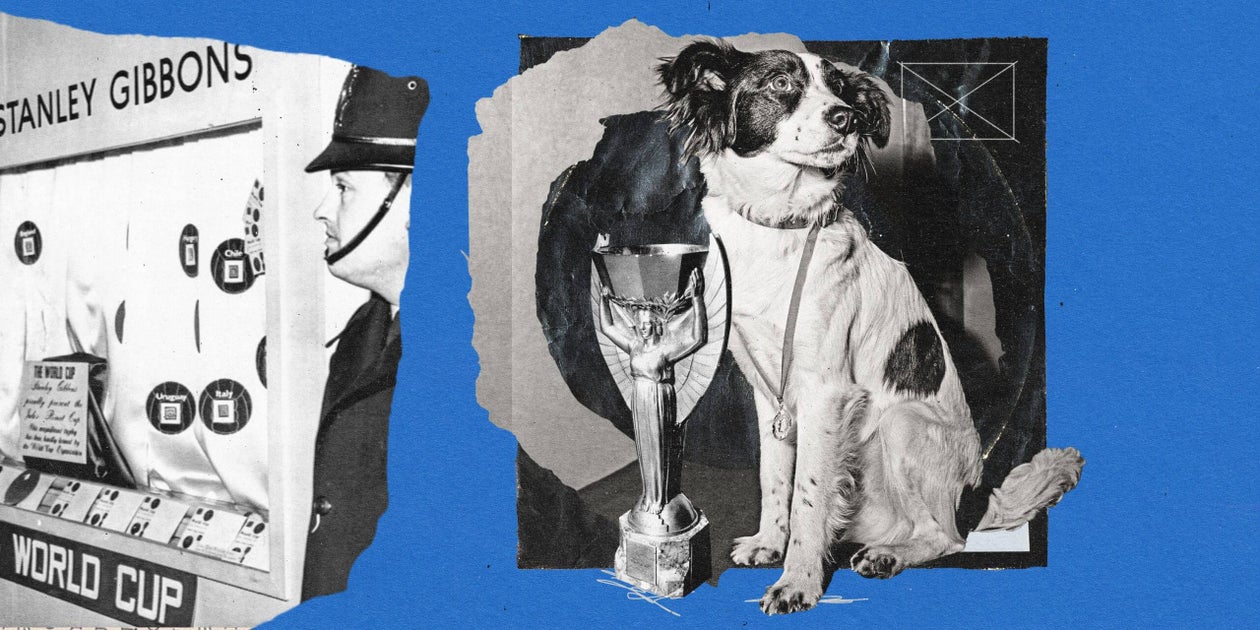
The plaque that marks the spot is as neatly hidden as the World Cup was in 1966.Unless you’re looking for it, you’d walk on by. It’s tucked away on a flight of steps leading up to the door of a pretty Victorian apartment block in Upper Norwood, south London: “Pickles the dog found the Jules Rimet Trophy here.” Who would have guessed?(Phil Hay/The Athletic)A man emptying the boot of a car in the driveway asks if he can help me, sizing me up like I’m lost, looking for somebody, or up to no good.I explain that I’m writing about the theft of the World Cup, the Jules Rimet Trophy, 60 years ago. He knows the story, right?“Pickles,” he says, rhetorically. “Yeah. A long time ago now, though.” I wonder if he’s aware of how it was stolen or the name of the man convicted of the crime. “Not really. I’ve heard bits of the story, but I mostly just know about the dog.”That goes for the average person, too. Pickles, a collie cross, was the hero of the tale, responsible for sniffing out the discarded cup on this very patch of land in March 1966, earning minor celebrity in the process. It had been abandoned beneath a bush, seven days after it was stolen from an exhibition hall in central London. Charges were later brought against Edward Betchley, a petty criminal, who attempted unsuccessfully to extract a ransom for the trophy. He was sentenced to two years in prison.Pickles poses for photographers in 1966, after finding the trophy (DB dpa/picture alliance via Getty Images)His conviction ended a detailed investigation, and the case lay dormant for decades, apparently solved. To all intents and purposes, Betchley was the man behind the World Cup’s disappearance — or at any rate, the only individual punished for it.Then, around 2017, a crime reporter fell into conversation with a contact of his, one with knowledge of London’s organised crime network. They were meeting to discuss another matter entirely, but randomly, the subject of the 1966 trophy theft came up. The architect of the heist was not in fact Betchley, the contact claimed. Somebody else pulled it off. And if the reporter wanted to uncover their identity, he ought to start with the name “Sidney Coo”.The Jules Rimet Trophy — about 35 centimetres high, made of gold-plated sterling silver, named after the founder of the World Cup and designed in the image of Nike, the Greek goddess of victory — was the original World Cup. FIFA replaced it in 1970 after Brazil won the tournament for a third time and claimed it outright. Retiring the ‘Jules Rimet’ made way for the more recognisable cup used today: the twisting gold stem supporting a globe on top, which one nation will lift after the final in New Jersey on Sunday.In 1966, with England due to host the World Cup that summer, the Jules Rimet Trophy came to London. Ahead of the tournament, an agreement was reached for the cup to be displayed to the public at a stamp exhibition, at the city’s Central Hall in Westminster, run by the firm Stanley Gibbons.The irony of the theft that ensued was that the value of the Jules Rimet Trophy — recorded as £3,000 (about $4,000) in police documents at the UK’s national archive — fell far below that of other items on display. A BBC report at the time estimated that certain stamps in the collection would have fetched a seven-figure sum. None were stolen or obviously targeted.At FIFA’s insistence, guards were assigned to closely patrol the World Cup’s cabinet while visitors wandered around the venue. The exhibition opened on March 19, but the following day, a Sunday, Central Hall was closed, save for those attending a Methodist church service. Shortly after midday, having briefly left the trophy unattended, one member of staff approached a group of his colleagues to ask if they had “moved the cup”. Amid confusion and sudden panic, they rushed to inspect the display case. It was empty, and a door to the rear of the hall was ajar, forced open from the outside. The World Cup was gone.The hysteria when the news broke was uncontainable. And the hysteria went global. Letters to the UK authorities arrived from members of the public abroad, from France, Germany, Belgium, Brazil, Chile and elsewhere. Some offered their commiserations. Others espoused theories or suggested possible suspects. One writer claimed: “My clock indicates that the gold World Football cup stolen in London, can be found at Wicklow (or in the immediate vicinity) in Ireland” (the translation does not expand on how his clock told him this).A second, from Austria, advised investigators to search for a man he had marked with ‘X’ on a random photo. A third said, in complete seriousness, that it might be worth speaking to the guards.The translation of a letter to the Metropolitan Police in 1966, indicating the World Cup could be found in Wicklow, Ireland (UK National Archives)What ensued in the seven days that followed was a nervous game of cat-and-mouse in which an anonymous source offered to return the trophy in exchange for a cash payment, and the Metropolitan Police worked frantically to track it down, in the full glare of a media frenzy. The risk of national embarrassment was acute.A copy of the letter to Joe Mears (Credit: UK National Archives)A letter and a small part of the World Cup arrived on the desk of Joe Mears, the chairman of Chelsea Football Club and the Football Association. The trophy would be returned, the letter said, if a payment of £15,000 was guaranteed. Otherwise, it would be melted down. A man going by the name of “Jackson” planned to oversee the exchange.A letter, written in German, to the police asking them to investigate a man marked with a faded ‘X’ (far right) in a photo – and below, the translation by Special Branch (UK National Archives)Posing as a close friend of Mears’, and going by the name “McPhee”, the Met’s Detective Inspector, Charles Buggy, agreed to a meeting at Battersea Park. He took the ransom with him, but what looked like a stack of banknotes was in fact mostly scrap paper. Jackson duly joined Buggy in his car, but spooked by a van which tracked the car and contained other police officers, he tried to make a run for it and was arrested in the street.In custody, he was recognised as Edward Betchley, a 47-year-old who served as a Lance Corporal in the British army during the Second World War and then traded as a second-hand car dealer. He had a prior conviction for receiving stolen goods, back in 1954.
When a dog, Pickles, found the stolen World Cup: A crime mystery solved?
Before the 1966 World Cup, the trophy was stolen — only to be later found by a dog named Pickles
2,627 words~12 min read