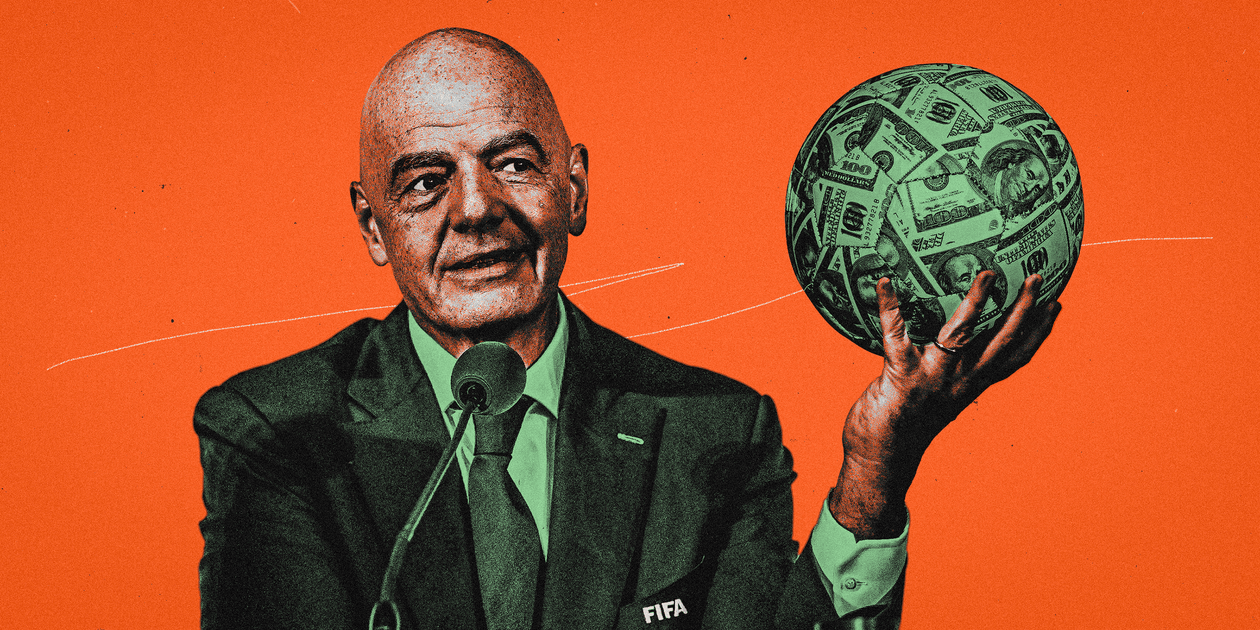
FIFA struck a triumphant tone in its financial reports for 2022… and with good reason.Just short of $5.8billion (£4.3bn at the current rate) of revenues had been collected in a year that concluded with a winter World Cup in Qatar. “An unmatched financial achievement,” was the conclusion drawn.World football’s governing body had never found the vast sums it was able to mine over those few weeks on Qatari soil. Everything spiked: commercial revenue, TV revenue, ticketing revenue. The eventual totals were considerably more than FIFA had managed at Russia 2018 or Brazil 2014 and near twice what was generated at the tournament in South Africa ($3.36billion) 16 years ago.FIFA had never had such money rushing in through the doors but, just four years on, another staggering number waits to be counted.Double Qatar, is what FIFA’s president Gianni Infantino has publicly forecast for the 2026 World Cup. Or, in other words, the first $10billion sporting event in history.A World Cup co-hosted across the United States, Mexico and Canada has carved open a new frontier for FIFA. A thousand headlines might have been sparked by the exorbitant ticket prices but an expanded 104-game tournament, concluding with Sunday’s final between Spain and Argentina, has also enabled huge commercial growth and inflated broadcast rights.FIFA is familiar with talking up its events, but there is now nothing like the World Cup.The summer Olympic Games had long provided the nearest comparison but the latest edition, based in French capital Paris two years ago, had revenues of just over $5billion. In terms of football, the most recent European Championship, played that same summer in Germany, generated $2.9bn.Infantino forecast doubling the Qatar 2022 revenue for the 2026 World Cup (Carl Recine/Getty Images)The booming popularity of the club game has created the platform for FIFA to capitalise at national-team level — and it has already forecast further growth. The 2027-30 cycle, concluding with the centenary World Cup that will feature single matches in Argentina, Paraguay and Uruguay as well as its main co-hosts Morocco, Portugal and Spain, aims to make $1billion more than the prior four-year period that is about to end.“It’s supply and demand,” says Professor Rob Wilson, Dean at the University Campus of Football Business (UCFB) in the UK. “The supply is relatively restricted because the World Cup is only every four years, and then you have the demand that has spiked in the last 20 years.“You end up with this meeting point where limited supply meets huge demand, and FIFA then construct their rate card on the back of that. They know what it’s worth.”And, remarkably, that sum now runs into 11 figures.The past five weeks have seen FIFA harvesting fertile ground. Canada and Mexico joined in as co-hosts, but a tournament predominantly held in the United States (78 of the 104 games, including everything after the round of 16) was the golden chance to cash in.Ticket prices were untethered in a market where people are familiar with paying premium sums for sporting events, and still supporters showed up in droves. A cumulative attendance of over six million has clicked through turnstiles, all willing to swallow the inflated cost of doing so.Last year, FIFA forecast its ticketing and hospitality figures for this four-year cycle to be in the region of $3.5billion, three times the previous record that involved Qatar 2022. An expanded tournament, with 48 teams this time, up from 32, and an additional 40 matches, has contributed to rapid growth, along with twice as many tickets being made available.FIFA to extend half-time for World Cup final | World Cup Daily BriefingMegan Feringa and Luke BosherA controversial dynamic pricing model and resale platform, where FIFA takes two 15 per cent fees on each sale, has also opened further earning capabilities not in place in 2022. Not until next year will the final ticketing revenues from this World Cup be clear but whatever they are, FIFA cannot hope to match those sums in four years’ time.FIFA’s latest financial report, published in 2025, forecast a $938million reduction in revenue generated through tickets and hospitality in 2027-30, an indirect acceptance that it might be a while before another World Cup brings the riches of this one through turnstiles. Another expansion, to 64 teams, still might not be enough.A World Cup held largely in the U.S. has brought other obvious benefits, too. It has been a commercial behemoth, with the marketplace attracting new partnerships and their millions. “Russia and Qatar were difficult commercially,” says one senior figure, familiar with FIFA’s commercial operations, speaking on the condition of anonymity to protect relationships. “The U.S. World Cup was always going to be massive. This was always going to be the one to target.”As well as FIFA’s main commercial partners, such as Adidas, Coca-Cola, Visa, Aramco and Hyundai, paying anywhere between $80million and $100m a year in their long-term deals, this World Cup has a roster of sponsors, including Bank of America and McDonald’s, paying as much as $100m for their association. Then there are another 14 ‘supporters’, including Home Depot and American Airlines, on the next rung down whose deals have been worth as much as $40m.“There’s no question that there are lots of brands who have a heritage within football who are American, for whom this was a must-buy,” says Phil Carling, managing director of football at Octagon, an international sports and entertainment agency. “They wouldn’t want to have their home market represented (by) or give a benefit to a competitor.“Also, there were plenty of organisations and brands that would not normally look at football but, because it was going to be in America, the 250th anniversary of the country etc, needed to be involved in the tournament.”Ticket prices soar for England vs Argentina | World Cup Daily BriefingFelipe Cardenas and Adam JonesAn engaged American audience has undeniably helped FIFA build out its marketing strategy, but it retains an international appeal to brands.AB InBev, the largest brewing company in the world, extended its partnership with FIFA through to 2030 on the eve of this tournament, joining companies already locked in for that next World Cup. FIFA sees marketing rights as its biggest opportunity for growth in the coming years, an outlook made all the more striking by the fact commercial revenues have almost quadrupled since the 2007-10 cycle.“It is the sheer magnitude of football as a global phenomenon,” adds Carling. “Not only as a sport but as a cultural phenomenon, which has grown since Qatar. It’s a global mega-event which has no parallel. I don’t think the Olympics touches it. Not the Super Bowl or any other.“Events that deliver a global audience at scale, in the context of peoples’ enthusiasm and passion, are vanishingly rare. There isn’t anything that delivers this type of scale. With a World Cup, you’re embedded into the content. That’s what drives the value.”Eyeballs are key, and FIFA has estimated that six billion people would “follow” this tournament. It is an unquantifiable number that leans on engagement and news output around the globe but the firmer TV viewing figures, collated independently, underline both the enduring and broadening interest in a men’s World Cup.New markets have been awoken, including the States, where the USMNT’s last-16 exit to Belgium was watched by a record-breaking 30 million viewers on domestic broadcaster Fox. North of the border, Bell Media reported an average of 5.4m for Canada’s defeat to Morocco at the same stage — said to be the biggest audience for a Canada game on record.European countries, such as Portugal and Norway, have attracted audiences close to half of the population, while a release from FIFA, based on overnight data, said Sweden’s opening group game against Tunisia had a 96 per cent share of the domestic television audience (though the match kicking off at 4am back home may have had something to do with that near-monopoly).“It’s the ultimate football property,” says Pierre Maes, an expert in TV rights sales in Europe. “We know the World Cup is able to attract people who don’t watch football for the rest of the four years. It attracts more than just football fans, and that is why we see these huge audiences.”It is also why FIFA is able to generate such high broadcasting revenues. The 2023-26 cycle has been forecast to generate $5.2billion, to ensure it remains the body’s No 1 revenue stream.FIFA intends to make it more impressive still for the 2030 World Cup but has limitations in the European market, traditionally its biggest.A European Commission decision, subject of a failed appeal by FIFA in 2011, ruled that the World Cup had to be available to all TV viewers and not placed behind a paywall. It has left free-to-air channels, such as the BBC and ITV in the UK, holding the rights in a small and uncompetitive field.“It’s not been good for FIFA, as it limits how they can sell their product,” says Maes. “You cannot sell your product to the most powerful and rich players. We have seen free-to-air stations get poorer and poorer, and these are FIFA’s partners.“Another problem for FIFA was the joint-bidding we see. So in the UK, it is BBC and ITV. In Germany, it is ARD and ZDF. If the free-to-airs talk together and (make a combined) bid, you cannot play with competition and grow the price tremendously.“As a TV product it will continue to grow, but FIFA’s problem is that they have to sell a lot of their rights to the poor people in the room. That’s what makes it difficult. ”It is why the significance of TV rights sold in Europe is shrinking. In the 2007-10 cycle, these accounted for 50 per cent of broadcast revenues but that has fallen to 31 per cent.FIFA, inevitably, will see greater opportunities elsewhere.The income from broadcast rights for the MENA — Middle East and North Africa — region grew by 70 per cent between 2014 and 2022 (a point that saw the Qatar-hosted World Cup arrive in that territory), while there will also be a chance to boost TV income in the North American market.Argentina captain Lionel Messi celebrates their triumph at the 2022 World Cup in Qatar (Anne-Christine Poujoulat/AFP via Getty Images)The Fox Corporation paid just $485million to screen this World Cup in the United States, an extension to an initial deal that covered the 2022 tournament. The New York Times has reported that this arrangement eventually left FIFA out of pocket, with the U.S. rights worth “between $1billion and $1.5bn” if put out to tender today.FIFA also encountered difficulties selling broadcast rights in China and India for this World Cup, with an eight-year deal struck with Zee for the latter country only signed off 10 days before the games began.It has outlined ambitions to see broadcast revenues climb north of $6billion between 2027 and 2030, and the gamble taken with expansion is that more World Cup games will encourage that growth. The past week has seen the door left open for even more football in the 2030 edition, with Infantino saying a 64-team field cannot yet be discounted.“An event that is only played once every four years has an appeal but I would also say that having 48 teams, rather than 32, can lead to boredom,” said Maes, speaking ahead of this tournament.“Long-term, we know it’s not a good decision, because it dilutes the attractiveness and interest in each game. There will be games that don’t interest anybody in countries that are not playing. But short-term, it allows FIFA to go to the broadcasters of this world and tell them they can have more games, bring in more revenues through advertising.”Everyone, in theory, wins.FIFA has undeniably reared a monster in the shape of the World Cup. Favourable winds, generated through football’s increasing cultural significance and revered individuals, have helped create a perfect storm of appeal.“They’ve got lucky blood,” says one experienced figure who worked with FIFA during the build-up to this tournament. “It’s the tide that lifts all boats, isn’t it? Football’s general popularity is less to do with FIFA and more to do with the clubs and UEFA competitions.”The question remains whether it can all be maintained. Can FIFA replicate the huge revenues that have been generated on the back of a World Cup staged in North America over the past five weeks when heading to economically less-advanced countries in 2030? Spain, Portugal and Morocco will not offer the same commercial opportunities locally, nor provide a stage for ticket prices to be as high.Hyping up that World Cup as a centenary celebration will help but it might require further expansion, from 104 games to 128, for the ticketing shortfall to be made up.“A big part of this World Cup’s success is where they picked (as hosts),” says Prof Wilson. “You’ve got the world’s biggest sporting competition being held in the world’s most mature commercialised market. We might see a lot of sovereign wealth go into the competition for Saudi Arabia in 2034 and make it look on paper to be a more lucrative tournament but FIFA is earning these revenues in the U.S.”FIFA already has some of its leading partners in place for 2030, including Adidas and Hyundai, and will spend the next four years building a roster of sponsors they hope will also include deals on next year’s Women’s World Cup and the 2029 Club World Cup. Marketing rights for 2027-30, FIFA believes, have the capacity to climb by £1billion.“The fact it’s not in North America (in 2030) will be a factor,” says Carling. “I would think maybe £500million has been generated from local sponsors in 2026 — Home Depot and so on. I don’t think they’re going to be able to replicate that in Morocco, Spain and Portugal. That said, I think there will be companies that look to build a legacy with football and will be back in 2030. FIFA shouldn’t fall back there.”The past month has illustrated that the World Cup has never been bigger; in size, reach and span. FIFA and its 211 national member associations will soon learn just how much bigger the bottom line has become.
How FIFA built a $10bn World Cup: ‘A global mega-event with no parallel’
After the huge revenues of Qatar 2022, FIFA is waiting to count up to another staggering number following this year's edition
2,347 words~11 min read