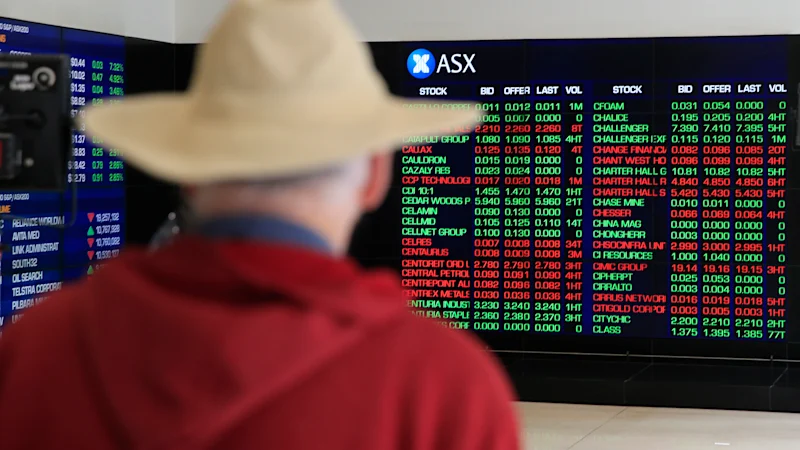
Staff writersUpdated July 17, 2026 — 5:08pm,first published July 17, 2026 — 5:19amThe Australian sharemarket finished the week with a session in the red after drops for computer chipmakers and other winners of the artificial-intelligence boom dragged down stock markets worldwide overnight.Miners led the declines, extending Thursday’s losses, after the US launched its fifth straight day of attacks on Iran, reigniting concerns about the war’s implications for global growth as rising oil prices push up inflation.Technology stocks weighed down Wall Street overnight, setting the tone for the local market.APThe S&P/ASX 200 was down 44 points, or 0.5 per cent, at 8796.70, even as seven of its 11 industry sectors advanced. The overall dip follows a flat session for the ASX on Thursday. The Australian dollar was trading at US69.86¢.Iron ore heavyweights BHP and Rio Tinto helped push the market into negative territory, sliding 2.7 per cent and 2.4 per cent, respectively, as they were sold down for a second day.Gold miners were also down sharply, after bullion prices dropped over 2 per cent overnight to trade below $US4000 an ounce on fears the oil price spike will prompt the Federal Reserve to raise interest rates, a headwind for the demand for precious metals. Northern Star Resources fell 4.1 per cent, Evolution Mining slumped 4.3 per cent and Newmont lost 3.6 per cent.Tech stocks struggled after the AI sell-down on Wall Street, with AI data centre operator NextDC down 2.5 per cent, while family tracking app Life360 fell 3.4 per cent and network provider Megaport slumped 8.5 per cent. The nation’s biggest software firm, Xero, bucked the trend with a rise of 0.9 per cent.Meanwhile, Coles shares gained 2.9 per cent after the supermarket giant said it will no longer pursue a potentially pricey takeover of Greencross Pet Wellness Company. The deal had hung over the share price since talks with Greencross’ private-equity owner, TPG Capital, were disclosed early this month.Energy stocks benefited as oil prices headed for their biggest weekly advance since April because of worries that the war with Iran will keep oil tankers out of the Strait of Hormuz and prevent shipments of crude from the Persian Gulf to customers worldwide.Global benchmark Brent traded around $US85, on track for a weekly gain of about 12 per cent, while West Texas Intermediate rose toward $US80 a barrel. The US carried out another wave of attacks on Iran, hitting targets including defence sites, following the prior night’s strikes that hit an oil tanker near the OPEC member’s main export terminal. Woodside shares jumped 3.3 per cent, and its smaller rival Santos rose 1.9 per cent, while refiners Ampol and Viva Energy were up 1.7 per cent and 1.3 per cent, respectively.Telstra climbed 2.7 per cent as its top brass faced a Senate inquiry into last week’s outage. Telstra chief executive Vicki Brady said the telco had “let Australians down” and she was “deeply sorry” for the failure that struck at people’s ability to run businesses, stay in touch and reach emergency help. But she ruled out blanket compensation for affected customers, saying most payouts would probably come as bill credit rather than cash.Financial stocks were mixed, with Commonwealth Bank losing 0.8 per cent, Westpac edging down 0.2 per cent and ANZ Bank slipping 0.4 per cent, while National Australia Bank added 0.2 per cent and Macquarie Group finished 0.7 per cent higher at $258.41, a fresh record. Meanwhile, consulting firm KPMG has confirmed that senior auditor Kim Lawry has resigned, after Westpac requested she step down as its lead auditor following her role in the audit leak scandal where senior partners allegedly used confidential customer information to win new business.KPMG said Lawry left the KPMG Australia Board on Friday and is retiring from the partnership after a “smooth transition of her responsibilities”.On Wall Street overnight, the S&P 500 fell 0.5 per cent, even though more stocks rose within the index than fell. The Dow Jones Industrial Average dipped 105 points, or 0.2 per cent, and the Nasdaq composite sank 1.5 per cent.Nearly three out of every four stocks rose within the S&P 500 after more of the country’s biggest companies reported better earnings for the latest quarter than analysts expected.But a 1 per cent move for Nvidia’s stock packs more punch on the S&P 500 than a 1 per cent move for any other company because it’s the largest on Wall Street by value.And Nvidia fell 2.4 per cent, making it the heaviest weight on the index. Other AI winners also sank, giving back some of their stellar gains.Micron Technology fell 5.6 per cent to shave its gain for the year so far below 199 per cent. Sandisk fell 12.6 per cent, but is nevertheless up 494 per cent for the year so far.Such stocks have been under pressure for weeks because of worries their prices shot too high and that voracious demand for computer memory and processors may not be sustainable if AI ends up not producing as much profit and productivity as promised.The losses came even though Taiwan Semiconductor Manufacturing, a bellwether of the chip industry, reported a stronger profit for the latest quarter than analysts expected. Its stock in Taiwan rose 1.2 per cent, but its stock that trades in the US fell 2.3 per cent.In South Korea, drops for AI winners like Samsung Electronics and SK Hynix dragged the Kospi index down 6.4 per cent. It’s been among the world’s shakiest markets recently because of how dominant the two AI winners are.The day before, the Kospi jumped 6.2 per cent, but it’s had drops of 8.9 per cent, 7.8 per cent and 5.3 per cent in the last couple of weeks.A hike to interest rates by the Bank of Korea also weighed on stocks in Seoul, the first by the bank since 2023.Higher interest rates can keep a lid on inflation, but they also slow the economy and hurt prices for all kinds of investments. And worries are rising that the Federal Reserve and other central banks around the world may have to raise rates to rein in the effects of expensive oil.In the bond market, the 10-year Treasury yield edged up to 4.56 per cent from 4.55 per cent late Wednesday and just 3.97 per cent before the war with Iran began. Higher yields have already sent the average 30-year mortgage rate to its highest level in nearly a year.In other international markets, indexes fell across Europe.From our partners
Mining stocks send ASX lower at end of week; Coles, Telstra shares rise
Miners led the declines after the US launched its fifth day of attacks on Iran, reigniting concerns about the war’s implications as rising oil prices push up inflation.
1,074 words~5 min read