Skip to content
[Dr. Gough] bought a generic USB 3.0 hub on an Asian website. Surely, USB 3 is mature enough that even the cheapest hub will have some IC in it that will work well, right? You’d think so, but a little exploratory surgery showed that the only thing about this hub that was USB 3 were the blue port connectors.
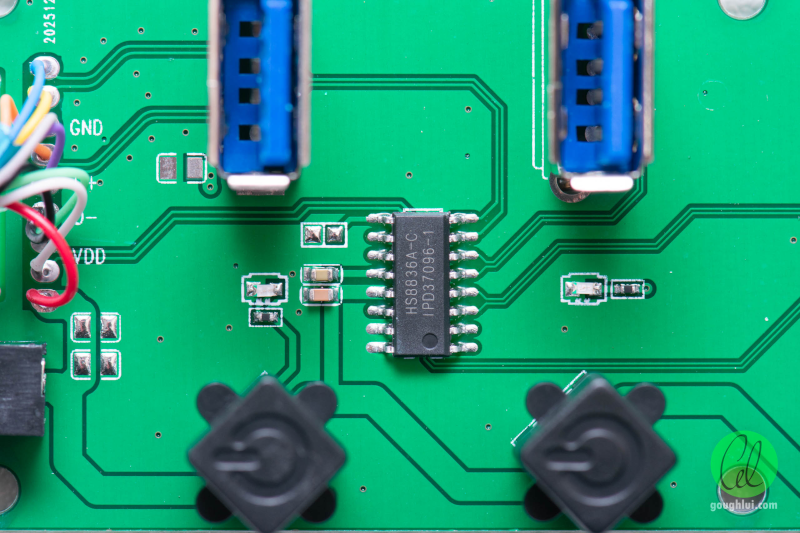
We have a few problem USB hubs ourselves, so it might be worth doing this to any you have lying around. The first clue: most of the connectors on the PCB only have four pins. On closer examination, the hub appears to be a USB 3.0 extension cable with a USB 2.0 hub made from two HS8836A chips.
Not only are these USB 2-only, but all the ports on an HS8836A also share the same USB 1.1 bandwidth. Some hubs can provide multiple ports full 1.1 bandwidth, using the higher-speed USB protocol to the PC as a backhaul.
There were quite a few other issues. Missing solder, cables soldered to the board directly, and no bypass capacitors. The per-port switches cut off USB power, but that wouldn’t stop a device with its own power from connecting. The hub has a barrel jack for power, but it would feed back to the PC, which is bad practice at best.