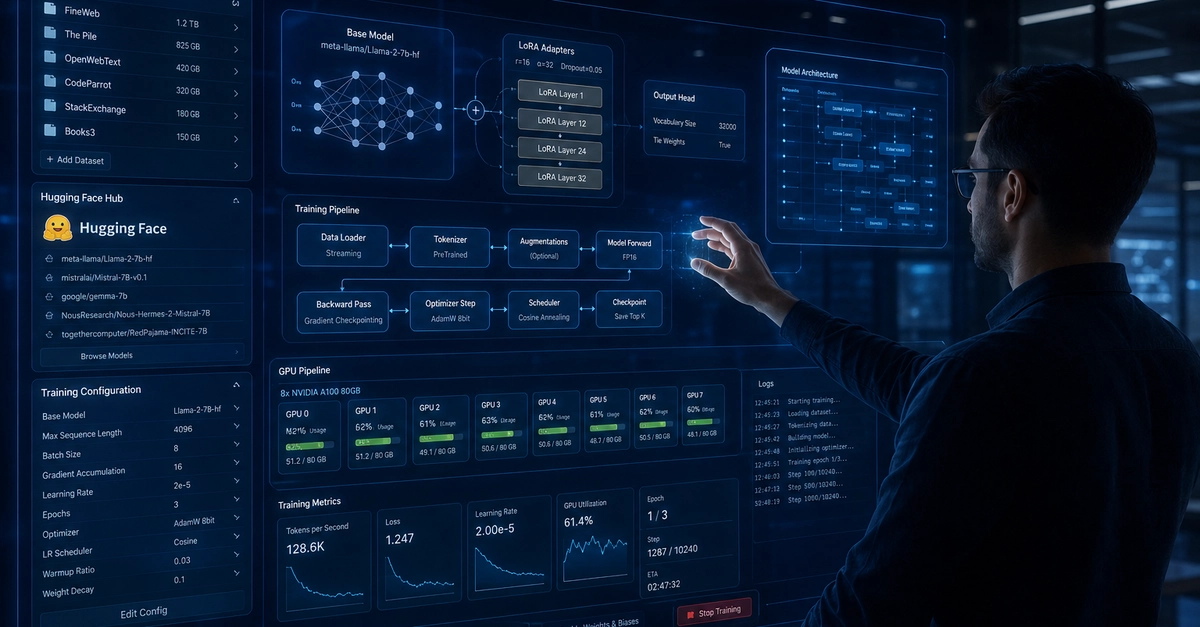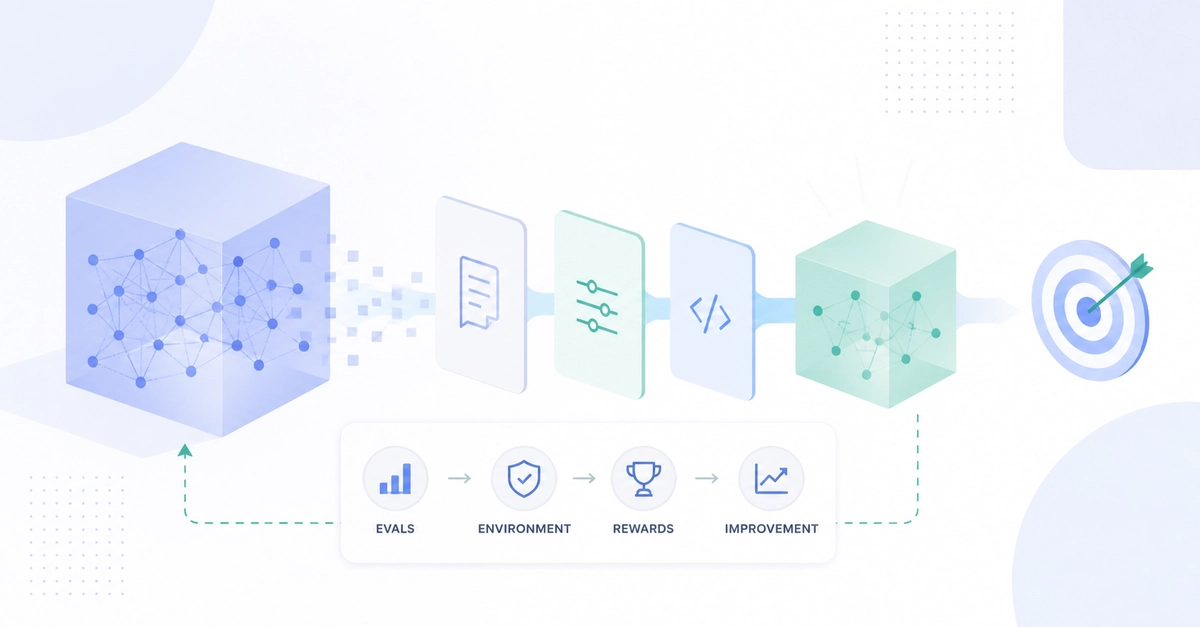
From data preparation and tokenizer selection to pretraining, LoRA, RLHF, evaluation, and production monitoring, this guide covers the major stages involved in training an AI model.
Training an artificial intelligence model is not simply a matter of loading a dataset onto a GPU and running a few commands. A successful model requires a measurable objective, legally usable and carefully cleaned data, an architecture suited to the problem, controlled optimization, independent evaluation, and continuous monitoring after deployment.
In large language model development, a mistake in any one of these stages can waste millions of training examples and a significant amount of compute.
This guide explains the model development process primarily through the training of large language models. However, fundamental concepts such as dataset splitting, loss functions, overfitting, and evaluation also apply to computer vision, speech, and predictive models.
The goal is not to provide a single fixed recipe. Instead, it is to explain which training approach is appropriate for which problem and to clarify the cost difference between training a model from scratch and adapting an existing model.