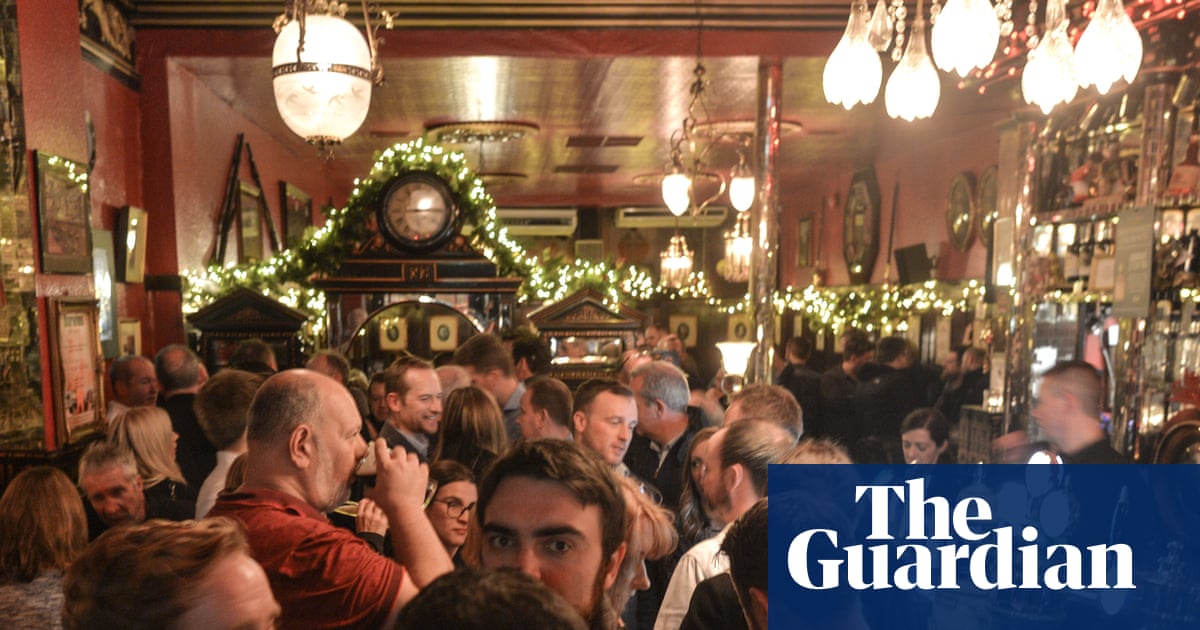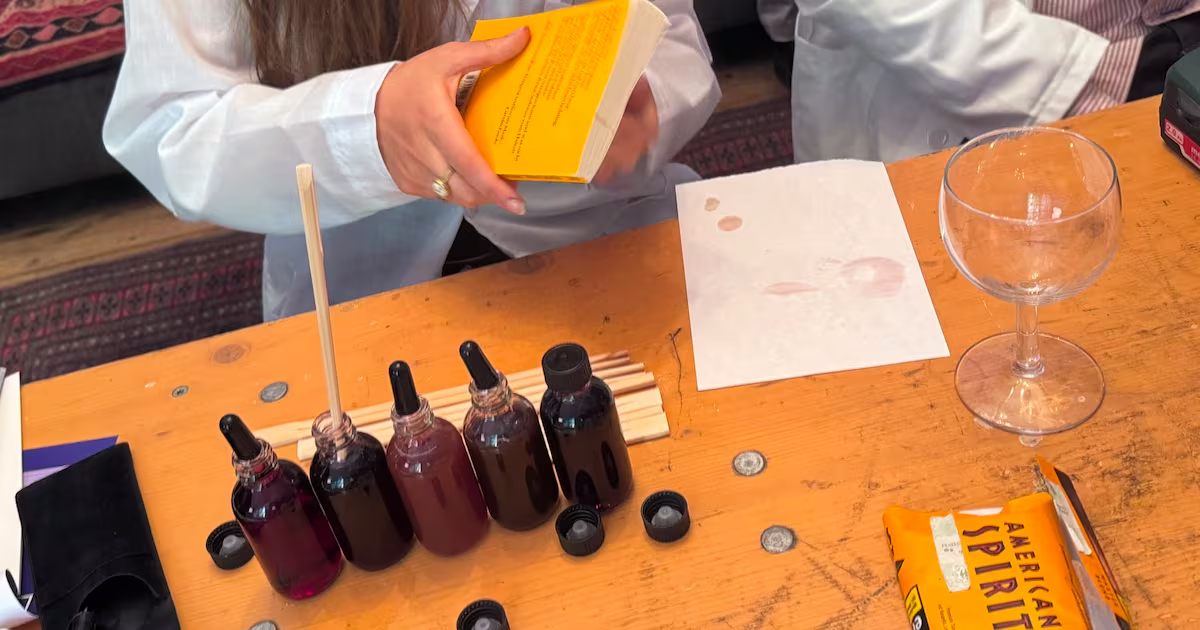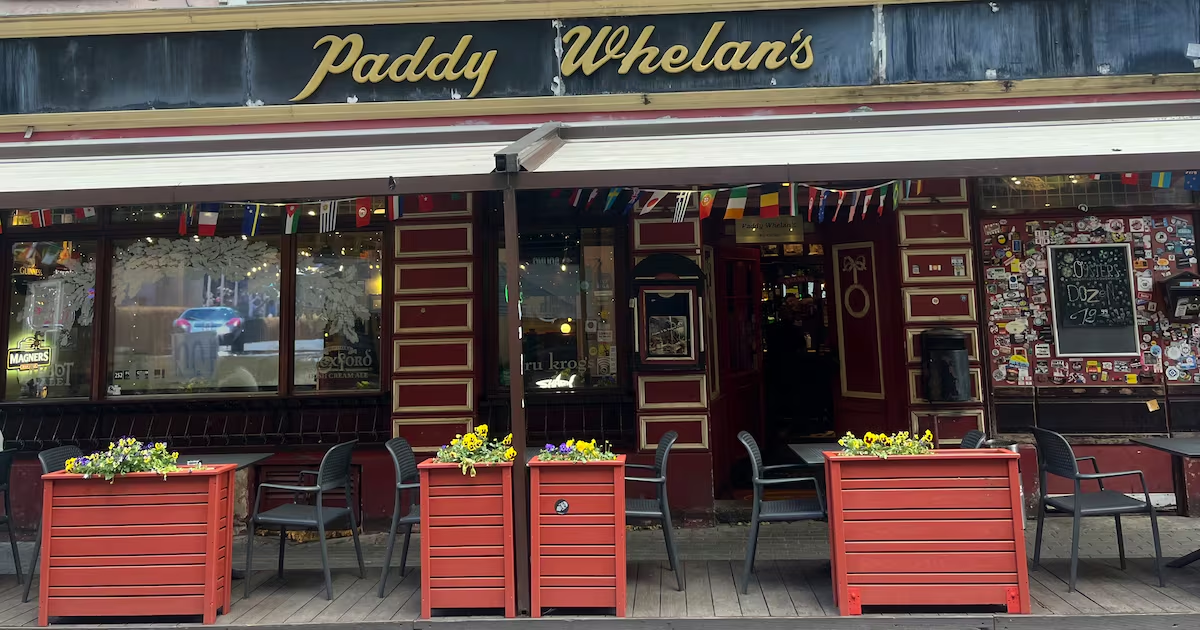
Expecting authenticity from Irish pubs abroad is a fool’s errand, usually. But in Riga last weekend, watching football in a bar called Paddy Whelan’s, I was intrigued by the very specific name. It turns out that the Paddy in question was a real, Kilkenny-born grandfather of the female half of an Australian-Latvian couple who established the business in 1995, when it became the first Irish pub in the Baltic republics.They no longer run it, but an earnest editorial on the website explains the lengths to which new Irish bars go to appear old: “When a pub is being designed, one of the biggest problems is to create a lived-in atmosphere, which means purposefully scuffing everything from table surfaces and chairs to walls and accessories. This is to ensure that the pub has a history...”Ironically, as the same piece mentions, the building that houses Paddy Whelan’s dates from 1795 and still has original features from then, along with later adornments such as an art nouveau ceiling. But in Irish pub years, the 30-something Paddy’s is itself relatively ancient, so that natural erosion has long since supplemented the original design. The website expresses pride “that our tables have been scuffed by countless guests ...” And pictures of the latter include, from 2003, Shane MacGowan: already well-scuffed himself.***Were he alive today, Myles na gCopaleen might be subsidising his poorly paid literary work with a lucrative sideline in Irish pub consultancy, advising exporters on how to reproduce the authenticity of the originals. He did enough research, God knows.But I’m delighted to see from Derek Scally’s latest Berlin dispatch that another of Myles’s specialities is now attracting renewed interest abroad.In a celebrated series of columns in 1941, he floated the concept of a “book-handling” service, aimed at the vulgar rich and others who considered it socially necessary to have libraries but were too busy or distracted to read them.Services would range from the mild distressing of volumes to “Le Traitement Superbe”, which might include forged inscriptions and even letters (inserted as “forgotten” bookmarks) from famous authors, expressing admiration and gratitude – or in some cases thanks for loans of money in poorer times – to the owner.All right, the Berlin book-mauling Derek reported was a deliberate homage, organised by a literary magazine. But I can foresee further such events, as charity fundraisers at least. And who knows? In an era when books are sold by the metre as furniture, there is surely now a commercial market among the “illiterate but wealthy upstarts” Myles mentioned. I can think of a certain resident of the White House, establishing his post-presidential library in line with tradition, who might be interested in a quote for the de luxe service.***Back in Dublin, having my hair cut by a friendly eastern European, I was struck by the contrast between his still-robust Slavic accent and his strong grasp of the Hiberno-English vernacular: one now ubiquitous phrase especially.When I suggested a scissors cut rather than the clipper, for example, he announced his agreement to the tune of “a hundred per cent”. My traditional “not too short” plea was similarly approved. And even when I was less sure of something, specifically his proposed trimming of my eyebrows, assented to with caution, he declared himself “a hundred per cent” behind that plan too.The barbershop in this case is not one of Dublin’s cheaper establishments. Even for a simple wash-and-trim, barely 20 minutes’ work, you get little change out of €50. Even so, on my latest visit, I noticed it had joined the burgeoning number of service outlets whose card-payment process is now prefaced with a menu of suggested gratuities. As always, I wasn’t sure how much – if anything – to add. But I definitely wasn’t asking the barber.***Further to “Corke Hill”, as spelt on a new OPW sign at the main gate of Dublin Castle (Diary, July 9th), reader Finbarr Healy suggests that the 16th century poet Edmund Spenser would have approved.In The Faerie Queene, at least, Spenser wrote about “The spreading Lee that, like an island fayre/Encloseth Corke with his divided flood”. Thanks too to Aodán Ó Conchúir, who sent me a copy of a 17th century engraving in which the southern capital is anglicised as “Korck”. I have also been reminded, meanwhile, of what, although much more recent, may be the most eccentric spelling of Cork ever. That was in 2011, when The New York Times had to publish a correction after, in an article that also mentioned Galway, it referred to a person from there making “a five-hour drive to Quark”. The separate question arose then as to whether anywhere in Ireland, never mind Galway, could be a five-hour drive from Cork/Quark. But having dragged quantum science into the equation, the New York Times could probably have protested that the shortest distance between the two cities is not a straight line, and that the journey might be affected by the massive gravitational warp of Limerick.
Scuff and tumble: Frank McNally on the art of ageing pubs (also applicable to literature)
In Riga, Paddy Whelan’s pub went to great lengths to ensure it looked authentic
824 words~4 min read