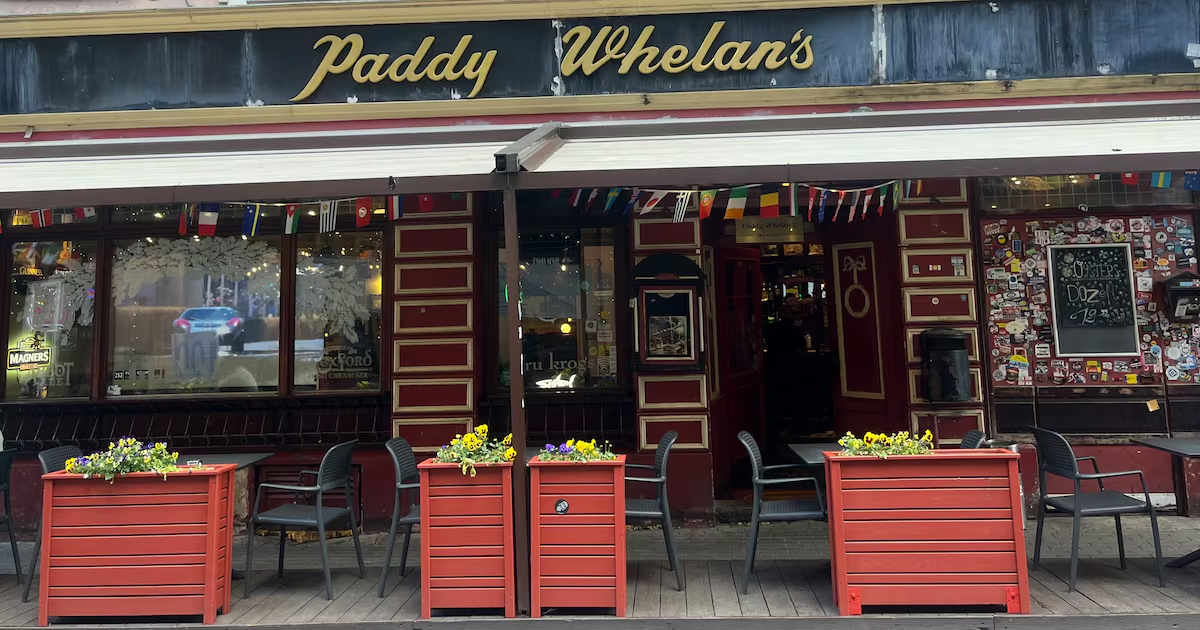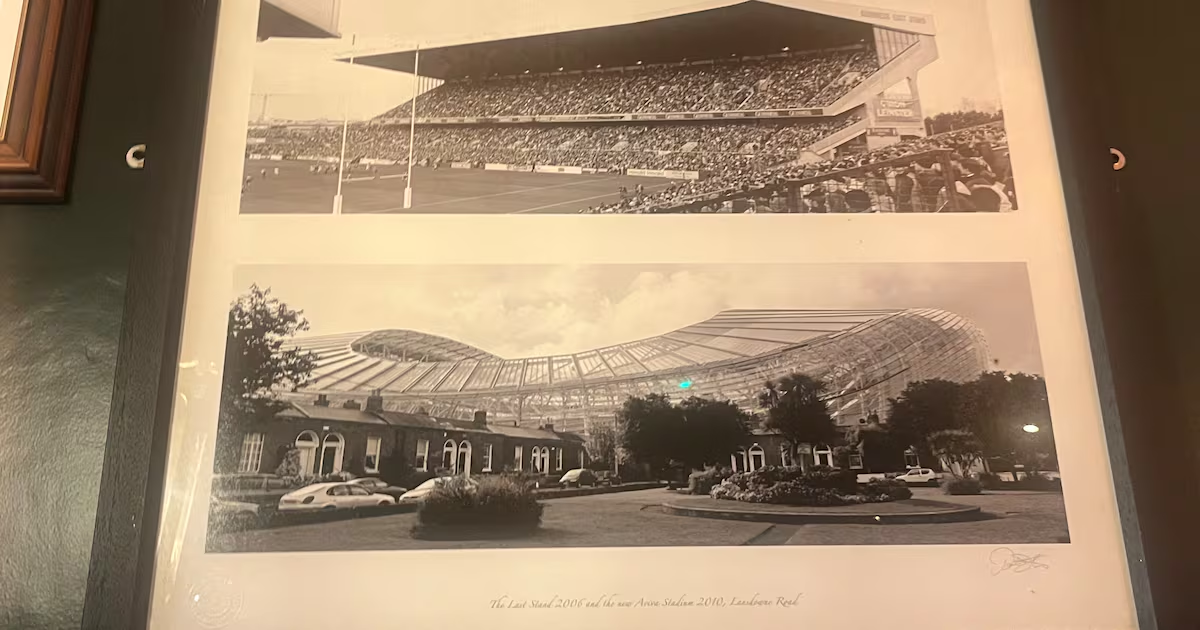
Until very recently, I had assumed the Old Stand pub in Dublin’s Exchequer Street was so named for a stand of the sports stadium variety. It is a sort of sports bar, after all, with two small televisions usually showing rugby or football. And among the pictures on its walls is one of Lansdowne Road before and after redevelopment, showing the old East Stand and the modern Aviva. Mind you, the old East Stand was the new stand in my lifetime: it had been rebuilt in 1983. But still, the picture seemed to emphasise the pub’s theme.Then, as mentioned yesterday, I underwent belated enlightenment from the unlikely source of Lucy Maud Montgomery, author of Anne of Green Gables (1908).Her Complete Journals of the Prince Edward Island Years features the sentence: “Here I am back in the old stand.” To which she adds a footnote that the phrase is “Irish slang for home” and, by extension, “the name of many pubs in Ireland and the US”.Both the phrase and pub name must have all but have died out since then, I thought, wondering if the Dublin example was the old stand’s last stand. But no, as Google Maps reminds me, there is still an “Auld Stand” in Ratoath, and there are “Old” ones in Trim, Mullingar, and Limerick too, if not elsewhere.While we’re on the subject, we might as well pause to consider the mystery of English whereby a “stand” is the part of a stadium in which you sit. This seems perverse enough in an all-seater like the modern Aviva. It’s even more so in rural GAA clubs, the height of whose infrastructural ambitions often is to build a small “stand” where people can go precisely to avoid standing. Then there is the related concept of league tables, also called “standings”. Within those too, paradoxically, a team may “sit” in third place, or 10th, or just above the relegation zone. Despite which, their collective positions are never “sittings”.That concept is not unique to Ireland. What is, I think, is the fear of falling “out of your standing”, a personal trauma that has nothing to do with stadium infrastructure. It’s just the Irish way of fainting, a direct translation from the phrase “Tuitim as mo sheasamh”. And in my mother’s usage, it usually related to being weak from hunger or, sometimes, from astonishment at some turn of events. Also, it was not something that ever actually happened, only threatened to. So I’m glad to see the typical example of its usage cited in Terry Dolan’s Dictionary of Hiberno-English. That arose during a school production once of the musical Finian’s Rainbow, whose song Begat humorously describes the discovery by Adam and Eve of the human reproductive cycle. Hence the dictionary’s sample quotation: “‘You know what this song is about, don’t you?’ asked the ex-priest, who was directing this part of the show. ‘Eh, no,’ answered the schoolgirl. ‘Sex!’ he said, and she nearly fell out of her standing.’”To be “a person of good standing”, by contrast, is something you can do while sitting down, or even in bed. In fact, if you hear the phrase used about you, you probably are sitting ... in a courtroom. [ Soul sanctuary: Frank McNally on ‘staggeringly beautiful’ library of St GallOpens in new window ]Then you’ll be depending on your lawyer to prove you haven’t fallen out of good standing or, conversely, that you have, temporarily, in circumstances demanding libel damages.“To stand” is a verb of almost endless flexibility. You can stand up, down, in, out, by (idly or otherwise), and aside. You can stand for something (an idea, your godchild, etc) or against (oppression, another election candidate).And crucially in Ireland, you can stand a drink, or not, with consequences that may affect your standing in general. As I warned in a guide for tourists once, exaggerating only a little: “To the outsider, this may appear a casual custom; you will not necessarily be told it’s your round and other participants may appear only too happy to substitute for you. But make no mistake, your failure to ‘put your hand in your pocket’ will be noticed. “People will mention it the moment you leave the room. The reputation will follow you to the grave, whereafter it will attach to your offspring and possibly theirs as well. In some cases, it may become permanently enshrined in a family nickname.”On his way to Paddy Dignam’s funeral, the fictional Leopold Bloom thinks about asking someone for a free pass to the theatre but concludes it would be a false economy: “Have to stand a drink or two. As broad as it’s long.”[ Deadly Buzz – Frank McNally on a belated ‘inquest’ for James Joyce’s Paddy DignamOpens in new window ]Later, unwittingly, he is rumoured to have backed the winner of the Ascot Gold Cup, then failed to stand anyone a drink from the proceeds.The allegation is both untrue and defamatory. But being unaware of it, he is forced to take a stand against bigotry in another Dublin pub, before having to flee the premises, with invective, an Irish wolfhound and a biscuit box all hurled after him.
Stand off, put to rights: Frank McNally on the mysteries of a Dublin pub name
You can take a stand in the pub, but make sure to stand a drink too
859 words~4 min read