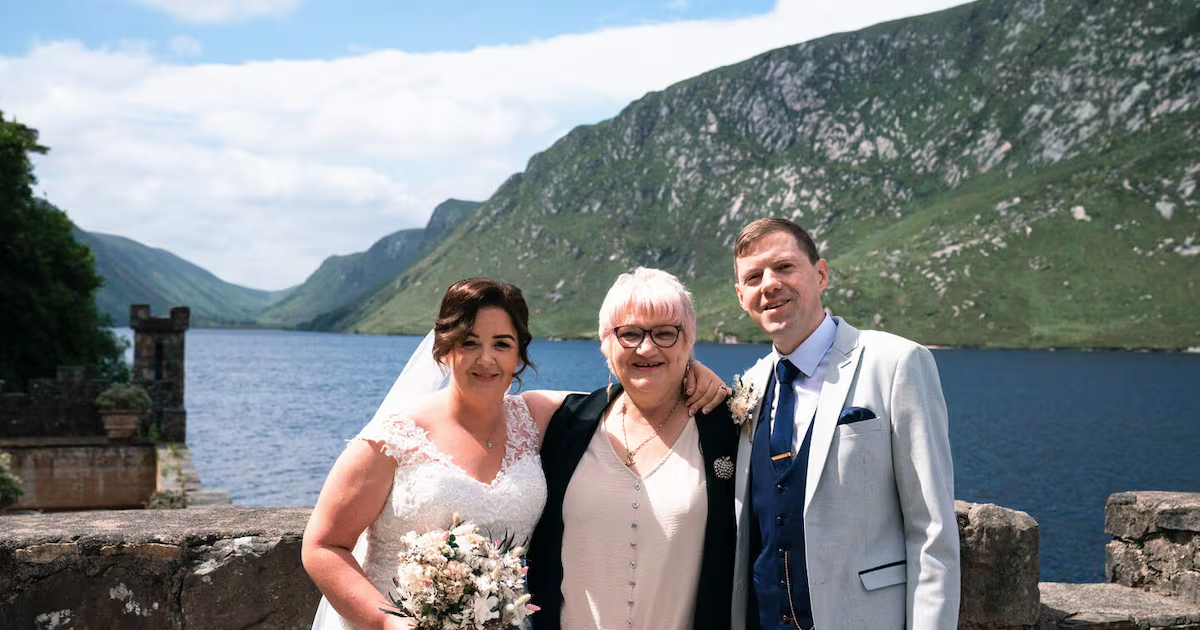
In 2024, civil ceremonies overtook church weddings in popularity – a turn of events that would have seemed impossible just a few decades ago.The retreat of religion from the milestones of life – marriage, birth, death – has created an opening, and the charming new documentary Breith, Beatha, Bás (RTÉ One, Thursday, 8.30pm) celebrates those who have stepped into that gap to minister to our spiritual needs in a non-religious way.In Dundalk, we are introduced to newly-weds Aisling and Ronan, who already have a house and a family and have decided now is the time to tie the knot. “We’ve been together a long time,” says Aisling. “The pressure is gone – we have our children, we have our house. This is just celebrating that life.”The ceremony is conducted by Nóra Ní Raghallaigh who is part of a 21st-century phenomenon of secular wedding officiants. This is a new profession, and it would have been unthinkable until recently to imagine anyone making a living out of non-church nuptials. But now business is booming, as Nóra acknowledges with a smile. “I’ve had a very busy year.”That trend has extended to what was once called the Baptism business. In Newry, Ciara Turley discusses her decision to opt for a secular naming ceremony for her infant son, Noah. “We didn’t have a choice when I was young,” she says, recalling how, as a child, she would often be dragged to mass multiple times in the same day. “Now with my own children I felt that I wanted to give them choice.”Breith, Beatha, Bás (Birth, Life, Death) isn’t particularly profound or inquisitory – it offers snapshots rather than a deep dive. But not every series has to change the world, and the best thing about this Seán Ó Baoill film is that it chugs along in neutral – never earth-shattering but always watchable.The project is nonetheless deeply personal for director Ó Baoill, who was raised Catholic in the Donegal Gaeltacht but who felt that, as a gay man, he had no place in the traditional way of doing things in Ireland: he could not, for instance, be married in a church.The stories he unpacks in Breith, Beatha, Bás are straightforward ones about people just getting on with their lives. But together they draw a perceptive portrait of an Ireland that has undergone huge upheavals and emerged as a country that is both unrecognisable and, in a way, unchanged. After all, we still go to weddings and funerals – the difference, as the documentary explains, is that we no longer feel the need to have these fundamental chapters in our lives legitimised in every instance by a stranger wearing a collar and carrying a prayer book. Regardless of your beliefs, it is hard to think of that as anything other than progress.
Breith, Beatha, Bás on RTÉ One: Charming snapshots of ordinary lives in a changed Ireland
Television: The simple stories unpacked here depict an Ireland that has undergone huge upheavals
466 words~2 min read