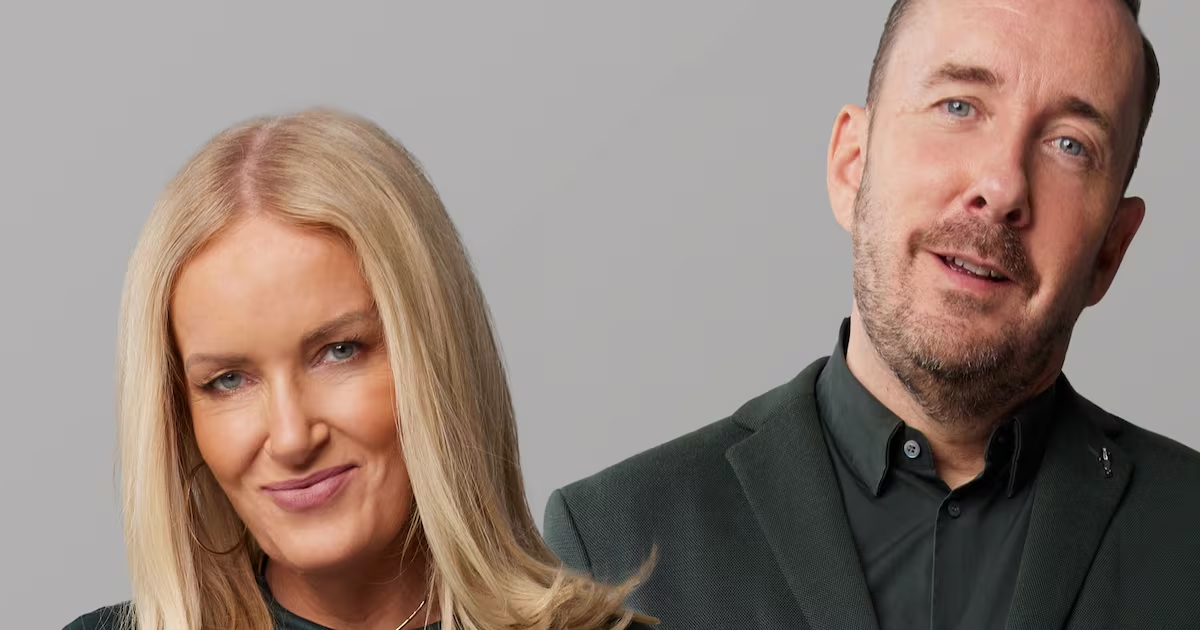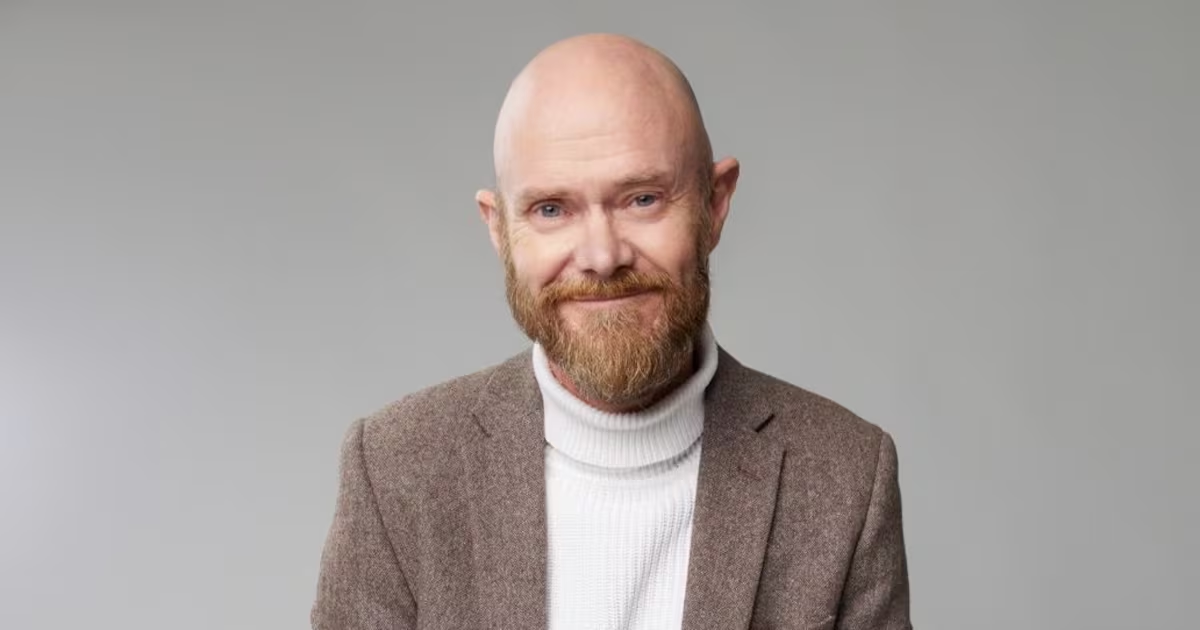
Heated arguments about abortion, earnest debates on Irish unity, paeans to footballers from Ireland performing heroics at the World Cup finals: there’s a decidedly retro feel to the topics on Liveline (RTÉ Radio 1, weekdays) as Kieran Cuddihy sounds out callers on a range of subjects that wouldn’t have been out of place three decades ago. It could be seen as a case of the more things change, the more they stay the same – barring the fact that the Republic of Ireland are absent from the football festivities in North America, of course – but while the issues covered by Cuddihy are hardy perennials, he’s not merely indulging in nostalgia.Tuesday’s discussion about abortion, for instance, is prompted by Sinn Féin’s (subsequently passed) Dáil motion to remove the mandatory three-day wait for such procedures, with the views of some callers underlining that it remains an irreconcilably charged issue. Kiera tells the host why she’s against removing the waiting period – “You never make a very important decision when you’re in desolation” – before talking about the effect of “aborting babies” on women and the virtues of seeing any pregnancy through to full term.Kiera’s tone is heartfelt and compassionate, but her fundamental position is unwavering, as Cuddihy notes: “These are mainly arguments against the access to abortion full stop.” Similarly, Mike is opposed to ditching the mandatory wait on grounds of prudence – by way of baffling comparison, he cites the 30-day cooling-off period for consumer purchases – but also articulates his implacable hostility to abortion, stating that “100,000 babies will be killed” over the next decade.Cuddihy handles this ever-controversial topic with fairness and patience, letting his callers use their terminology of choice and only calling them out if things start to get tendentious. When one caller suggests the three-day period allows women with emergency pregnancies to research their choices, the host coolly responds that this “makes it sound like they’ve popped down to the GP for an abortion”.And while the rationales for or against the waiting period get somewhat lost in the retread of impassioned arguments, new elements in the debate seem to emerge. Some of the loaded phrases that callers use – “Europe is dying because of abortion”; “10,000 Irish babies were saved” – hint that that anti-abortion sentiment here may be dovetailing with nativist ideas, intentionally or otherwise.Themes of identity and division inevitably arise during Monday’s ruminations on the possibility of a united Ireland. The announcement by Tánaiste Simon Harris that Fine Gael will publish a blueprint for a “unified island” prompts some predictable arguments but, thankfully, little of the virulence that once accompanied such exchanges. There’s still the odd curveball, however, such as Kevin’s steadfast opinion on why he doesn’t want the Republic to “take” the North.“Violence is in their DNA up there,” the caller says. “They’re racist. They’re not like us down here.” Cuddihy pushes back, sounding more amused than outraged: “No offence, that is utterly daft.” Still, it’s a diverting discussion, even if, as with the abortion programme, the reliance on dependably contentious chestnuts to generate excitement doesn’t dispel the impression of a show struggling to retain relevance.Amid it all, Cuddihy’s chat with Judy Lopes, mother of the Cape Verde soccer player Pico Lopes, is a welcome bright spot, highlighting as it does the fact that at least one Irish-born player has made it to the World Cup. Talking before Cape Verde’s clash with Spain, Lopes says that her son, a Crumlin native who qualifies for his country through his father, Carlos, is “taking it all in his stride”, an assertion subsequently confirmed by his impressive performance in the drawn match. It’s the second time in a week that Cuddihy speaks to Lopes, a self-confessed Liveline fan (there are still a few), but, far from being overkill, it’s an unambivalently celebratory tale that couldn’t be more timely.Radio 1: Today presenter David McCullagh. Photograph: RTÉ He may represent Cape Verde, but Lopes, who also captains Shamrock Rovers, is the first active League of Ireland player to appear at the World Cup, as Stephen McGuinness of the Professional Footballers’ Association of Ireland points out on Today with David McCullagh (RTÉ Radio 1, weekdays). With racist attacks and anti-migrant rhetoric growing ever more brazen, Lopes’s feats provide an uplifting, if unspoken, rejoinder to those who would frame identity in zero-sum terms. As for Cuddihy, he sounds happier talking about hopeful omens for the future than covering old ground.While the four women whose stories are retold on Control (2FM, Monday-Thursday) are familiar to the point of global fame, the resulting portraits of Mariah Carey, Kate Bush, Enya and Sinéad O’Connor are designed to shatter stultifying preconceptions about women in music. Broadcast over four evenings on the 2FM New Music Show with Beto da Silva (weekdays), the documentary recasts its central protagonists, all of whom are Irish or have Irish ancestry, as innovative musicians and pioneering producers rather than as singing stars. (Full disclosure: in a previous life, its producer, Kate Butler, and I were colleagues.)The series, which is narrated by Renn Miano, recounts the way these women embraced new technology and emerging genres to make music that challenged the accepted gender (and racial) norms of the male-dominated music industry.While the thematic thread is underpinned by a commendably wide array of contributors, with only an occasional surfeit of academic jargon, the broader musical story is recounted in fascinating detail. Whether it’s Enya’s use of the Fairlight synthesiser to produce the signature sound of her seminal hit Orinoco Flow, or Mariah Carey’s working with the hip-hop group Wu-Tang Clan to break out from an unwanted pop image, the series is studded with surprising anecdotes that keep the narrative flowing.Told with the passion and conviction of a manifesto – the final part looks to what the future might hold for female practitioners – the documentary isn’t obviously pitched at the youthful, pop-oriented demographic traditionally courted by 2FM. But just as Luke Clancy’s long-running Lyric FM arts strand, Culture File, unapologetically trades in highbrow sensibilities yet lifts the curtain on seemingly forbidding forms, so Control offers curious 2FM listeners a passionately argued and thought-provoking alternative history of pop. Yet there’s nothing remotely retro about it: you’ll never hear an Enya track in the same way again.Moment of the weekArena host Rick O’Shea. Photograph Nick Bradshaw/The Irish Times It has been a striking couple of weeks on Arena (RTÉ Radio 1, weekdays), with Rick O’Shea, its presenter, conducting enjoyable interviews with the broadcaster Graham Norton and the novelist Maggie O’Farrell. Tuesday’s edition is again noteworthy, as the host invites the author Colm Tóibín to mark Bloomsday by demystifying James Joyce’s modernist classic Ulysses. Tóibín, who teaches a course on the novel at Columbia University, in New York, talks knowledgeably about the opus but also has simple advice: rather than “treat it as a big hard book for big boys written by a genius”, readers should divide the volume up into episodes (“as Joyce did” when he wrote it) and dive in. O’Shea, who brings a silky irreverence to his confident tenure as Arena host, is suitably impressed by his guest’s accessible guide to Joyce’s daunting novel: “I can already feel people unclenching. This is fantastic.” Blooming marvellous.
Kieran Cuddihy risks relevance and goes retro in a week that could have come from the 1990s
Radio: When the Liveline host revisits reliably contentious subjects, he’s not just indulging in nostalgia
TL;DRAI
L'articolo fornito è una critica di programmi radiofonici irlandesi (Liveline e Control su RTÉ Radio) su temi sociali e musicali. **Non è rilevante per Warptech Tech News** — non contiene alcun elemento tech, business o di mercato che interesserebbe manager IT, CTO o decision-maker AI. Verifica il testo: potrebbe essere stato copiato per errore?
1,203 words~5 min read