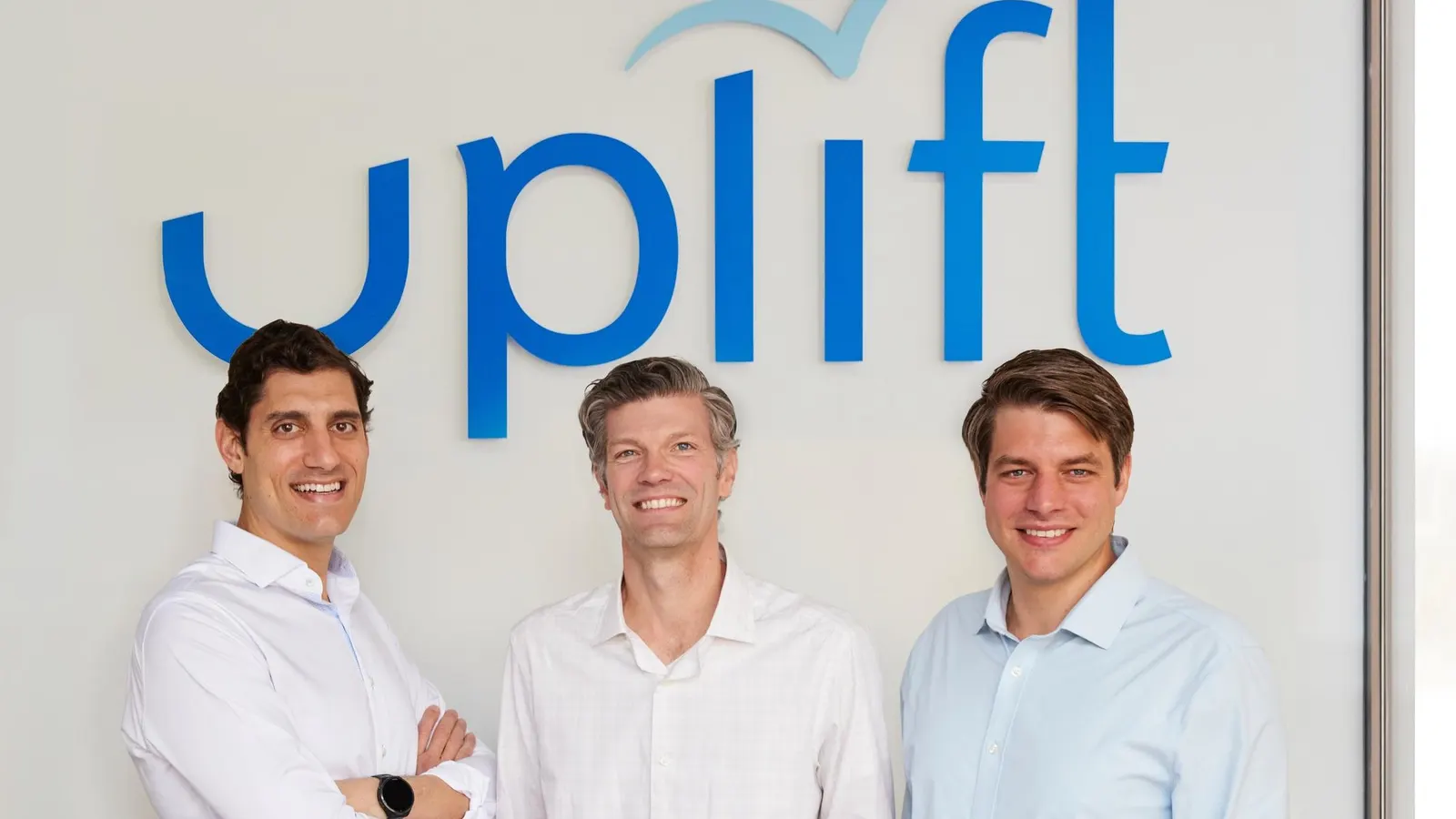
Uplift Investors founders Brad Skaf (L), Will Hausberg (C), and Doug Rosenstein (R).Uplift InvestorsRaising a first-time private equity fund is not easy these days. Higher interest rates have made debt more expensive, exits remain slow and the AI rollout has spawned fears that software companies, PE’s bread and butter just five years ago, have become walking corpses. As a result last quarter, the buyout industry’s fundraising haul “leaned on a handful of giant closes,” such as KKR’s new $23 billion North America fund, according to PitchBook. Against this backdrop, new buyout firm Uplift Investors closed its first fund with $670 million in capital commitments to invest in services businesses, including the legal market. The Darien, Connecticut-based firm was started last year by Will Hausberg, Doug Rosenstein and Brad Skaf, who all formerly worked together at Gridiron Capital, the $9.5 billion (assets) firm located 15 minutes away in New Canaan.Uplift’s pitch to LPs is built around what it calls its “5-5-5 Framework.” The firm starts with five services sectors—legal services, financial services, knowledge and talent solutions, technical trades and industrial services—then looks for narrow niches where a fragmented market and a repeatable business model give it room to build a larger platform.“We invest in services, but services alone is too broad to be a specialization,” Hausberg, 42, tells Forbes. Uplift looks for smaller niches where a service industry meets a specific business model. The firm calls these “microsectors”: clusters of a few dozen companies where it can back one platform, improve operations and build a market leader through acquisitions and growth. “We define a really narrow universe,” Hausberg says.One of Uplift’s earliest and biggest tests of that thesis is in legal services, a market private equity has long wanted to enter. Law firms are fragmented, fee-rich and potentially less correlated with the broader economy than many cyclical businesses, making them ideal targets on paper for outside investors. The catch is that, in most states, ethics rules modeled on ABA Rule 5.4 prohibit nonlawyers from owning law firms or sharing in legal fees. That has left buyout shops staring hungrily at the legal market from outside the fence.Uplift’s recently launched workaround is Orion Legal MSO, its first platform investment and a clear example of its microsector logic. Orion is not a law firm, but a managed services organization (MSO) that supports plaintiff law firms, providing non-legal functions—marketing, finance, technology (including AI), and other operating infrastructure—to law firms, which continue to own and control the actual law practice.Orion’s first business partner and client was Dudley DeBosier Injury Lawyers, the Louisiana personal injury firm. It has since added Hughes & Coleman Injury Lawyers, based in Kentucky and Tennessee, and John Foy & Associates, the Atlanta firm. Hausberg tells Forbes that more firms are on the way.Uplift owns a majority stake in Orion, while Orion’s partner law firms can also own minority stakes in Orion, meaning they have a potentially profitable stake in the same services platform which is charging them for support services. Those fees are worth it, Orion says, because it means participating law firms don’t have to make investments in management systems or technology platforms. All this takes place without any sale of the law firm, which state law generally prohibits.Orion’s playbook is borrowed from older private equity campaigns in other licensed-professional services. In the 1990s, dental support organizations emerged as a way around state rules that generally barred corporations from owning clinical practices: the dentist kept the practice, while the DSO owned the business infrastructure around it. That division helped open the door to MSOs and physician-practice-management companies in specialties from ophthalmology to gastroenterology. IMS Legal Strategies, Uplift’s second investment, shows the buyout firm’s legal-services thesis from a different angle. IMS provides expert-witness, litigation consulting, jury research and trial-support services–all of which nonlawyers can own outright. IMS CEO James Crane said in an interview that his company had talked with dozens of private equity firms before choosing Uplift, describing the process as “a little bit like dating.” Since Uplift’s investment, Crane said IMS has completed its first acquisition under the new ownership, buying Fulcrum, a California litigation consulting practice, and has two more acquisitions lined up. “I think every part of the legal industry has been asked to be more efficient in how they deliver their services,” Crane says. Uplift’s founders bring standard-issue private equity polish to their new venture. Hausberg was a senior managing director at Gridiron and previously worked at Nautic Partners and Credit Suisse; Rosenstein, 39 years old, worked at Gridiron, Sterling Partners and Bank of America Merrill Lynch; and Skaf, 38, worked at Gridiron, Harbor Bridge Capital and Lazard. “We are a people-based business investing in people-based businesses,” says Hausberg. (There is probably a Patagonia vest somewhere with that stitched inside the collar.)Still, beneath the soft-focus language is a clever thesis. Uplift is trying to raise private equity’s pattern-recognition game in services businesses, where the same operating model can show up in different industries wearing different clothes: A litigation-services expert network may resemble a staffing marketplace more than a law firm, while a plaintiff-law MSO like Orion looks more like a physician-practice management company than a legal-services vendor. The risk around its hallmark investment Orion is that regulators may one day take a dimmer view of MSO models that place investors near law-firm management, even if the law firms themselves remain lawyer-owned. For now though, Uplift seems to have found a structure that gives plaintiff firms scale, tech and operating leverage, while giving them access to the economics of cash-generating law firms, and all without a frontal assault on state laws.
Buyout Firm Uplift Investors Raises $670 Million To Invest In Legal And Other Services
A debut private equity fund from a trio of dealmakers is betting big on legal services, including a management-services structure for plaintiff law firms.
934 words~4 min read