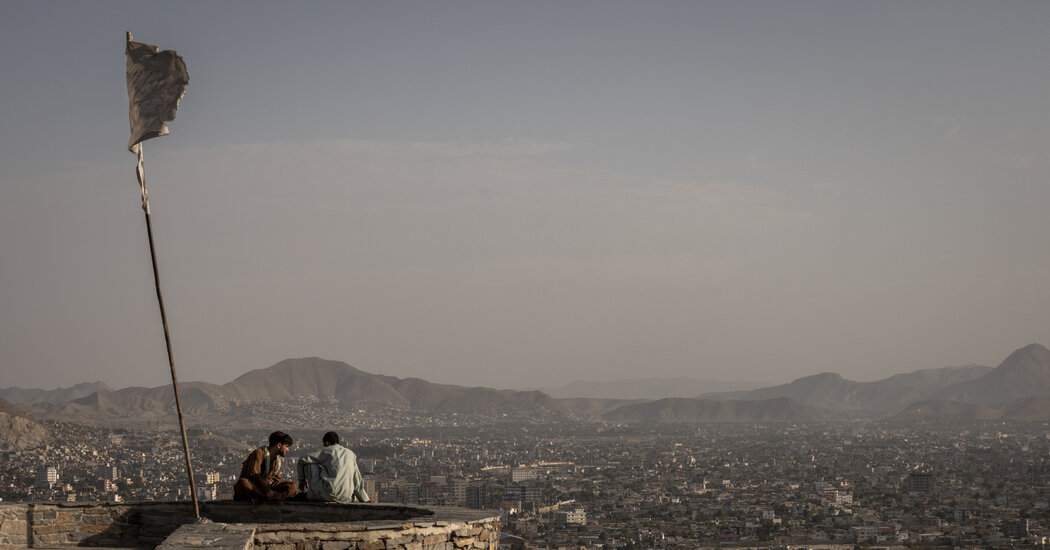
Momin Khan works long hours running a small shop in the Afghan capital, Kabul. He's fortunate to have work, but like many of those around him who don't have a job, he finds himself in the same position as them: relying on remittances from family abroad to survive.Since the Taliban regained control of Afghanistan five years ago as international military forces withdrew, the country's economy has sputtered, inflation has spiked to erode purchasing power, and international investment has all but dried up, leaving ordinary Afghans like Khan scrambling.Khan told RFE/RL's Radio Azadi that each month, expat members of Afghan families send money back home from around the world, providing a lifeline amid troubled economic times.“Those [families] depend entirely on the money that is sent to them [from abroad]. So, almost every month, I collect the money for them and deliver it. It has turned into a main source of survival for those families,” he said.
Since retaking power in August 2021, the Taliban-controlled government has tried to play up economic successes after rolling out a five-year National Development Strategy last year.But few Afghans are feeling a positive impact. In fact, many are feeling the opposite in one of the world's poorest countries, which has been wracked by decades of war.The annual inflation rate in May hit 8 percent, compared with 0.5 percent in the same month a year earlier. Food inflation, which measures price growth across a basket of food items, was even higher at 8.2 percent.When Radio Azadi spoke to families in different provinces around the country, the same problems -- inflation and a lack of employment opportunities -- were brought up.Abdul Sattar Ayubi, a resident of Sawkay district in Afghanistan’s eastern Kunar Province, told Radio Azadi that had it not been for his son sending money, his family would have been left with no other source of income."My son is based in London and supports the family by regularly sending money from there. We wouldn’t be able to fulfill our daily expenses without his support,” said Ayubi, adding that “with no jobs or business opportunities in the country,” Afghans who have relatives or family members abroad basically have to receive financial support to survive.There is no official figure indicating the exact number of foreign remittances to Afghanistan in 2026, mainly because most of the money inflows come via channels such as Hawala, an informal system of lenders that operates outside the traditional banking system.Azarakhsh Hafizi, former head of Afghanistan’s Chamber of Commerce, told Radio Azadi that foreign remittances have effectively tripled in recent years.“In the past, Afghans living abroad used to send around $1 billion a year. That amount now stands between $2.7 billion and $3.5 billion annually,” said Hafizi, who returned to Kabul after staying in Germany for many years.