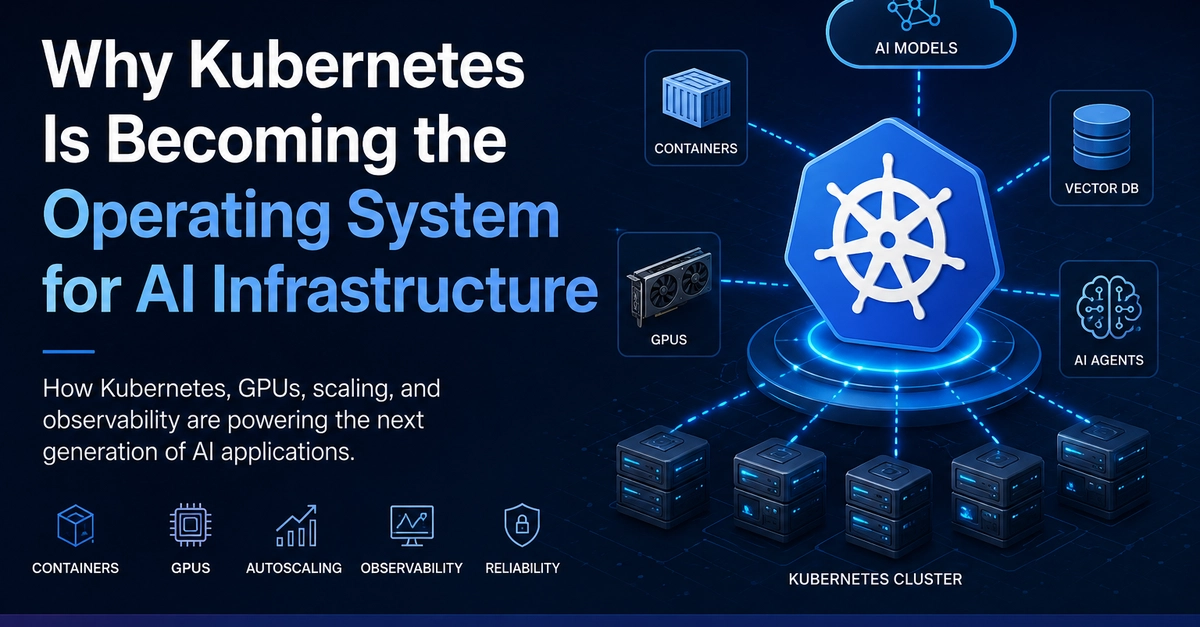
For a decade, Kubernetes was the right answer. It organized containers, scaled services horizontally and gave platform teams a shared vocabulary for running software in production. It abstracted away enough of the underlying complexity that engineers could stop thinking about servers and start thinking about services. Most cloud-native infrastructure today is built on top of it, directly or in spirit, and EKS made that model the default for the majority of enterprise teams running workloads on AWS.
The workload that defined that era was the stateless HTTP request, fast in, fast out, disposable. A user action triggers a request, the request hits a service, the service returns a response and the container is done. Kubernetes was optimized for that pattern down to the scheduler internals: Bin-pack containers onto nodes, autoscale on CPU and memory, evict and reschedule when something goes wrong. The whole system is tuned around the assumption that individual units of work are short, stateless and interchangeable.
That assumption no longer holds for the workloads that matter most right now.
The agent workload is structurally different
Agents are long-running, stateful processes. They reason across time, call external tools, spawn subprocesses, write and execute code, and make decisions that depend on what happened five steps earlier in the same task. A single-agent workflow might run for minutes or hours, touching a dozen external systems and generating intermediate outputs that subsequent steps depend on. The compute layer for that kind of work needs to do things the old model was never asked to do. That is the new pattern: Execution infrastructure designed around agent semantics rather than request semantics.