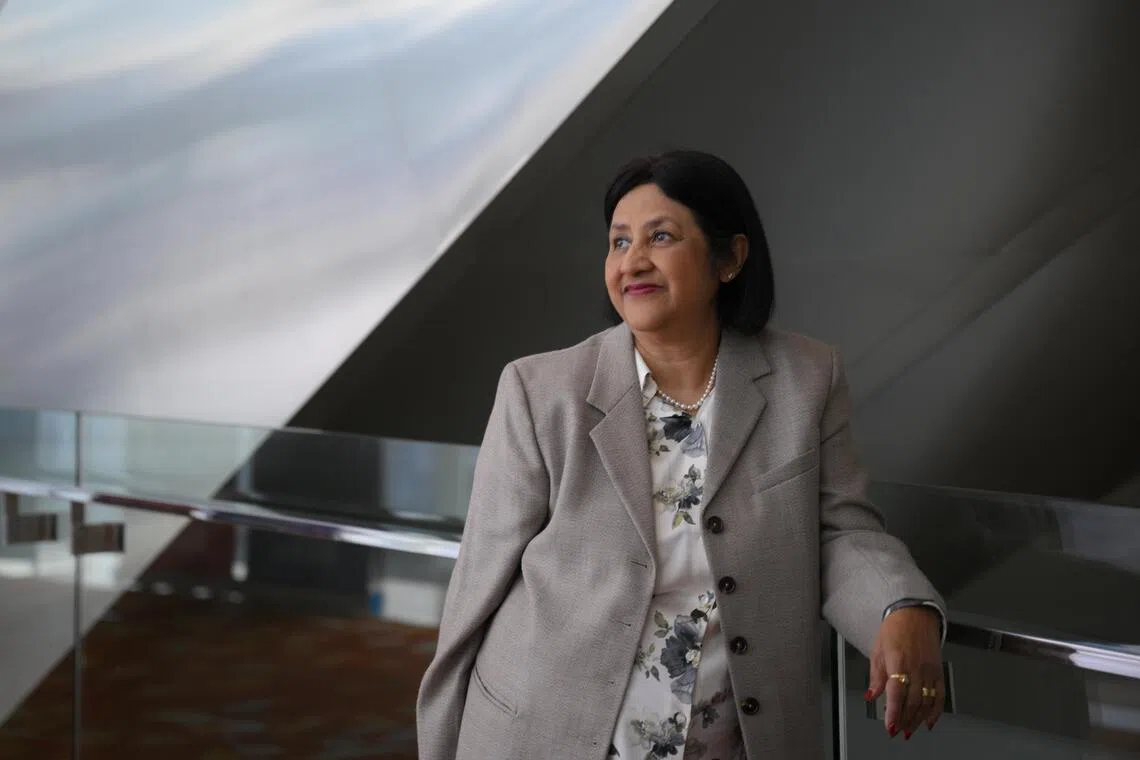
SINGAPORE – Ask a worker in a modern and advanced country such as Singapore about artificial intelligence, and you may hear apprehension. Ask one in India, and you are more likely to hear hope.In advanced economies, by contrast, people who already enjoy a comfortable standard of living may simply have less to aspire to.This disparity in AI sentiment could stem from the transformative impact that technology has had on Indian society, says Arundhati Bhattacharya, cloud software provider Salesforce’s South and South-east Asia president and chief executive.She recalls an AI summit she attended in Delhi in February. “Not one of the attendees asked what would happen to their jobs,” she says. “How would AI help them and what are the opportunities – that was what all of them wanted to know. This was such a contrast to some of the other conferences I’ve been to in the West.”Amid global fears that AI will displace jobs, optimism about the technology is growing in India – home to the world’s largest youth population of some 371 million, says the 70-year-old Indian national.People in lower socioeconomic classes, she notes, have benefited enormously from technologies like mobile connectivity and universal digital payments, which have transformed the way locals do business. Living standards in India have risen rapidly as a result.“Young people in such countries believe technology is going to make their lives better and, therefore, welcome AI,” says Bhattacharya.While Singapore already has the expertise, with digital services well entrenched in society, its ageing population makes it urgent for workers to become proficient in AI, Bhattacharya notes.This way, younger Singaporeans can combine their technological know-how with the experience of their older colleagues to take on more complicated tasks once considered too difficult.The spread of AI, Bhattacharya believes, will lift living standards worldwide.Adapt, don’t fearShe says more needs to be done to educate people on how much AI can improve their lives. Beyond enhancing citizen services, it can open up new opportunities and knowledge fields once closed to them.In countries larger and less developed than Singapore, AI has become essential to delivering public services, she adds.“AI gives you the ability to go across the world and find solutions to problems, and the kind of expertise that you would never have been able to access otherwise. It gives meaning to what you are doing.”Humans working in tandem with AI, rather than being displaced by the technology, will be the real future, believes the former chairperson of the State Bank of India, who was the first woman to assume the role.This is evident in San Francisco-based Salesforce’s latest suite of customer relationship management (CRM) products. Called Agentforce, it comprises autonomous agents – AI systems that can perform tasks and design workflows – to handle work across a company’s sales, service, marketing and operations.For instance, it could generate new sales leads on a company’s web chat platform and then nurture them via e-mail, without human input – increasing a sales team’s productivity.On Slack, the team communication platform which Salesforce acquired in 2021, companies can customise the embedded AI agent to perform specific tasks with simple conversational commands.Complementary forceDespite these autonomous functions, Bhattacharya stresses that the technology is designed not to replace human workers but to complement them – giving people the tools to build and manage a suite of AI agents.“We need to have a balanced view of what agents can contribute to a company. Autonomous agents can provide us with outcomes, while humans provide the strategy and direction, as well as the intent and ethics.”As a result, she says, there will be a fundamental shift in how companies operate.“I do believe we are the last generation of managers who are going to manage only humans in our teams. The future of managers is to be able to orchestrate teams that have AI agents as well as humans, and this is a change that will not go away.”Bhattacharya adds that the transformation need not lead to job losses, but that workers will have to equip themselves with a different set of skills for the new economy.“A person who knows AI will probably take one job; not AI taking the job. Jobs will not go away, but I might get ‘taken away’ because I don’t understand AI.”Surviving the shakeoutSalesforce’s AI push comes at a critical juncture for the software-as-a-service (SaaS) sector. Rapid AI development has replaced many coding and workflow tasks that software products used to handle, thus disrupting the “per-user” subscription model of most SaaS companies.As a result, this triggered a massive tech sell-off on Wall Street in early 2026, with around US$2 trillion (S$2.58 trillion) wiped out from software stocks.The world’s largest CRM provider has not been spared. While Salesforce’s revenue rose 10 per cent year on year to US$41.5 billion and net profit climbed 20.3 per cent to US$7.5 billion for the financial year (FY) ended Jan 31, its share price has fallen more than 40 per cent since a year ago.However, Salesforce remains optimistic. It forecast revenue growth of 10 per cent to 11 per cent in FY2027, with a target of US$63 billion by FY2030.It reported US$1.2 billion in revenue in the first quarter of FY2027 ended April 30 – a 205 per cent increase year on year – but it declined to disclose the figures for its Asia-Pacific business.“I don’t believe our business model is wrong,” says Bhattacharya. “It’s very relevant and very much required.”Agentforce will be a key growth driver for Salesforce – and a catalyst for changing how the company charges. Where its products were once sold on a per-user subscription basis, Salesforce can now price them in a hybrid model tied to customers’ usage.Bhattacharya says the new subscription and payment model will benefit the many customers saddled with legacy systems and accumulated technical debt – meaning they used expedited solutions over the years for increasingly outdated systems that are now too costly to upgrade.The pivot is also necessary for Salesforce to sustain its growth and defend its market share, she adds.The case for opennessIn an age of AI disruption, SaaS companies will need to offer more than just another software tool to survive. Salesforce, in Bhattacharya’s view, is well placed to keep growing by offering a software architectural ecosystem that enables customers to process data in the right context and within a highly secure environment.This platform is also designed to be open, letting customers combine external AI agents with Agentforce. While locking customers firmly into its own ecosystem and product suite might benefit Salesforce in the short run, Bhattacharya believes an open system – one that allows customers to use multiple AI agents and large language models on the platform – will serve the company better in the long term.Technology is evolving so fast that it is not realistic to lock customers in, she says. Instead, they are more likely to stay with a SaaS provider that both delivers the latest updates continually and gives them the freedom to use different tools.“Holding the customer tight is not the answer,” says Bhattacharya. “I’m reminded of a Buddhist saying – if you try to hold water by clenching your fist tightly, you will lose it. But if you hold it lightly, the water will rest on your hand.”
AI in management: The future of work
Salesforce S-E Asia CEO discusses how AI is changing management, urging adaptation for the future of work. Read more at straitstimes.com. Read more at straitstimes.com.
1,204 words~5 min read