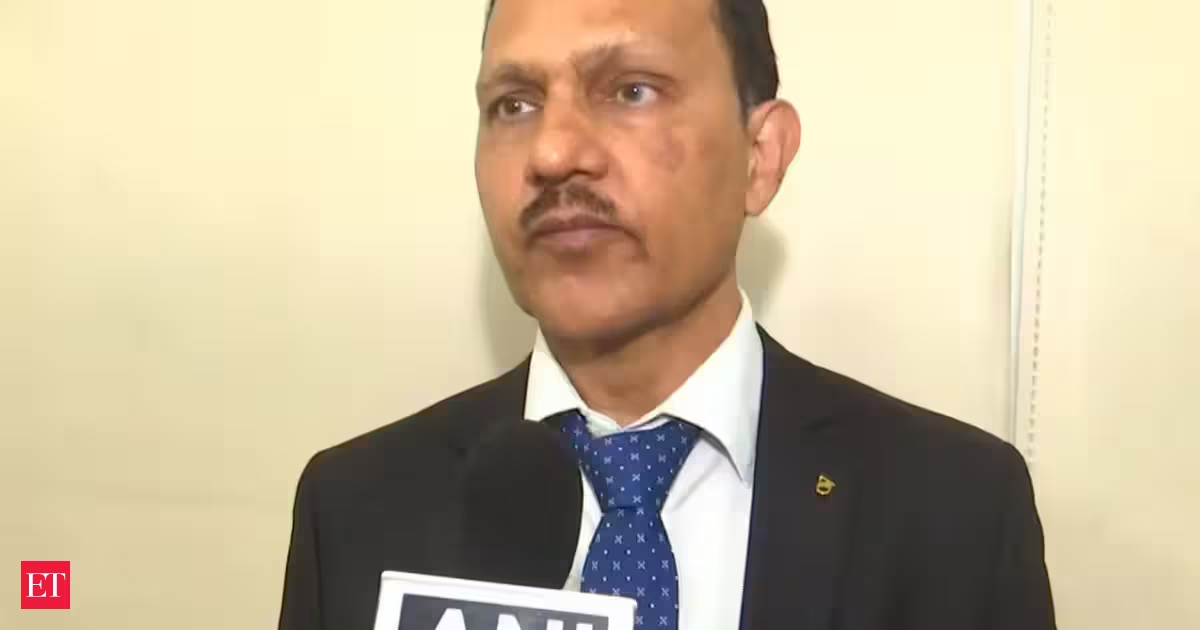
The approval of the next phase of Semicon India Programme (Semicon2.0), with an outlay of ₹1,27,500 crore, has the potential to position India not just as a manufacturing destination, but as a globally competitive hub for semiconductor innovation, said analysts and industry veterans.The Cabinet on Wednesday had approved the policy under the India Semiconductor Mission (ISM) to accelerate the development of a robust and resilient semiconductor ecosystem in India with six pillars in mind including design; machines and materials; setting up of more fabs; further strengthening the ATMP/OSAT (Outsourced Semiconductor Assembly and Test/ Assembly, Testing, Marking, and Packaging) industry; research and development (R&D); and talent development. Further, Semicon 2.0 will also support economic growth across all sectors, strengthen national security through enhanced supply chain resilience, and help establish technological leadership in critical sectors. Approach of building the complete ecosystem, will catalyse semiconductor design and manufacturing in India, the government said.“Semicon 2.0 marks decisive step in India’s journey from policy intent to execution at scale. Phase 1 established India’s credibility; Phase 2 builds long-term capability. By strengthening ATMP/OSAT packaging, R&D, and talent development, each backed by incentives of up to 75 per cent under the design and R&D pillars, the government is creating the full-spectrum support our industry has been advocating for and foundation for a globally competitive ecosystem that will attract sustained investments, create high-value employment and significantly enhance domestic value addition,” Ashok Chandak, President, India Electronics and Semiconductor Association IESA and SEMI India (Indian arm of the global semiconductor industry association), said.He said Semicon 2.0 comes at an opportune moment as the global semiconductor industry enters an unprecedented investment cycle.“With worldwide semiconductor manufacturing equipment spending expected to grow to nearly $230 billion by 2028, the policy positions India to capture the next wave of global investments in semiconductor manufacturing, advanced packaging, equipment and materials,” he added.According to IESA, the ISM 2.0 is also expected to catalyse another $40–50 billion in investments, create 2–3 lakh high-skilled jobs, significantly enhance domestic value addition and strengthen India’s position as a trusted global semiconductor partner.Together with complementary initiatives such as the Electronics Components Manufacturing Scheme (ECMS), Production Linked Incentive (PLI), Electronics Manufacturing Clusters (EMC 2.0) and State programmes, Semicon 2.0 has the potential to accelerate India’s journey towards nearly 40 per cent domestic value addition in electronics manufacturing, it added.Pankaj Mohindroo, Chairman, India Cellular & Electronics Association (ICEA), said that India has demonstrated the intent and long-term commitment to the semiconductor industry with more than 12 approved projects in just four years, under ISM 1.0 and ISM 2.0 now builds on this strong foundation with a significant emphasis on design, R&D, capital goods, and entire supply chain and skill development.“This reflects the government’s long-term vision to build capabilities that are relevant to global supply chains and position India as a consequential player in the global semiconductor industry. India has a unique opportunity to emerge as the skill capital for the global semiconductor industry, with our exceptional engineering and technology talent becoming a strategic resource for the world. Forward looking State governments will now fiercely compete for investments in their respective States to get a share of ISM 2.0. Semiconductor design including AI compute with IP owned by Indian companies will be a focus area,” Mohindroo said.Aisha Ali Hussaini, Semiconductor Tax Partner at EY India, said that with anchor investments secured in fabrication and packaging and commercial production now underway, India has moved decisively from ambition to execution.“The programme’s focus on strengthening the broader ecosystem, reflects the next stage of sector development,” Hussaini said.Published on July 16, 2026
Approval of Semicon 2.0 will make India global competitive hub: Industry veterans
Semicon 2.0 positions India as a global semiconductor hub, boosting economic growth, national security, and technological leadership.
594 words~3 min read