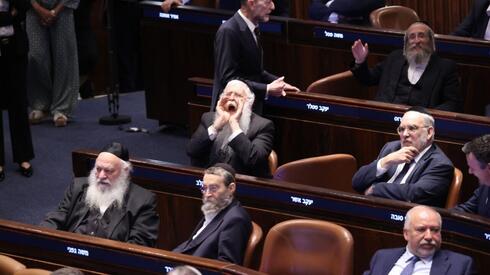
ByJPOST EDITORIALJULY 16, 2026 05:57On Tuesday afternoon, the ruling coalition delivered one final punch to the nation’s gut on its way out when the Knesset passed a bill freezing the arrests of haredi (ultra-Orthodox) draft evaders for at least six months.Fifty-eight lawmakers voted in favor, while 54 voted against. Prime Minister Benjamin Netanyahu, whose arrival in the plenum prompted verbal clashes with the opposition and cries of “disgrace” from bereaved families and IDF reservists watching the proceedings, left shortly afterward and did not remain for the vote itself.This legislation is, at best, an irresponsible attempt at solving one of Israel’s most divisive issues. At worst, it is a short-sighted political maneuver designed only to preserve haredi participation in the right-wing bloc for the next election cycle. Instead of finally confronting calls for equality in sharing the burden of national service, the coalition chose to shield one sector from enforcement while asking everyone else to continue carrying that burden.And, as expected, the High Court of Justice intervened on Wednesday, issuing a provisional order suspending the law’s entry into force until further notice. Justice Ofer Grosskopf explained that the order was necessary, among other reasons, because of the implications of freezing enforcement proceedings “with regard to only certain sections of the population.”The court was right to act swiftly to protect equal treatment under the law. Why should an 18-year-old in Bnei Brak be free to ignore a draft order while another 18-year-old, five minutes away in Ramat Gan, could face military prison for doing exactly the same? The bill was always destined for judicial review, and its temporary suspension should not surprise a single coalition lawmaker.The Knesset votes on a bill to freeze arrests of haredi draft evaders, in Jerusalem, July 14, 2026 (credit: CHAIM GOLDBERG/FLASH90)If the government hopes to convince Israelis that the High Court is overstepping its authority – an argument many find persuasive – introducing legislation that explicitly creates unequal enforcement is a remarkably poor way to make that case.It is certainly not unusual for a coalition to rush legislation through the Knesset in its final days before dissolution. But this coalition would do well to remember that it was the government in office on October 7, 2023, and remains responsible for leading Israel through the largest massacre of Jews since the Holocaust, as well as the longest and most demanding war in the nation’s history.A changing reality and greater manpower shortageThroughout that war, the military echelon has repeatedly sounded the alarm over the IDF’s severe manpower shortages. Chief of Staff Lt.-Gen. Eyal Zamir has warned that the army risks “collapsing into itself” if those shortages are not addressed. In a last-ditch effort to stop the legislation, Zamir warned lawmakers on Monday that implementing the bill would create significant national security risks and said he opposed it “completely and unequivocally.”This government was democratically elected in November 2022, but circumstances have changed dramatically since then. The October 7 massacre and the wars that followed have fundamentally reshaped Israel’s security reality. Poll after poll across Israeli media has shown that a majority of Israelis, many of whom have completed mandatory service and continue to serve lengthy reserve duty stints in Gaza, Lebanon, Syria, and the West Bank, oppose exempting haredim from military service.The lawmakers within the coalition who resisted this legislation deserve credit for doing so. Likud MK Yuli Edelstein had already announced he would seek a new political home, months after being removed as chairman of the Foreign Affairs and Defense Committee for insisting on haredi enlistment. Fellow Likud MK Dan Illouz is expected to leave the party, while Deputy Foreign Minister Sharren Haskel resigned following the vote.Their principled stance is commendable, yet it is difficult to escape the feeling that it is too little, too late. The Knesset will disperse on Friday, and Netanyahu’s government will continue to serve in a transitional capacity until elections are held and a new coalition is formed.The key issues that have divided Israel for years cannot be settled through short-sighted, last-minute bills pushed through the Knesset. Israelis, regardless of their political affiliation, cannot reasonably be expected to support legislation that even the prime minister could not bring himself to vote for.The only appropriate course of action now is to leave the question of haredi enlistment to the voters in October.Follow us on Google
The haredi draft question should be decided by voters, not outgoing lawmakers | The Jerusalem Post
Israelis, regardless of their political affiliation, cannot reasonably be expected to support legislation that even the prime minister could not bring himself to vote for.
720 words~3 min read