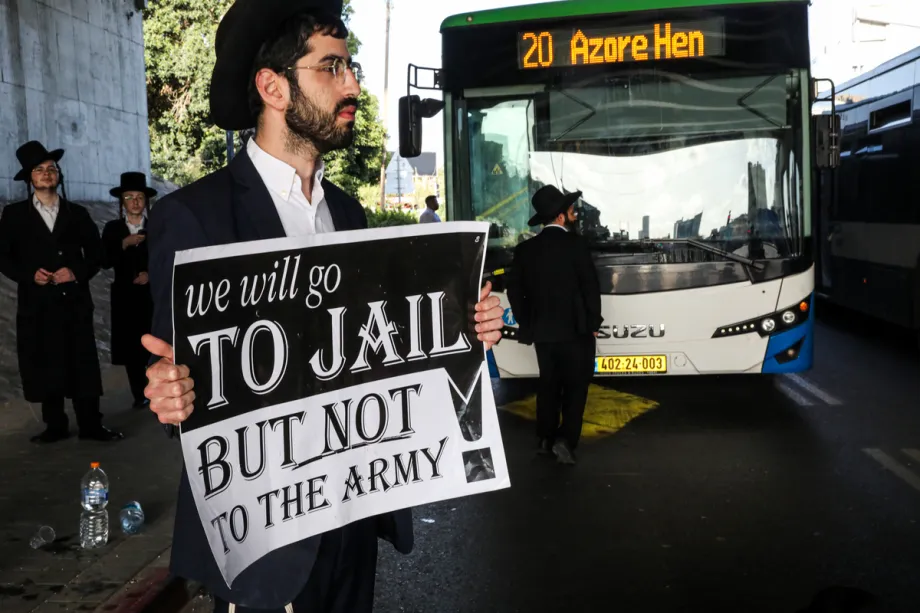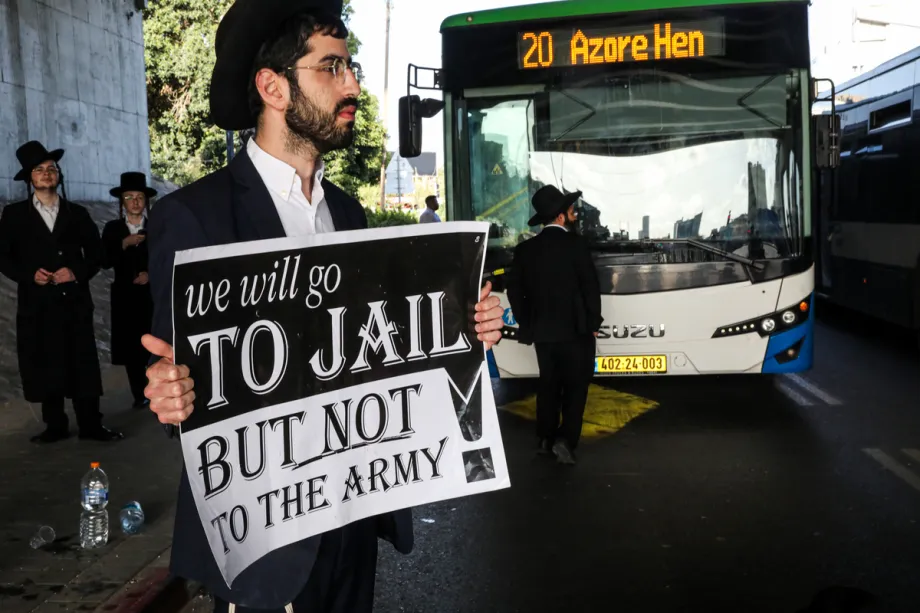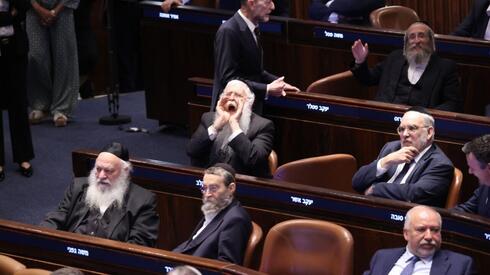
The arrest-freeze law is intended to prevent for several months the arrest, investigation and enforcement proceedings against ultra-Orthodox deserters who are recognized as yeshiva students; The law was approved by a vote of 58 to 54 The Knesset plenum on Tuesday passed into law a bill exempting Haredi draft dodgers from arrest in its second and third readings, as part of the coalition’s effort to ensure that all legislation included in its deal with the ultra-Orthodox parties, alongside other bills important to the government, is passed before the Knesset enters its election recess on July 17.Prime Minister Benjamin Netanyahu was again absent from a vote on a controversial bill, after also missing the approval of the Basic Law on Torah Study and the first-reading vote on the bill to establish a political commission of inquiry into the October 7 massacre.Amid the legislative blitz, and under pressure from the ultra-Orthodox parties, coalition chairman Ofir Katz removed the Metropolitan Authorities Law from the Knesset plenum’s voting agenda. The bill is considered the most important measure for improving public transportation in Israel’s most congested areas. Behind the pressure not to pass any legislation before the arrest exemption bill was an instruction from Haredi leader Rabbi Dov Lando to the ultra-Orthodox lawmakers not to trust Netanyahu “until the last moment.”GalleryLawmaker calls out his vote on the bill to freeze arrest of Haredi draft evaders (Photo: Alex Kolomoisky)A commotion broke out during the roll-call vote on the bill and continued throughout the vote. Likud lawmakers Yuli Edelstein and Dan Illouz voted against the bill, as did Knesset lawmakers Sharren Haskel and Moshe Solomon. Michal Woldiger and Ofir Sofer of Religious Zionism were absent from the vote. Netanyahu was not present in the plenum when his name was called and did not participate in the vote. The bill passed with 58 lawmakers in favor and 54 opposed. Immediately after its approval, petitions against the law were filed with the High Court of Justice by Yesh Atid, Yisrael Beytenu and the Movement for Quality Government.Communications Minister Shlomo Karhi lashed out at secular Israelis while filibustering during his speech after hours of debate. Opposition lawmaker Gilad Kariv attacked him, saying: “Hatred is not my Torah. Shame on you, you are a man of baseless hatred.”(Photo: Alexander Kolomoisky)Before the vote on the bill itself, the plenum voted on reservations submitted against it. The votes on the reservations were accompanied by opposition lawmakers shouting “shame, shame” and “go, go.” At the same time, Solomon of Religious Zionism declared in advance in the plenum that he would vote against the bill, citing “a deep understanding of the implications for society and for the IDF.”Ahead of the vote, Netanyahu arrived in the plenum after attending the Negev Conference in Dimona, but later left amid chants of “go,” and did not participate in the vote.During the debate on the bill exempting draft dodgers from arrest, ultra-Orthodox lawmakers were instructed by the Knesset legal adviser to disclose whether they had family members who are deserters and who could benefit from the law. Lawmaker Elazar Stern said before the vote: “Following the legal adviser’s instruction, Deri has deserter grandchildren” — and Deputy Knesset Speaker Limor Son Har-Melech demanded that his microphone be cut off.Prime Minister Benjamin Netanyahu left the plenum before the vote(Photo: Alexander Kolomoisky)She later read a disclosure statement on behalf of nearly all Shas and United Torah Judaism lawmakers, though it did not explicitly state that they had deserter relatives. The statement said: “Among the tens of thousands of Torah students, we too have children and grandchildren over the age of 18 who serve as the tribe of Levi, and we are proud of them, and it is possible that the provisions of the current bill will affect them.” Opposition lawmakers argued that this did not constitute proper disclosure.The arrest-freeze bill is intended to prevent, for several months, the arrest, investigation and enforcement proceedings against Haredi deserters who are recognized as yeshiva students. Under the updated text, the law will remain in effect until November 30, instead of only 90 days as originally stipulated. Due to provisions of Basic Law: The Knesset and the approaching election, its validity could extend into the next Knesset’s term.The text includes a mechanism for declarations and inspections, as well as a list of yeshivas to be determined by the defense minister while taking into account the recommendations of the yeshiva committee and the Education Ministry’s oversight mechanisms. At the same time, several sanctions initially proposed against yeshivas found to be in violation were removed from the text.Opposition lawmakers call out 'Shame, shame'(Photo: Alexander Kolomoisky)The legal adviser to the Foreign Affairs and Defense Committee also sharply criticized the proposal, defining it as a “sectoral exemption” that does not include a balancing mechanism to reduce inequality. In her opinion, she warned that an arrangement exempting a certain group from the obligation to comply with the Security Service Law, without effective oversight or complementary sanctions, intensifies the constitutional difficulty posed by the bill.As part of the deal with the ultra-Orthodox parties, Netanyahu decided to advance the laws they demanded just before the end of the term for one reason: to preserve the coalition bloc so the parties enter the coming election united. Given the current polling situation, Netanyahu and his aides believe the price he will pay for advancing the Haredi legislation is lower than the cost of being left without a united bloc, which could at least prevent the opposing side from forming a government.On Monday, the softened version of the Basic Law on Torah Study passed amid sharp criticism from reservists and the opposition. As part of the deal, the ultra-Orthodox parties gave up on passing the daycare subsidy law in the current Knesset, but in return received passage of the Basic Law on Torah Study, the law preventing arrests of deserters and the kashrut law.(Photo: Alexander Kolomoisky)The ultra-Orthodox parties, for their part, will support the bill splitting the attorney general’s role, which is therefore expected to pass in its second and third readings. In addition, the ultra-Orthodox lawmakers voted in favor of the bill to establish a political commission of inquiry into the October 7 massacre in its first reading.The bill exempting Haredi draft dodgers from arrest reached final approval in the Knesset plenum despite opposition from IDF Chief of Staff Lt. Gen. Eyal Zamir, and a day after the Foreign Affairs and Defense Committee approved for second and third readings the bill extending mandatory military service to 32 months — shortly after the Knesset gave final approval to the Basic Law on Torah Study.The Metropolitan Authorities Law, it should be recalled, reached the final stretch only this month after years of ego and power struggles. Had it passed, the Transportation Ministry would have given up broad powers to local authorities in the Tel Aviv metropolitan area, Jerusalem and Haifa, which would be responsible for comprehensive planning at the metropolitan level.The long-awaited change was meant to improve public transportation, bicycle lanes, schedule coordination between different modes of transportation and easier travel from city to city, so that fewer residents would rely on private cars in the country’s most crowded areas.The Economic Affairs Committee approved the Metropolitan Authorities Law about two weeks ago, and it appeared on the agenda as one of the bills to be brought for legislation in the final week. But ultra-Orthodox lawmakers pressured Katz to prioritize legislation important to them under the deal, including the exemption from arrest for Haredi draft dodgers, the kashrut reform, expanded gender segregation in academia and more. The ultra-Orthodox parties also oppose the law out of concern that it would lead local authorities to create independent solutions regulating public transportation on Shabbat.In addition, other bills important to the coalition — such as Karhi’s Communications Law and the law extending mandatory service — are also expected to be advanced urgently. As a result, and because debate on every controversial bill lasts long hours, other bills were pushed aside, including the Metropolitan Authorities Law.The opposition made clear to the coalition chairman that even without the ultra-Orthodox parties, the bill would receive its support. But in the end, Katz yielded to political interests.If the bill is nevertheless added at the last minute and passes in the Knesset this week, perhaps under pressure from Transportation Minister Miri Regev, the new authorities could begin work within six months. But removing it from the agenda would miss a historic opportunity and delay it by at least a year. At a time when traffic jams are only growing and Israel’s population continues to expand, this is a fateful decision that will affect the lives of hundreds of thousands of residents.
Law freezing arrests of Haredi draft evaders passes Knesset as Netanyahu absent from vote
The arrest-freeze law is intended to prevent for several months the arrest, investigation and enforcement proceedings against ultra-Orthodox deserters who are recognized as yeshiva students; The law was approved by a vote of 58 to 54
1,444 words~7 min read