This is a submission for DEV's Summer Bug Smash: Smash Stories powered by Sentry.
If you have built event-driven systems for any length of time, you have probably internalized the mantra of at-least-once delivery: keep retrying until the work is done, and design everything downstream to be idempotent. It’s good advice. But there’s a subtle failure mode that hides right underneath it - one where your system faithfully reports success, commits its progress, and quietly drops work on the floor. No exception, no alert, no dead letter. Just a message that was supposed to do something, and didn’t.
I ran into this recently while debugging why a small percentage of events were mysteriously never being processed. Everything looked healthy. The producer got a 2xx. The consumer committed its offset. The dashboards were green. And yet the work never happened. This post is about that gap - the space between “the system accepted my request” and “the system actually did the work” - and why it’s one of the more dangerous places for a distributed system to lose data.
Motivation
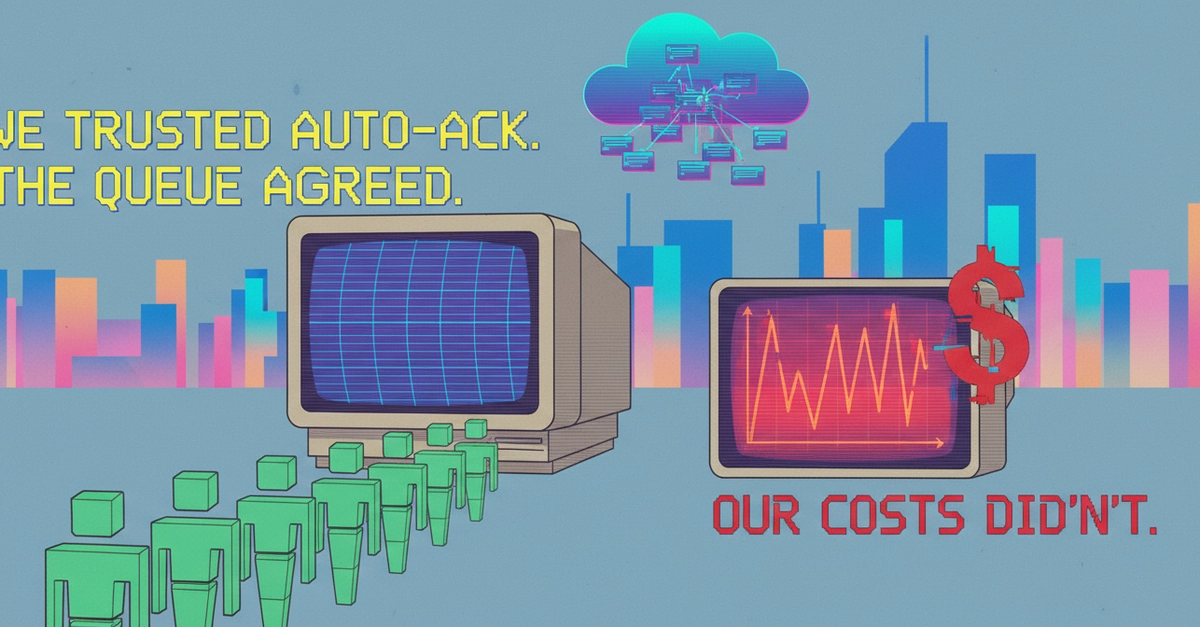
Most write-ups about message-processing reliability focus on the well-known hazards: duplicate delivery, out-of-order messages, poison pills, consumer lag. Those are real, and there’s plenty written about them. What I found much less discussed is the case where the acknowledgment itself is a lie - where a component reports success for an operation that has only been accepted, not completed, and a second component treats that acknowledgment as permission to throw the original message away.