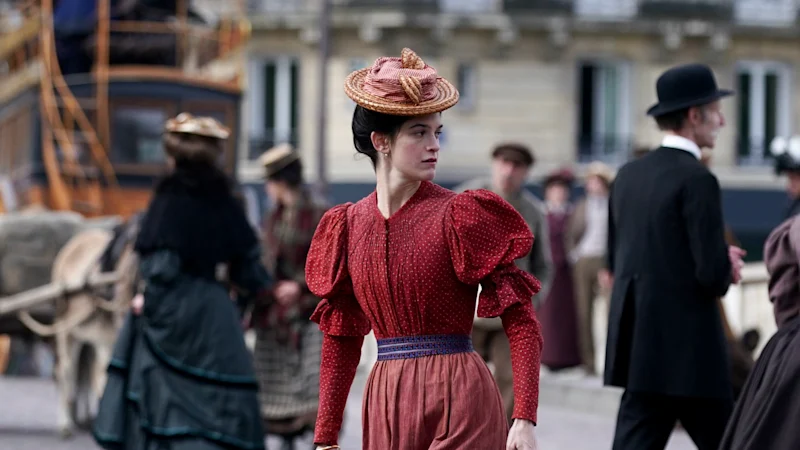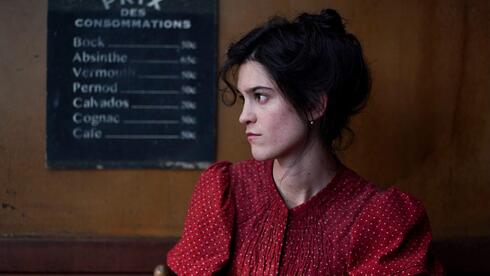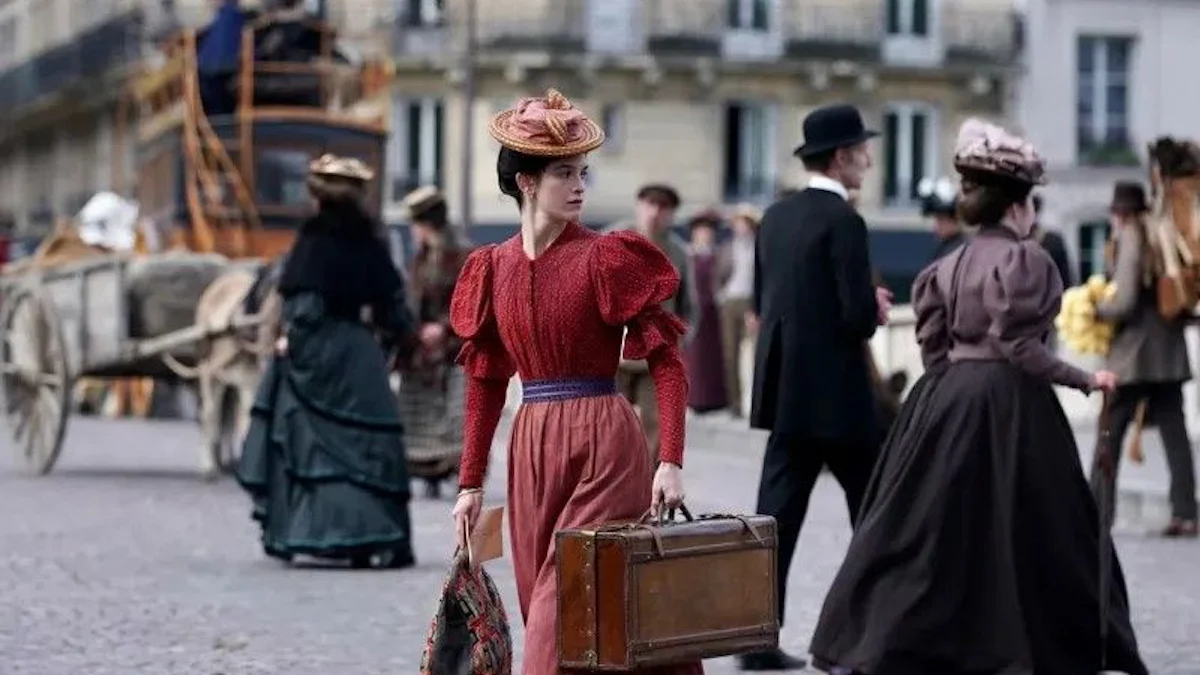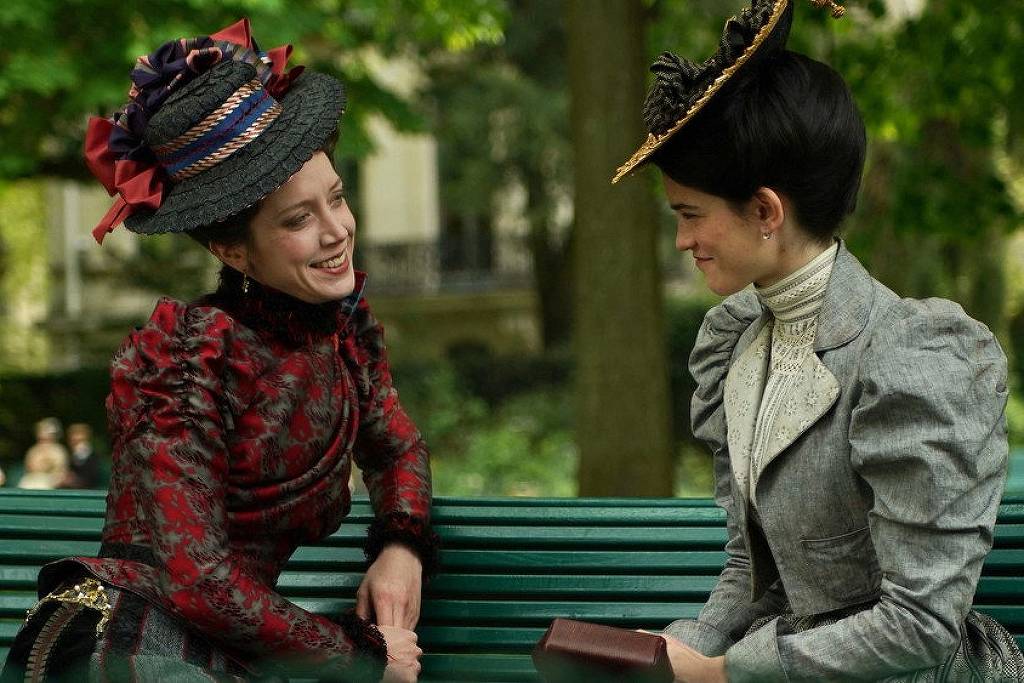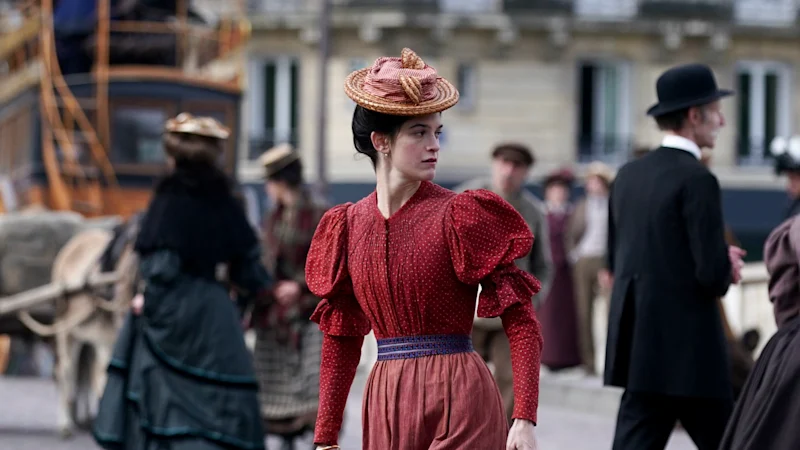
There comes a moment in a French film director’s life when he feels the call of the costume drama. “I had never done that,” says Cedric Klapisch, whose latest film, Colours of Time, is partly set in 19th-century Paris. “I really wanted to create a period – and I love the time before 1900.” His immediate interest, he says, was in the emergence of photography and how it changed painting. Impressionism was the first response; ultimately, it led the way to abstraction. He wanted to make a film that somehow addressed that aesthetic revolution.“But it’s really about stimulation, because so many inventions were created at that moment: trains, electricity, photography and cinema. That time was really so inventive, especially in Paris.” The Eiffel Tower was completed in 1889, while much of Paris was being rebuilt by Baron Haussmann and his successors. “It was just very vivacious. But then, when I made the movie, I realised it’s a period that looks like today. We don’t see it because we’re stuck in the middle of it, but look how the internet has changed our lives, how mobile phones have changed us: life is changing very fast.”Vassili Schneider, Suzanne Lindon and Paul Kircher in Colours of Time.StudioCanalKlapisch, 64, is best known in the Anglosphere for The Spanish Apartment (2002), a comedy about a motley crew of international students sharing a flat in Barcelona, which is so full of wit and joie de vivre that he need have done nothing else to secure a fandom for life. Colours of Time is ostensibly very different. It does include sequences set in the present, but its beating heart is the past, with much of its imagery rendering the costumes and social norms of another time, bathed in colours that emulate the first colour photographs. Even so, it is drawn from the same well.At its centre is 20-year-old Adele (Suzanne Lindon), a farm girl who travels to Paris in search of the mother who abandoned her as a baby. Adele was raised by her grandmother; all she knows about her mother is that she would send money each month for her upkeep. Adele has no artistic aspirations; she doesn’t yearn for the big city; she can’t even read. She has never imagined a future that didn’t involve milking cows and raising children.Almost immediately, however, she is absorbed into grubby, thrilling Montmartre life, sharing a room with two young men she met on the boat from Le Havre. One is a photographer who regularly announces that his art spells the end of painting; his friend is a painter. Their arguments are a constant entertainment. Like the backpackers of later generations, Adele stumbles into a job in a bar and becomes a model for her new friends. Paris is extraordinary; the electric lights installed along the Champs-Élysées sparkle before her and her life opens up, much as Xavier’s did in The Spanish Apartment. That youthful thirst for experience is a perennial.Almost as soon as he began work with his writing partner Santiago Amigorena, however, Klapisch realised that they needed a modern-day counterpart to balance Adele’s story. That became the story of Adele’s descendants, a large and disparate group who together have inherited the farm where she once lived, now worth a good deal of money to developers planning to destroy it as part of a plan for a shopping mall.Four of them – a literature teacher on the brink of retirement, a gung-ho railway engineer who describes herself as a disruptor, a young director of online video content and a middle-aged hippy who raises bees – take on the negotiations. They also enter the house, which has been shuttered for decades, to discover a treasure trove of old photographs and letters that make the past and their legacy suddenly very alive. They even manage to travel back in time to the first exhibition of the Impressionists, with the help of a dose of psychoactive ayahuasca – at least, they think they do.Klapisch slips between the two periods so artfully that they seem to merge at the edges. In one scene, Adele gets off the riverboat and walks up the steps to the embankment; as she leaves the frame, the light shifts and a jogger runs down the same stairs. “Paris is so much about the past and so much modern at the same time,” says Klapisch. “Some of it is very old – I grew up next to a Roman ruin! So you feel past and present are always confronting each other. And like those stairs, there are places that are exactly the same as they were 150 years ago.”With the introduction of a parallel present, says Klapisch, the film pivoted from his initial interest in fin-de-siecle Paris to become a reflection on memory, the significance of the past and the meaning of family. Audiences seem to double down on those themes, so that scenes he thought would be comic relief play more seriously than he anticipated. A prologue sequence, in which his young content creator is doing a fashion shoot in front of Monet’s Water Lilies and is told to change the painting’s colours with AI so they don’t clash with the frocks, regularly draws gasps of disgust. “It’s like a blasphemy.”Vincent Macaigne, Zinedine Soualem, Julia Piaton and Abraham Wapler play family members connected by an inheritance in Colours of Time.StudioCanalHe also thought of the ayahuasca trip, where Adele’s descendants find themselves at an exhibition where she herself is still a babe-in-arms, as a comic interlude. All the big names are there. “Look, it’s Renoir!” squeals Cecile de France, playing a somewhat over-enthusiastic art historian; it’s just funny nonsense.“But once I showed it in theatres, I noticed people don’t laugh much at all,” says Klapisch. “Because I think it’s very emotional also, to meet these painters in real life. It’s a fantasy that is funny and light, but it’s really also deep and heavy, so I really like the mix of the two.”“Young people are always right,” says Colours of Time director Cedric Klapisch.Emmanuelle Jacobson-RoquesSo potent is the pull of the past in the film that people often assume Klapisch would like to live there, but he isn’t nostalgic in that way; he sees himself as more like his characters, excited by modernity. It isn’t only the 19-century bohemians who face forward with optimism, he points out; teaching is in itself an investment in the future, while both the engineer and the beekeeper are working in different ways towards saving the environment. Each of them embodies a kind of hope.“I think the future can be better,” he says. “Even now when we question a lot the future, with the environment, with war, with Brexit, with many things that were more enthusiastic in the last decades, even now I have that belief – life is related to believing in the future. And I think we have to be positive, otherwise there is no life.”At the same time, he concedes he is a man of his own time. The music in the film is matched to each timeframe but, to my ear, the songs in the contemporary sections could have been playing in the Barcelona apartment where Cedric/Xavier misspent his youth. Klapisch laughs. “I have a feeling that for music, today, it’s not as interesting as it was at that time, but I’m almost 65,” he says. “So in that sense, maybe I am nostalgic.“But I’m really paying a lot of attention to young people who say that no, music now is really interesting, because I really feel young people are always right. When you get older, you don’t see your own time with the right eyes. You see it with old eyes. The young generation probably see today’s world in a better way.” You only have to look at the past, as Colours of Time does, to see that they always have.
‘It’s like a blasphemy’: Why this film drew gasps of disgust
Colours of Time slips between present-day Paris and the dawn of Impressionism to find that some things haven’t changed.
1,313 words~6 min read