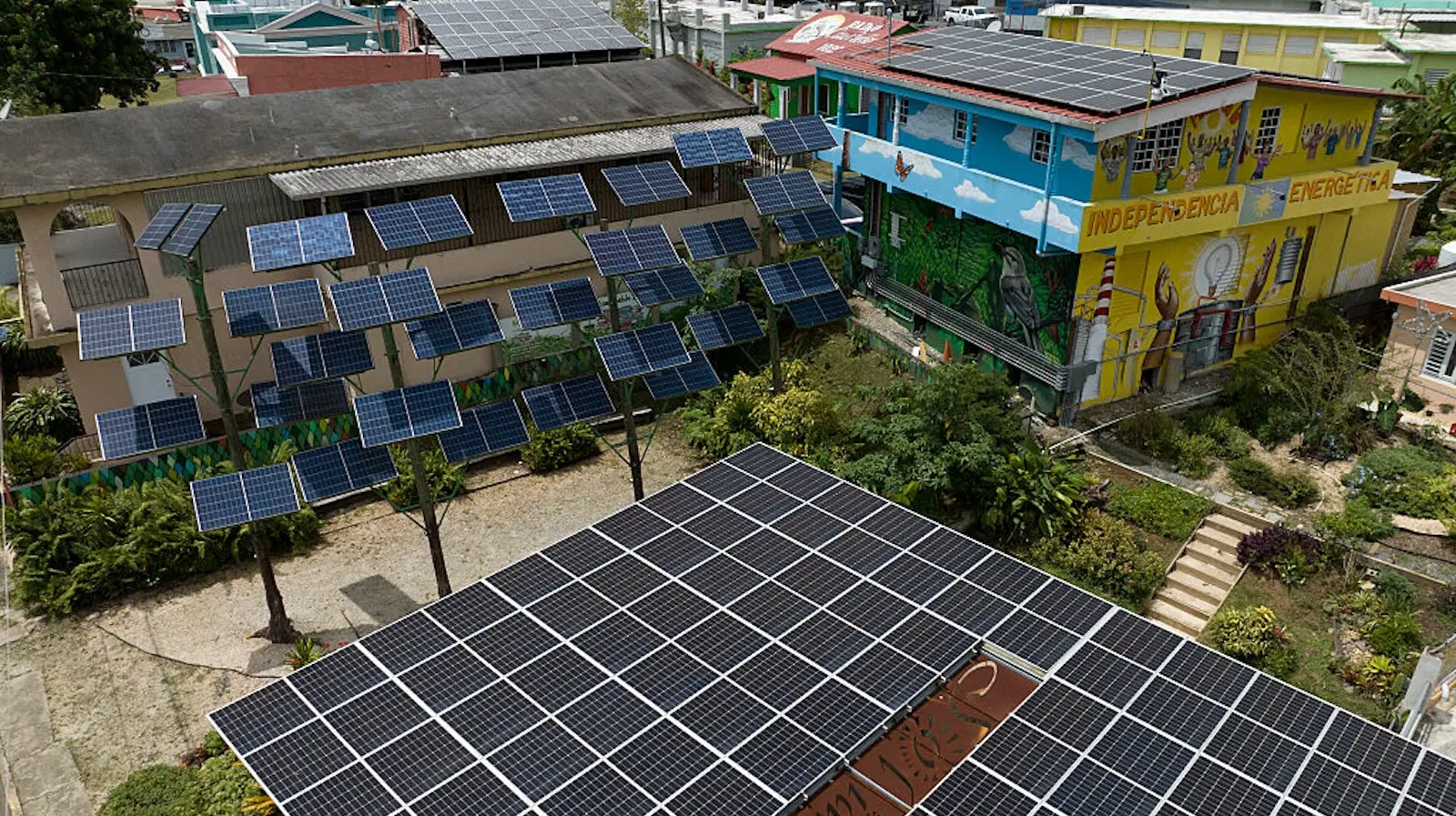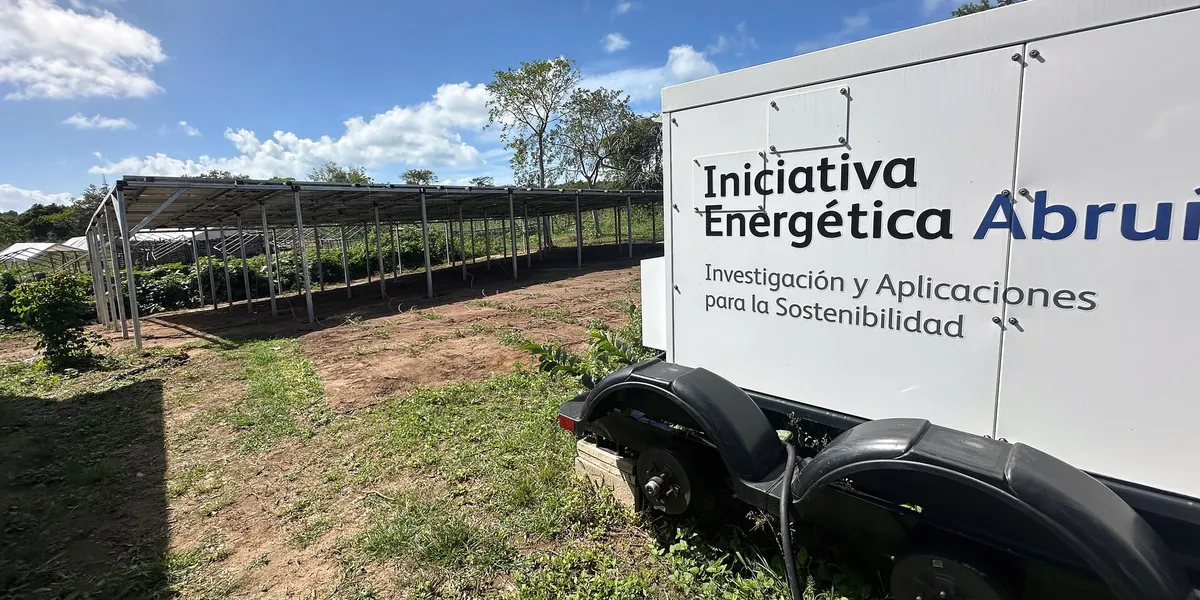
On the nights after Hurricane Maria ravaged Puerto Rico’s power grid in 2017, former Puerto Rican energy regulator Javier Rúa-Jovet remembers watching the sky warp along the horizon as thousands of fossil fuel-powered generators spewed emissions into the atmosphere. The “whole society” was running on this carbon-intensive backup power at the time, says Rúa-Jovet. Now, nearly a decade later, at least one of Puerto Rico’s microgrids is getting a clean upgrade. On the small island of Vieques, 10 miles east of mainland Puerto Rico, a team of Cornell University researchers is deploying a first-of-its-kind clean hydrogen-enabled microgrid on a local farm. The project will include a solar-plus-battery system that will provide electricity for on-site hydrogen production. The hydrogen will then be compressed and stored in on-site gas cylinders for later use in fuel cells that can power the island’s essential services during grid outages.The architecture builds on existing hydrogen-based microgrids, like a 293-megawatt-hour one installed in California’s rural wine country in August 2025 by the utility Pacific Gas & Electric. That system runs on batteries and hydrogen fuel cells, but doesn’t include on-site solar power, and involves trucking in the hydrogen rather than producing it there. Vieques’ system, meanwhile, will use an on-site, solar-powered electrolyzer to produce hydrogen that can then be used in fuel cells. The hydrogen part of the microgrid can provide power when the solar array can’t–such as during the periods of low solar output that are common following storms. The plan is to use the system to power essentials like a health clinic, refrigeration, and drinking water pumps.If the strategy works in Vieques, the idea is to apply it to other communities, says Cornell’s Héctor Abruña, the Puerto Rican researcher leading the project. “It’s eminently deployable just about anywhere, and so we make a point that this solution should be scalable and particularly good for isolated – which are almost always also forgotten – communities,” Abruña says.While the economics of hydrogen production have historically rendered the technology unviable in most cases, a community like Vieques is one specific instance where the costs might just balance out. Backup power generation has long been a part of Puerto Rico’s culture. Storms and a legacy of disinvestment in the territory’s grid infrastructure have led to frequent blackouts that leave residents without electricity for days at a time. This has forced residents to turn to gasoline or propane-fired generators, and increasingly to solar-plus-storage. Vieques, a community of around 8,000, receives power from Puerto Rico’s grid via undersea cable from the main island and does not have its own source of baseload power generation. This leaves the community particularly vulnerable to outages. When storms roll through, days of cloud cover often reduce solar output from the island’s existing microgrid, forcing residents to rely on diesel generators to power basic services, including water and refrigeration for food and medicines.The microgrid’s batteries can keep the community’s essential services running for a few days without sunshine, but hydrogen fuel cells would extend that up to 10 days, says Abruña. In early 2027, the team plans to deploy a Nel Hydrogen electrolyzer to produce hydrogen. During outages, the farm’s owners will be able to move the fuel cells around the island to where they’re needed for critical services, providing up to 2.5 megawatt-hours of additional power. (When the island is not experiencing outages, the owners of the farm, La Finca de Hamberto, use some of the solar and battery power to keep food from spoiling in refrigerated conatiners.)To prepare the microgrid to power the electrolyzer sufficiently, Abruna’s team is planning to double the island’s installed solar capacity from 50 to 100 kilowatts and scale up its battery storage. When the sun is shining, the electrolyzer will run on solar and storage to build up a reservoir of clean hydrogen ahead of hurricane season. “If your power’s out for more than a few hours and your battery runs out of power, then you can switch over to a fuel cell and run off of all that stored hydrogen,” says Kathy Ayers, senior vice president for research and development at Nel Hydrogen and a member of the scientific advisory board for Abruña’s lab at Cornell.Despite hydrogen’s high startup costs, Cornell’s researchers are confident that Vieques’ unique situation makes the economics feasible. Diesel is pricey on Vieques due to the 1920 Jones Act requirements mandating that goods shipped between U.S. ports are transported on U.S.-made ships manned by U.S. crew. Making the hydrogen onsite eliminates these transport costs. Over the microgrid’s 20-year lifetime, hydrogen installation and maintenance costs will be less than the cost of using diesel generators during the same timeframe, estimates Cornell’s Paul Mutolo, a strategic advisor to the microgrid project. Hydrogen is also cheaper than adding more batteries onto the island’s existing microgrid. Most batteries scale in specific increments, making them less efficient in terms of physical space. “For hydrogen, you have the tanks, which are completely separate from the fuel cell. You don’t have to scale up the fuel cell to get more energy. All you do is scale up the tanks and add more tank volume,” Mutolo says. The hydrogen setup becomes a cost-competitive alternative to batteries as grid outages extend beyond a few hours, Mutolo and Ayers say. Keeping costs low is a priority in Vieques. Power prices across Puerto Rico are among the highest in the U.S., with residents paying 28-29 cents per kilowatt-hour, according to Rúa-Jovet, who is now chief policy officer at the Solar and Energy Storage Association of Puerto Rico. And those prices could increase: on 1 July, 2026, residential customers saw their monthly fixed charge jump from $4 to $8, and it will double again to $16 next year, per the Puerto Rico Energy Bureau’s recent rate case ruling. Small commercial customers are seeing similar increases. The kilowatt-hour prices on Vieques are higher than other parts of Puerto Rico because the island relies on power from the territory’s mainland via the undersea cable. Abruña’s goal is to get electricity prices down to 15-16 cents per kilowatt-hour for a 50 percent reduction from the state-run utility prices. Still, the upfront costs of setting up a microgrid could make it challenging to replicate elsewhere, even if the costs eventually level out over time. The Vieques project is supported by settlement funds from Volkswagen’s 2019 class-action lawsuit, and the Cornell team is looking for funding to procure the necessary components to enable hydrogen production, storage, and fuel cells. U.S. Dabbles in Hydrogen Backup PowerSeveral U.S. national laboratories have been working to prove the viability of hydrogen-enabled microgrids for years. In November 2024, the National Laboratory of the Rockies launched a demonstration project on the lab’s Arvada, Colorado campus with Southern California Gas Co. and GKN Hydrogen. Then, in March 2026, the U.S. Army’s Construction Engineering Research Laboratory installed a hydrogen nanogrid after a year-long demonstration at the White Sands Missile Range in New Mexico. In small-town Calistoga, California, the utility PG&E unveiled a hydrogen-enabled microgrid last August alongside battery storage company Energy Vault and hydrogen maker Plug Power. Like Vieques, the community of Calistoga, population 5,200, is vulnerable to grid outages due to wildfires in the region that force preemptive power shutoffs for safety. PG&E chose Calistoga as a host because historically, the community has had one of the highest frequencies of power shutoffs in the utility’s service area. In April 2023, the California Public Utilities Commission (CPUC) allocated $46.3 million for the development and commissioning of the hydrogen microgrid over a decade. PG&E has only built one such hydrogen microgrid so far because the utility hasn’t yet identified additional locations that meet the CPUC’s requirements for vulnerability, says Renata Bakousseva, a manager for PG&E’s design and microgrid delivery team. So far, Calistoga hasn’t had a reason to turn to its microgrid for a real-life event, but the system underwent a fresh round of performance testing in April, Bakousseva says.Soon, the battery system supporting Calistoga’s microgrid will be able to export power to PG&E’s grid outside of planned power shutoffs. The installation is awaiting a change to its interconnection that will allow this, says Craig Horne, Energy Vault’s CTO. That will help alleviate some of the installation’s cost burden, he says. Despite the upfront cost, Horne echoes what Abruña’s team is trying to prove in Vieques: that in the long term, hydrogen can be more efficient than adding batteries. “Today the cost of hydrogen is expensive, but you know that cost is coming down, as is the cost of fuel cells,” Horne says. “So all those things really are showing that this is a superior solution.”
Tiny Puerto Rican Island Tests Hydrogen to Slash Sky High Power Bills
Better backup power system aids storm recovery
1,436 words~7 min read