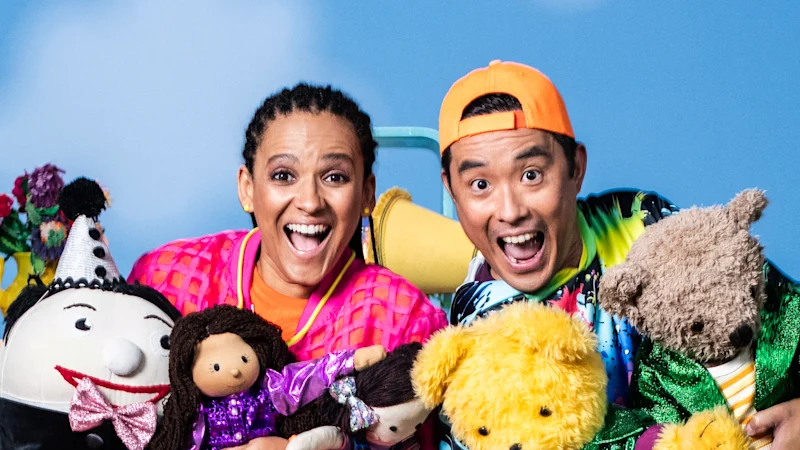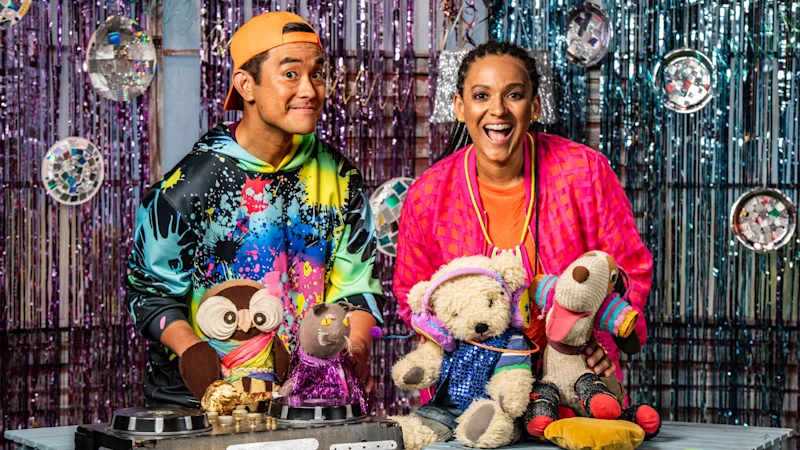
On a Wednesday morning in March, tucked away in the ABC’s Studio 22, Play School hosts Zindzi Okenyo and Kaeng Chan are performing Rock Around the Clock again. And again. And again.A live band is accompanying them nearby, while the show’s crew pump out bubbles and spend breaks between shots adjusting the set, which is decorated like a disco, while Maurice the teddy bear, clad in a blue sequinned vest, and his canine sidekick Scrap are both wearing headphones.The team are filming a week of Party Series episodes, which celebrate the show’s 60th birthday on July 18. And for any keen watcher of Play School – the under-five set and their bleary-eyed parents – it very much presents as Play School as usual. But for the keen-eyed observer, and for series producer Bryson Hall, it is not so much Play School Classic as Play School Classic+.“That’s a little bit of a magic trick that we’re performing,” says Hall. “Where people go, ‘Yeah, that’s Play School’, because it’s got the two presenters and all that kind of stuff. But it has changed a fair bit, but it changes slowly.”Play School presenters Kaeng Chan and Zindzi Okenyo filming the Party Series episodes to celebrate the show’s 60th anniversary.Steven SiewertFilming now takes place across four different sets to capture four different segments, instead of one continuous shot, and the pace has quickened substantially. Overhead shots of the artwork – once considered discombobulating for a pre-school audience – are now commonplace, and the toys even venture outside (personal favourite: Little Ted’s Big Adventure). Episodes are also no longer planned around a Monday to Friday schedule, but organised around a theme, such as dinosaurs, the beach or our senses.“Preschoolers are completely literate now, screen literacy is beyond what ours was,” says Hall, who has worked with the show since 2018. “To go all the way back [to the show’s early days], you had to start on a wide shot of the full body of the full person, so the kids weren’t freaked out by the close up [thinking it was half a person].”The fact Play School is now steaming into its seventh decade is no accident. While it may be powered by nostalgia, it has never stood still. First broadcast in black and white in 1966 and presented by Alister Smart and Dianne Dorgan, it is now one of the most diverse and inclusive shows on Australian television, featuring presenters with a wide range of backgrounds and different abilities. It showcased same-sex parenting more than 20 years ago with a Through the Windows segment that featured two mums going on an outing with their eight-year-old daughter, and in 2016 it featured two gay dads.It has included children from Indigenous and migrant backgrounds and has long championed caring for the environment, not only through recycling materials in its craft projects (who among you hasn’t turned a toilet roll into a tree) but through learning to care for habitat and animals.Behind the scenes of Play School, where Zindzi Okenyo and Kaeng Chan perform Rock Around the Clock many, many times.Steven SiewertIn short, it’s made a mark. Not only on its audience, but on its presenters, too.“I always think it’s great and embarrassing that Play School is the most diverse show on Australian television,” says Okenyo, who has been part of the presenting crew since 2013. “Yes, optics, but there’s a lot of talk often about representing Australia [on screen], and yet we don’t do it.“But I think what’s special about Play School, and what’s missing from other programming in terms of diversity, is the understanding that we really need it [diversity] and we always need it, and it needs to evolve, and if there’s a gap, you need to fill that gap, but you really need to do that in a genuine way, not just because you were told to.“And because I’ve been on the show coming up to 12 years, I’ve met kids who are 10-11, and meeting those brown kids and meeting those African kids, they get it [the diversity], but the parents are like, ‘Thank you’. Even refugees, [who say] ‘When we moved to Australia, we didn’t know English, and this was a show that we watched, and my kids felt at home because they saw you.’ It’s incredibly powerful, and that can happen and needs to happen across Australian television.”In fact, Okenyo was in the same position when she was a young fan of Play School and watching former host Trisha Goddard.“It was probably watching Trish, who is an Afro-British woman – she’s also an amazing journalist – [but it was] just that representation,” says Okenyo, whose father is Kenyan. “Obviously, as a kid, I didn’t think about it as representation. But she was just so natural and silly. And so I think, definitely, I try to channel her.”Play School’s first presenter Alister Smart in an episode from September 1966, the year it was first broadcast.ABCFor all of Play School’s work in championing diversity, however, Hall says there is more work to do. “Recently, we did a diversity inclusion workshop, people with disability presenting on Play School, and it was incredible, and it was eye-opening,” he says. “It was just a thing of which we were all like, ‘Well, that’s just a Play School segment’, very natural, nothing different about it at all in terms of what it normally is.”For Chen, who has presented on the show since 2013, Play School’s biggest drawcard – and its biggest trump card in terms of future-proofing the show – is its connection with its young audience.“There’s something about moving with the times, yet, at the same time, still holding on to the core of what makes Play School, Play School, which is being settled and connection,” says Chen. “And that also goes hand in hand with the progress of society, really. But we’ve got to be really mindful of not going too far [with change] that alienates the kids at home.”Okenyo agrees, likening Play School to the work of revered Japanese director Hayao Miyazaki. “He was talking about how if you follow the rhythm of the child and their emotional level, and you follow that tempo and keep it small and quiet, there is no need for action, and it’s so you don’t need drama to happen,” says Okenyo. “It’s moving at their pace … and it has great emotional impact, which is really important for children to build that emotional complexity and that landscape.”Play School series producer Bryson Hall with floor manager Warren Parsonson on the set of Play School in March, filming the Party Series episodes. Steven SiewertAnd while Play School’s 60th birthday is an occasion to be celebrated, whether it can survive another 60 years – or even 40 years to make it an even 100 – is a huge question. Its budget has been cut, and the number of episodes it produces each year has been reduced. According to a recent RMIT report, the ABC has seen a 59 per cent decrease in new hours of Australian children’s content since 2018-2019. It’s also staring down streamers, YouTube and all manner of AI slop.Hall, however, is optimistic. He says, despite the rise of streaming over the past 10 years, where Netflix and Disney+ in particular have hundreds of hours of programming aimed at children, Play School’s audience has grown, across both free-to-air and ABC iview.“I’m not sure there’s any other show that Australian audiences would trust more than Play School,” says Hall. “And part of that [growing the audience] is just maintaining that trust and being an AI-free zone. I think parents will really want that, and I can kind of see that happening already, even with the stuff that’s on YouTube, with those short animations and things that you can get that do captivate a child, but not in a very good way.“And parents and carers, I think, seem to be really cluing in on that now, and returning to shows like Play School that have that fun, captivating nature, but have a really good educational foundation to it.”Ironically, it’s nostalgia that will also play a huge part in Play School’s future. It’s not pester power, it’s parent power.“It’s parents and carers wanting to watch Play School with their child because they have fond memories of that,” says Hall. “So it’ll be interesting to see how well that keeps up because, obviously, between that generation and the next generation, they would have had so many other options and so many things that they watched, and Play School is only going to be a small part of that. Obviously, it was a bigger part of that 20 or 30 years ago, just purely on the amount of content that was available at that time.“Nostalgia is hard to live up to. So that’s the responsibility I feel like I have, where you want to keep adapting, moving along a little bit. If someone comes and turns on Play School and goes, ‘Oh, it’s not the Play School I remember,’ or whatever, then the parents will switch off.“So a little part of it is for the parent as well. Just maintaining that the heart of Play School is still there, and it is. And while the Play School that they’re going to watch today is going to be very different to the Play School from before, the heart of it is what people connect with and keep coming back to.”Play School airs Monday to Friday on ABC Kids. The Party Series episodes are now streaming on ABC iview.Get the day’s breaking news, entertainment ideas and a long read to enjoy. Sign up to receive our Evening Edition newsletter.
Play School has been here for 60 years. Can it survive another 60?
The fact Play School is now steaming into its seventh decade is no accident. While it may be powered by nostalgia, it has never stood still.
1,613 words~7 min read