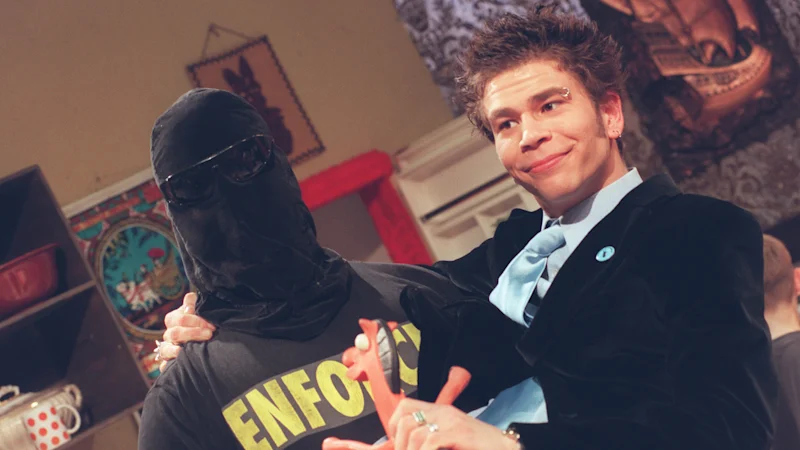
It’s 30 years since the ABC gave chaos a Saturday morning timeslot. Debuting in 1996, Recovery was a live music and youth culture show that became appointment viewing for Australia’s teenagers. Bands that had barely slept, a hyped studio audience and a disregard for convention made for haywire energy. The personification of this was neophyte host Dylan Lewis. Now hosting afternoons on Double J, he explains – with immense affection – what made Recovery unique.Dylan Lewis on the set of Recovery in 1997 with the Enforcer.Christina UeltzenHow does a 23-year-old with no television experience get to host Recovery?It was an accident. There was an ad in the paper, which I did not see, but my girlfriend at the time – now wife, Hollie – saw it and took it upon herself to send in my résumé. Then I got a call from some people I didn’t know asking if I could come in for a chat. That was a résumé that I was still working on to try and get a job at a toy shop. It included that I’d been in cubs and scouts and had a swimming certificate.It arrived late, was on top of the pile, and was so bad and funny that they took note of it. Meanwhile, in a moment of magic, someone else was going for an ABC position as a cameraperson and on their audition tape was me being interviewed with my band – I was wearing a suit because I was on my may to collect my teaching degree from Melbourne Uni. I was drinking a carton of milk and halfway through I threw it over my shoulder. That’s when the producers said, “I think that’s our guy.”Who were the grown-ups who let you in?They looked like grown-ups, but they had amazing child-like energy. There was Paul Clarke, a surfer who’s worked on everything, and Bruce Kane, who is an urban cowboy who wears a dapper three-piece suit every day. They knew they wanted to make a rock’n’roll show and it kind of ended up being built a little bit around my energy. They didn’t try to fit me into their box.Dylan Lewis with early Recovery co-hosts Sarah Macdonald and Glen Mitchell.FairfaxWere there any guidelines given to you?There must have been some conversations, but I was so much less aware then of what was going on. I was hosting a TV show, but in my mind I was winging it. I had no training, but I put pressure on myself to do the research properly and make sure that every artist got the same amount of care and attention, whether they were huge or small. I crammed on a Friday night, pumped it out on a Saturday morning with my handwritten notes.And mostly it worked.It wasn’t intentionally my classroom, but it was certainly my playpen. I look back on it so fondly. It suited what rock’n’roll was, and it suited that era.In those freewheeling circumstances, the vast majority of people would shut down, but you seemed to grow, to meet the uncertainty with unbound energy.I think that I had a different operating system and didn’t realise. Now that I have a bit more understanding, it kind of makes sense: I’m alluding to some neurodivergence, and high energy, and pattern recognition. I’ve recently been diagnosed with ADHD, and if I look back on any footage from the ’90s it’s so undeniable. And I do thrive in those situations. I’m activated by mayhem. I can look back and go, yes it was rad and fun, so I wouldn’t wish for anything else than a bit more knowledge about why sometimes it was pretty overwhelming for me.Dylan Lewis interviews Dave Graney on Recovery.One of the best things about Recovery clips online is the audience’s faces: the diversity of looks, the measure of cultural innocence, and their excitement at being one of 100 kids in Melbourne’s Ripponlea studio.Most days on Double J, I get a text saying, “Oh man, I was in the audience – my mum drove me for an hour and a half to make the 9am start”. I’m grateful for the memories we made, like the iconic Jon Spencer Blues Explosion moment where Jon destroyed the set and broke down the fourth wall, jumping into the audience. Those kids got touched by rock’n’roll in a way they were not expecting.After Jon Spencer is finally done, it’s clear that you’re struggling to articulate words because you’re on a higher plane of pleasure. You make noises for 30 seconds and your arms are wildly gesticulating.I remember that moment so clearly. I didn’t think I should do anything other than what my body was trying to do. Eventually. I said, “Rock’n’roll is alive” – and that’s the moment that defines for me how rad rock’n’roll television should be. The chaos, the danger. We also had a lot of health and safety issues with Frenzal Rhomb. They tried to shave my head at one point. I offered them my legs instead.What were you like after an episode? Were you spent? Did you have time to reflect?With any kind of show or performance I do, at the end it’s a relief. I don’t feel a pride, but I do feel good. On Recovery, we’d have a barbecue in the dingy little courtyard with the bands and have some beers. Talking to the bands now, like Regurgitator or The Superjesus, they felt like they were in the family. We’d all hang. The bands weren’t nervous about doing live TV, even though they hadn’t been to bed the night before, because they felt comfy.Dylan Lewis with the Enforcer, aka Angus Sampson.The show launched a lot of careers: yourself, Leigh Whannell, Angus Sampson …I’m not surprised, because the producers nailed it. Leigh [who reviewed films] went on to be a big Hollywood filmmaker with the Saw franchise, Angus Sampson – who obviously was the masked Enforcer – is in Hollywood right now filming things, Jane Gazzo did years of radio in the UK and back here. I keep in contact with most, if not all, of the old crew. Bruce and Paul were magicians. They herded the unicorns together.Did you ever encounter the actual ABC management?I was shielded. There were lots of complaints about Recovery to the ABC, but they were all handwritten letters, and mostly about the fact that Gardening Australia was no longer on at the usual time and why was a man with an eyebrow ring trying to sell drugs to children. Apparently Recovery was discussed in parliament, especially after Green Day said more swear words in one song than in the entire history of the ABC, but I didn’t hear about it.Did you work a Monday-to-Friday week on the show?I’d go in most days because it was a home away from home. Our offices were really just storage rooms with some desks added. I asked for a grand piano in mine, and they did that! We might have seven or eight guests a week, and I’d start my research by sitting at the piano and playing some of their music, then I’d listen to their actual back catalogue and read all the liner notes, looking for easter eggs that let me ask questions they weren’t used to. That didn’t always work, as was the case with Weezer. That was the worst interview of my life [Lewis accidentally introduced the singer as Rivers Weezer, instead of Rivers Cuomo, and Cuomo – who was jet-lagged and possibly drunk – then continued the interview with one-word answers].Dylan Lewis and Recovery co-host Jane Gazzo in 2019.You really enjoy talking about Recovery.It feels a bit fairytale-like, especially when you talk about it out loud. The whole era epitomises humans raw-dogging the situation they had been dealt, and I think we did above and beyond the best. Things did go wrong, but part of the charm was the realness. We leant in to the mistakes and the awkwardness was fine. Talking to people since then, the show was an invitation to a lot of young people to feel welcome, that rock’n’roll wasn’t just for the cool club. Recovery had its heart in the right place.Want more TV? We’ve got you.Newsletter: Find out the next TV, streaming series and movies to add to your must-sees. Get The Watchlist delivered every Thursday.Rivals (season two) review: It’s Benny Hill meets Succession, and it’s the most OTT fun you’ll have watching TV this year.Legends review: Steve Coogan does a cracking Michael Caine impression, but with this British crime drama he’s mastered a Michael Caine role.Restoration Australia: How an unusual restoration and its “bleak” history stopped Anthony Burke in his tracks.The Other Bennet Sister: It’s been the most-watched new drama in Britain – and it celebrates an unexpected character.Shaun Micallef: The satirist has dissected gambling’s dark arts in his new documentary. It will leave you shattered.Streaming guides: What to watch this week and this month.
‘There were lots of complaints’: How Dylan Lewis survived and thrived on the chaotic Recovery
The ABC’s popular Saturday morning music show became iconic for its wild performances and complaints to parliament.
1,486 words~7 min read