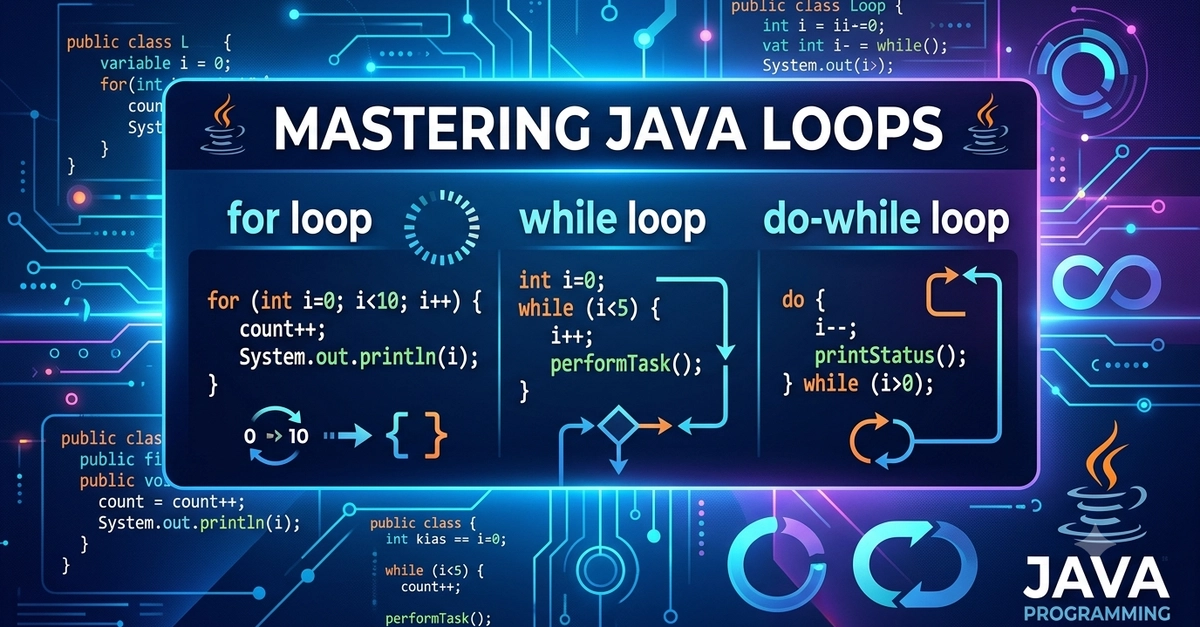
An architectural guide to understanding JVM loop bytecode, avoiding the silent GC traps of autoboxing, and engineering ultra-high-throughput loops.
Loops are the fundamental engines of data processing in Java. While they appear trivial at a syntax level, their runtime execution triggers a complex web of interactions between the Java Compiler (javac), the Just-In-Time (JIT) optimizer, and the Garbage Collector (GC).
In low-latency or high-throughput applications, a single suboptimal loop implementation can degrade performance, spike your P99 latency metrics, or lead to catastrophic heap exhaustion.
This guide dives into how the JVM handles loops at the bytecode level, exposes silent memory pitfalls, and explores strategies for optimizing loop mechanics in both microservices and enterprise-scale architectures.
1. The Taxonomy of Java Loops: Under the Hood