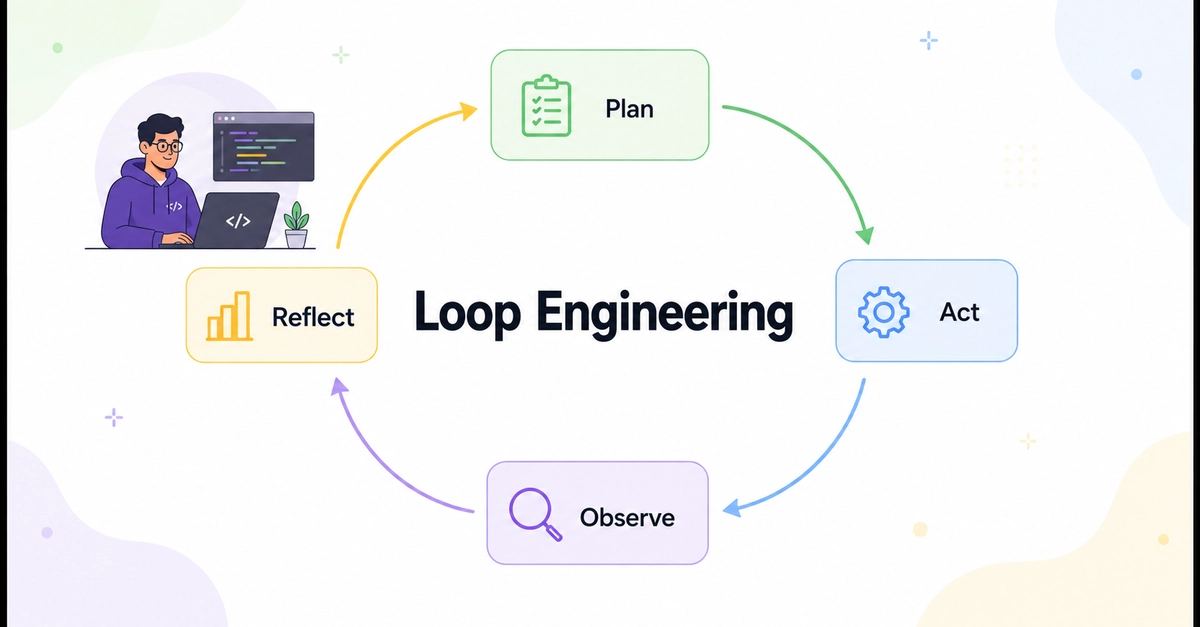
Most people still use AI like a 2015 search box. You type, you read, you type again. A newer pattern replaces that manual back-and-forth with a loop. This guide explains loop engineering using two verified artifacts. The sources are Andrej Karpathy’s autoresearch repository and the Bilevel Autoresearch paper. The framing follows a write-up by @0xCodila.
What is Loop Engineering?
To start, compare two modes. A prompt is one instruction, after which you decide the next step. A loop, by contrast, is a goal the model pursues until it arrives. The model plans, acts, checks its own result, then repeats. You define the objective once, and the loop handles iteration. Crucially, a loop only earns its cost when the work is measurable.
The Three Parts That Make A Loop Work
So what separates a real loop from a chatbot on repeat? Every reliable loop has three components.