Two active ingredients found in marijuana -- tetrahydrocannabinol (THC) and cannabidiol (CBD) -- led to significantly less agitation in hospice-eligible patients with Alzheimer's disease and other dementias, the phase II LiBBY trial showed.
At 2 weeks, Cohen-Mansfield Agitation Inventory (CMAI) scores were better in the THC-CBD group compared with the placebo group, with a mean between-group difference of -6.27 points (95% CI -9.66 to -2.87, P<0.0004), reported Jacobo Mintzer, MD, of the Medical University of South Carolina in Charleston.
CMAI scores were also better in the THC-CBD group at 12 weeks, with a mean area under the curve contrast between groups of -8.23 points (95% CI -11.6 to -4.86, P<0.0001), Mintzer said at the Alzheimer's Association International Conference. The CMAI ranks 29 agitation behaviors on a 7-point scale, with scores ranging from 29 to 203.
The THC-CBD intervention was well tolerated by a majority of participants, Mintzer noted. Adverse event rates were comparable between groups (46.7% vs 42.4%). There were more deaths in the THC-CBD arm, but there was no pattern in the cause of death in either group.
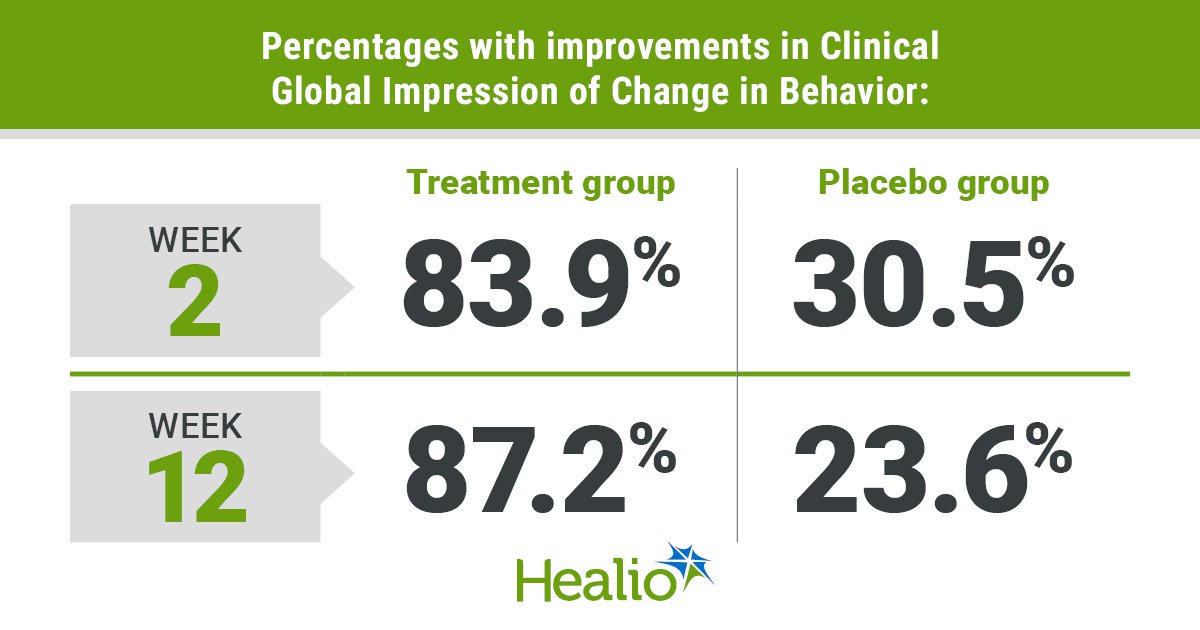
Clinical Global Impression of Change in Behavior scores improved for 83.9% of treated participants compared with 30.5% on placebo at 2 weeks. By week 12, that gap grew to 87.2% versus 23.6%.