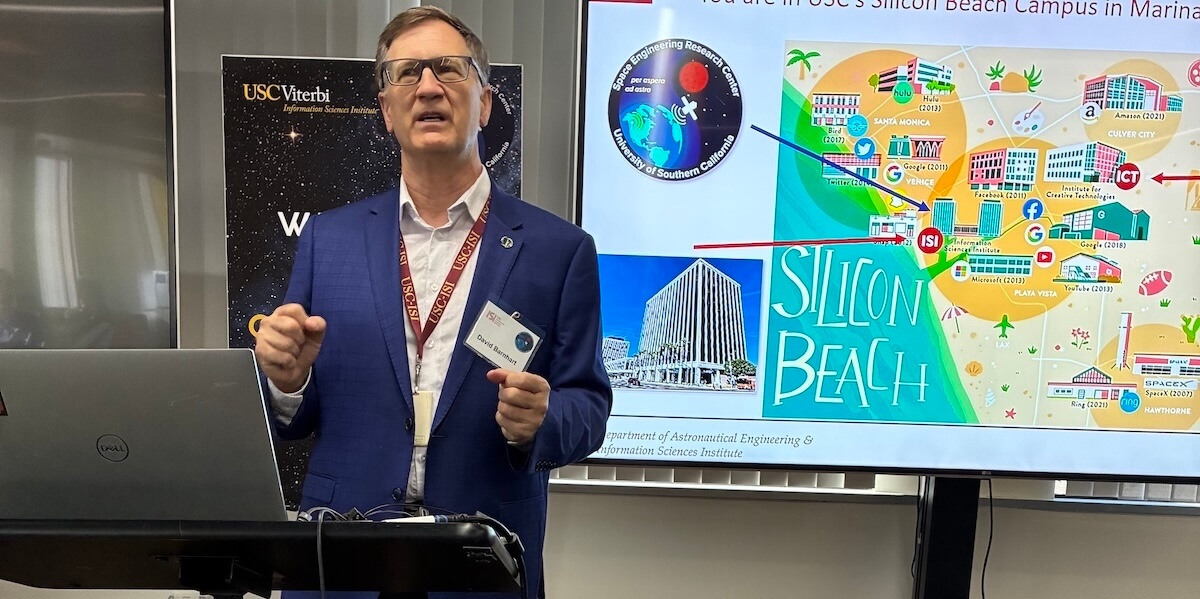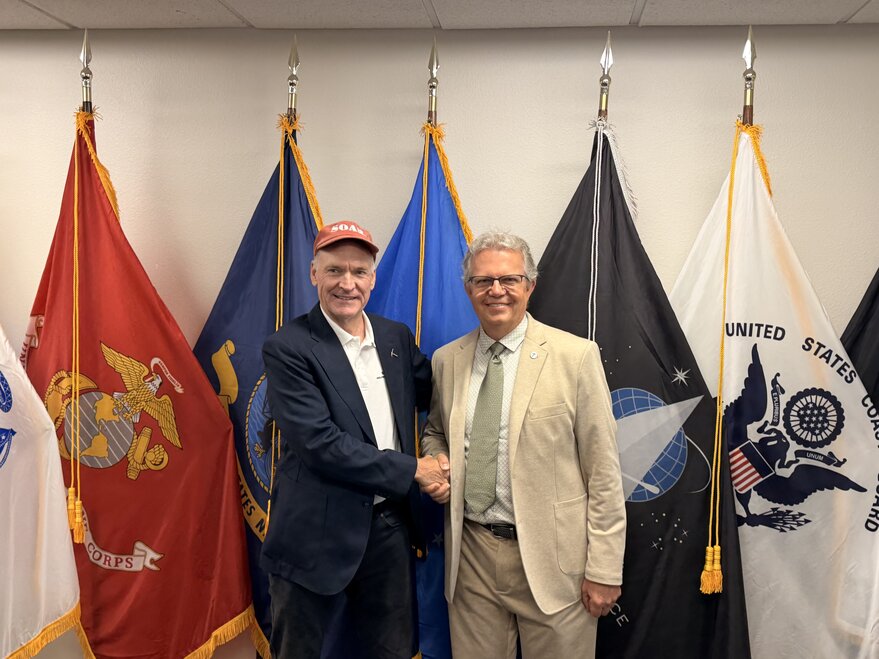
Satellite Orbital Access and Removal (SOAR) President Christopher Lee Jones (left) with retired U.S. Space Force Col. Eric Felt, director of the University of Texas, El Paso, National Security Institute. Credit: SOAR LLC
NAPA, Calif. – Florida startup Satellite Orbital Access and Removal (SOAR) announced a partnership July 15 with the University of Texas, El Paso, (UTEP) to develop a passive system to capture small space debris.
“The consequences of even small objects hitting a satellite can be catastrophic when they’re going 7,000 miles per hour or more,” Eric Felt, retired U.S. Space Force colonel and chief technology officer at UTEP’s National Security Institute, told SpaceNews. “Today the probability of a collision is still pretty low, but the risk is high because the consequences can be severe. We need to mature the technology to mitigate the impact of small debris before it becomes a crisis.”
SOAR was established in 2025 by Christopher Lee Jones, a retired firefighter and science-fiction author. Through his book, “Mars Mission I: Surviving the Kessler Effect,” Jones became acquainted with astrophysicist Donald Kessler, who predicted in 1978 that a growing population of orbital debris could cause a dangerous cascade of collisions. Kessler is a SOAR advisor.